E-Billing (E-Invoicing) in Nepal 2026: Is It Compulsory for Your Business?
Khatapana
August 13, 2026 7 min read
 Reviewed by Kailash Panday, Chartered Accountant & Corporate Lawyer
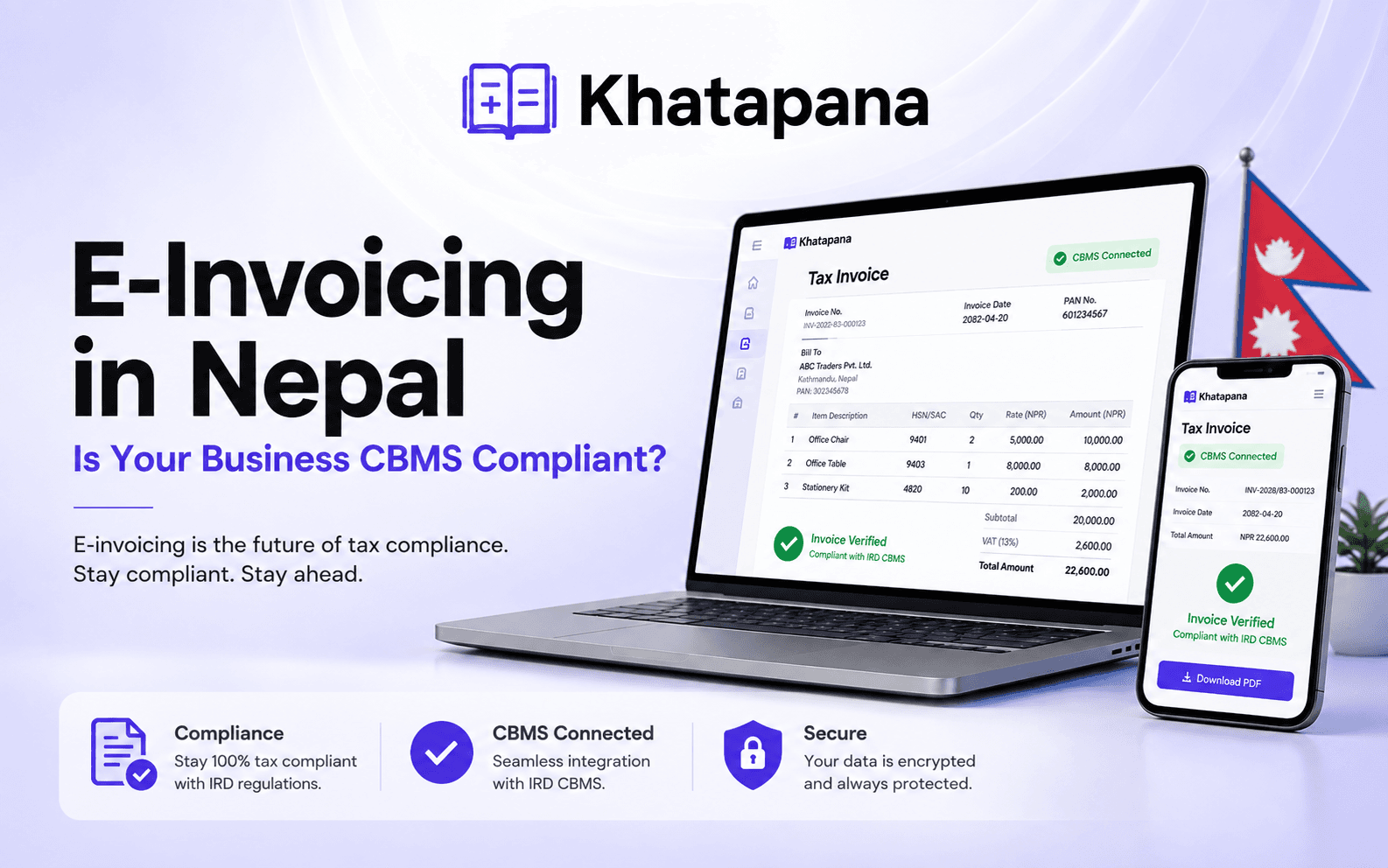
Confused about e-billing in Nepal? We break down CBMS thresholds, who must comply, and what happens if you don't. Read more to find out.
A retail clothing shop owner in Kathmandu got a call from his accountant last month. Turns out the IRD had flagged his business for not being connected to something called CBMS. He'd never even heard the term before. And it's not like he did anything wrong exactly, his shop just did well the past two years, his turnover kept climbing, and somewhere in there he quietly crossed a line into having to comply with this whole system without anyone explicitly telling him.
That's the issue with e-billing in Nepal right now. Nobody sends you a welcome email when you cross the threshold. For FY 2083/084, the government has widened who falls under its electronic billing and CBMS requirements, and the IRD has been actively issuing notices to businesses that haven't connected yet.
This piece walks through what e-billing actually is, who's on the hook this year, how the system works day to day, and what to do if you think you might be one of them.
Nepal Is Moving From Tax Returns to Transaction-Level Monitoring
To understand why CBMS exists, let’s look at how the old system worked. Under the traditional flow, a business issues an invoice, records the sale in its own books, and reports a summary to the IRD months later through a VAT return. Between the invoice and the return sits a lot of room for gaps (some accidental, some not) between what was actually sold and what got reported.
CBMS closes that gap by moving the reporting point earlier. Instead of a business → books → VAT return → IRD chain, e-invoicing creates a shorter path that looks something like this: business → invoice → CBMS → IRD, with the transaction visible to the tax department almost as it happens.
And no, it’s not entirely about making VAT filings digital. There’s more to the story here. With CBMS, the government aims to shift tax administration from periodic reporting toward continuous, transaction-level visibility. And Nepal has been building toward this since a pilot with roughly six hundred large taxpayers back in 2017.
First, What Exactly Is E-Billing?
Before going further, let’s clear up a few terminologies that we use interchangeably throughout the article.
- E-billing (also called electronic billing) is the overall process of issuing invoices through IRD-approved software that follows a prescribed format.
- CBMS, the Central Billing Monitoring System, is the specific IRD platform that receives and monitors that billing data.
- An e-invoice is simply the individual bill produced inside that process.
In short, e-billing is the process, CBMS is where the data lands, and an e-invoice is the document itself. Importantly, none of this happens automatically just because you use a computer. A Word or Excel invoice, however neatly formatted, is not an e-bill.
E-billing is not emailing an invoice as a PDF, or typing an invoice in Word or Excel, or printing a bill from ordinary, unapproved accounting software, or even scanning a handwritten paper invoice
E-billing is issuing bills through IRD-approved software, following the required invoice format and sequential numbering, and transmitting invoice data to CBMS where your business is mandated to do so
What's Changed for FY 2083/084?
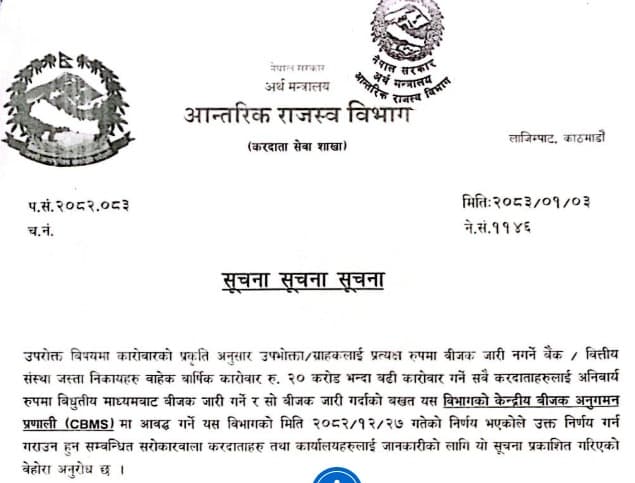
As per IRD's notice published on Baisakh 3, 2083, the general threshold for mandatory CBMS connection is annual turnover exceeding NPR 20 crore. That's the figure most businesses will need to check themselves against. Sector-specific thresholds, such as a lower bar for hospitality businesses, sit outside this particular notice and are worth confirming directly with the IRD rather than assuming the general figure applies to you.
There's also an interesting contrast running through this year's policy changes. The Startup Fast-Track Action Plan 2026 has eased some compliance load elsewhere, letting new startups file tax returns annually instead of quarterly for their first three years. At the same time, e-invoicing requirements have widened. In other words, the government is moving towards more targeted, more digital compliance, and easing paperwork in one place while tightening transaction-level visibility in another.
Does Your Business Fall Under the Requirement?
The NPR 20 crore figure shouldn't be read as a universal exemption for everyone below it. Coverage depends on several separate factors, not one number.
Situation | Where you likely stand |
| Turnover above NPR 20 crore | Generally within the FY 2083/084 threshold |
| In a prescribed sector (hotels, restaurants, alcohol, cigarettes, construction) | Check the sector-specific threshold separately |
| Already classified as a Large Taxpayer by the IRD | May already be covered under existing rules |
| You supply government bodies (B2G) | Existing e-invoicing requirements have applied since earlier phases |
| Individually notified by the IRD | Must comply per that specific notice, regardless of turnover |
| Below the threshold and none of the above apply | Not currently mandated, but worth rechecking each fiscal year |
A restaurant doing NPR 4 crore a year sits comfortably under the general threshold but could still fall inside a lower, sector-specific one. That's exactly the kind of gap that catches business owners off guard, so it's worth checking each category on its own before you assume anything.
What Happens When You Issue an E-Bill?
Say that same restaurant issues a bill for NPR 11,300. Under a CBMS-connected setup, the relevant transaction details, buyer information, PAN, amount, date, get transmitted to CBMS at the same time. The restaurant's internal sales records and what the tax authority can see are no longer two separate worlds.
Now suppose the cashier types NPR 1,130 instead of NPR 11,300. On a spreadsheet, someone would just fix the number and move on. Inside a CBMS-connected e-invoicing system, that original transaction can not be overwritten. Once a bill is transmitted, it's locked, and the correction has to follow the prescribed process, typically a credit note against the original invoice, rather than editing the number directly. Anyone used to manual bookkeeping, where a typo just gets retyped, will need to unlearn that habit.
E-Billing vs Ordinary Computerized Billing: What’s the Difference?
Ordinary computerized invoice | E-invoicing (CBMS-connected) | |
| Where it's created | Any software, including Word/Excel | IRD-approved billing software only |
| Where the data goes | Stays with the business until filing | Transmitted to CBMS in near real time |
| Can it be edited after issue | Usually yes | No, only corrected via credit note |
| Numbering | Business's own choice | Sequential, fiscal-year based, locked |
How to Get Your Business Connected to CBMS?
If you fall under the mandate, the path looks roughly like this, and it is essential to know who's actually responsible at each stage.
- Choose the software (business). Pick IRD-approved billing software that supports VAT compliance, real-time CBMS integration, and the correct invoice format.
- Set up and test (business and software provider). Run internal test transactions to confirm everything syncs correctly before going live.
- Prepare documentation (business). Business registration certificate, PAN/VAT certificate, software purchase agreement, sample invoices, user manual, and technical or hosting details.
- Submit the application (business or provider). Filed through the IRD Taxpayer Portal, under the Electronic Billing section.
- Inspection and approval (IRD). The department reviews the setup against its integration and data security standards.
- Go live (business). Once approved, transition to the CBMS-connected system within the compliance timeline the IRD has set for your case, rather than waiting until the last possible day.
Numbering sequences and PAN details lock in once you start issuing e-bills, so make sure to get the setup right the first time, rather than fixing it after bills have already gone out.
What Can Go Wrong?
If you’re thinking registration is where you need to be the most careful, and then everything will work smoothly since you’re now using a digital platform, you couldn’t be more wrong. These are the operational habits that you should be equally; if not more careful about:
- Entering the wrong PAN on a transmitted invoice
- Gaps or duplicates in invoice numbering
- Internet or connectivity issues at the point of sale
- An incorrect amount that can't simply be retyped
- Sales records that drift out of sync with accounting books
- Billing staff who haven't been trained on the correction process
None of these are catastrophic on their own, but each one compounds if it isn't caught early, since the data has already reached CBMS by the time anyone notices.
What Happens If You Don't Comply
The consequences of non-compliance are not automatic or even identical in every case, but it does carry huge risks. Depending on the nature of the violation, it can create serious issues during a tax assessment, including questions over the validity of billing records and related VAT claims, financial penalties under the VAT Act and the Income Tax Act, and complications during audits or refund claims, since IRD systems cross-check declared figures against CBMS data.
There's also a more concerning version of this problem that catches businesses off guard: using a non-compliant software. A business can issue digital invoices for months, believing it has already handled e-billing, and still be non-compliant the entire time, because none of that data ever reached the IRD. The invoices exist on the business's side, but not on the tax authority's.
That gap, later on shows up as non-recognition of invoices or disallowed input tax credit.
One thing to be careful about: one of it shows up gradually. It tends to surface all at once, usually during an audit, which is the worst possible moment to find out that your business's books and the IRD's version of them don't actually align.
What This Means for Small Businesses
If your turnover sits below NPR 20 crore and none of the sector-specific or notification triggers apply, e-invoicing isn't mandatory for you right now. But the exemption isn't permanent by default. The IRD has narrowed it every fiscal year so far, and a business that's exempt today can fall into scope next year through either turnover growth or a new Finance Act provision. So, make sure to check each year, because that would be a lot cheaper than finding out mid-audit that your business has been non-compliant.
How Khatapana Can Help
Figuring out whether you're in scope, choosing the right software, and getting through IRD's approval process can eat up weeks you don't have, especially if you're already juggling day-to-day operations.
Khatapana's compliance and accounting tools are built to take this off your plate: from checking whether your turnover or sector puts you inside the e-billing mandate, to handling your VAT filings, tax clearance renewals, and bookkeeping in one place. Instead of piecing together IRD notices and third-party software comparisons yourself, you get a single dashboard, and a team that keeps track of deadlines so you don't have to.
If you're unsure where your business stands, talk to Khatapana's compliance team before your next VAT filing.
Here’s a brief E-Invoicing Compliance Checklist:
- Confirm whether your business falls within the current mandate
- Check sector-specific thresholds separately from the general one
- Verify your PAN and VAT information is current
- Select IRD-approved billing software
- Complete CBMS setup and run test transactions
- Confirm invoice numbering is sequential and fiscal-year based
- Train billing staff on the correction process
- Reconcile billing records against your accounting books regularly
Frequently Asked Questions
Can I use Excel or Word for e-billing? No. Even a well-formatted spreadsheet invoice doesn't meet the e-invoicing requirement, since it isn't connected to CBMS and doesn't follow the prescribed invoice format.
Does every VAT-registered business need to connect to CBMS? No. Only businesses that meet the general threshold, fall into a prescribed sector, are classified as large taxpayers, supply government bodies, or are individually notified by the IRD are currently required to connect.
If I'm below NPR 20 crore, am I automatically exempt? Not necessarily. Turnover is one factor among several. A business under the general threshold can still be covered through a sector-specific rule or an individual IRD notice.
Can an e-bill be cancelled once it's issued? Not by editing it. Once transmitted to CBMS, an invoice is locked, and corrections are made through a credit note against the original bill rather than altering it directly.
Does CBMS replace my accounting software? No. CBMS is where transaction data is reported, not where your books live. Your accounting software still needs to reconcile with what's been transmitted.
Can my accountant handle CBMS compliance for me? Much of it, yes, particularly the filings and reconciliation. But the initial software approval and technical setup usually need direct business involvement, since IRD requires business-specific documentation to process it.
Starting a business in Nepal?
Register your company online — name reservation, MOA/AOA, PAN/VAT and OCR filings, all in one place.


Related Blogs
Subscribe to our newsletter
Get latest news and updates directly to your email.