NRB Fintech Strategy 2026/27–2030/31: What It Means for Businesses in Nepal
Khatapana
September 19, 2026 6 min read
 Reviewed by Kailash Panday, Chartered Accountant & Corporate Lawyer
Learn what NRB's Fintech Strategy 2026/27–2030/31 means for businesses, fintech companies and digital payments in Nepal, including its three key pillars.
It's 7 PM in Kalimati. A vegetable vendor packs up for the day, but before she does, dozens of customers have already paid her, not with cash, not with a bank card, but by scanning a torn, taped-up QR code stuck to the side of her cart. No branch. No paperwork. No teller ever asked for her signature. Her entire "bank" fits inside a five-inch screen.
Multiply her by millions, and you get a strange truth: Nepal's digital money habits sprinted ahead of Nepal's digital money rules. Everyday people and small businesses have been quietly building a cashless economy for years, one QR code, one wallet top-up, and one late-night transfer at a time, while the rulebook for all of it stayed thin, scattered, and years behind.
On September 15, 2026, Nepal Rastra Bank (NRB), the country's central bank, finally caught up. It unveiled a five-year strategy meant to bring order, security, and direction to the digital-money wave that's already well underway.
What Is NRB's New 5-Year Fintech Strategy?
On September 15, 2026, NRB's Payment Systems Department officially introduced the "Fintech Strategy for Digital Financial Services (2026/27–2030/31). "In simple terms, this is a five-year roadmap for how Nepal wants to build, regulate, and grow digital financial services, things like mobile banking, digital wallets, QR payments, and online lending.
"Fintech" is short for financial technology, basically any technology used to deliver or manage financial services, like the apps you use to pay bills or transfer money.
The strategy's vision, in NRB's own words, is to build a trusted, innovative, and inclusive digital financial ecosystem, meaning a system where digital money services are safe, encourage new ideas, and are accessible to everyone, not just people in cities or with existing bank accounts.
This isn't a vague idea on paper. It's a structured five-year plan, running from fiscal year 2026/27 through 2030/31, with specific goals, target groups, and a clear implementation structure.
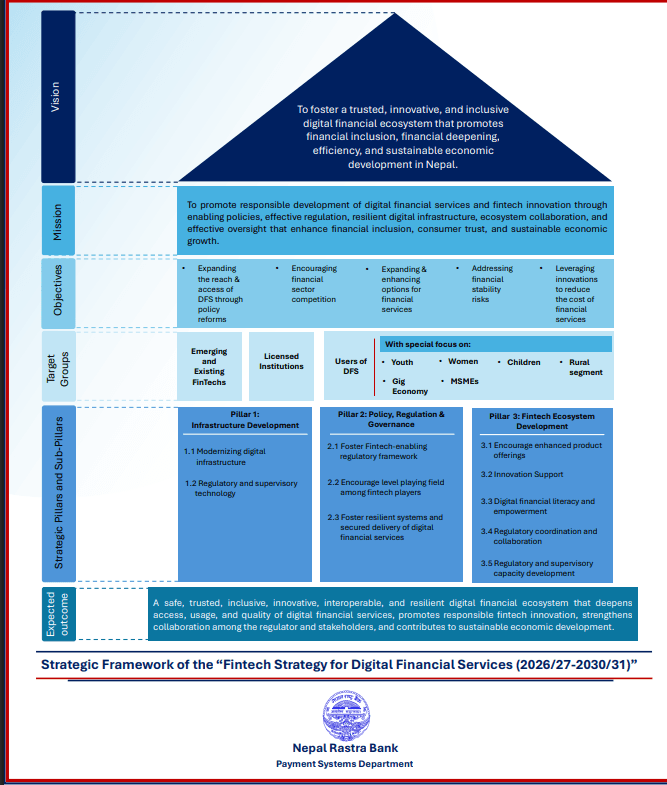
The 3 Key Pillars of the Strategy
The entire strategy is built around three main pillars; think of these as the three big areas NRB will focus its efforts on over the next five years.
Pillar 1: Infrastructure Development
This pillar is about the technical backbone of digital finance, the systems and networks that make digital payments possible. NRB plans to modernize the country's digital infrastructure and strengthen its own regulatory and supervisory technology (the tools NRB itself uses to monitor and oversee financial institutions). In simple words: better, more reliable systems so digital transactions run smoothly and NRB can properly watch over them.
Pillar 2: Policy, Regulation and Governance
This pillar focuses on the rules of the game. NRB wants to create a fintech-friendly regulatory framework, meaning rules that support new financial technology companies instead of making it too hard for them to operate. It also aims to create a level playing field, so smaller fintech startups can compete fairly alongside big banks, while making sure digital financial systems stay secure and resilient (able to keep working safely even under pressure or attack).
Pillar 3: Fintech Ecosystem Development
The third pillar is about growing the overall fintech environment. This includes encouraging better digital financial products, supporting innovation (new ideas and technologies), improving digital financial literacy (helping people understand how to safely use digital money tools), and strengthening coordination between NRB, banks, and fintech companies. It also includes building up NRB's own capacity to regulate and supervise this fast-changing sector.
Why Does This Strategy Matter?
It's easy to read "strategy" and "pillars" and assume this is just internal government paperwork. But a few things make this genuinely significant:
● Digital financial services: NRB wants far more people using mobile banking, digital wallets, and online payments as part of their everyday life — not just occasionally.
● Innovation: The plan actively supports new fintech companies and new financial products, instead of just tightly restricting them.
● Financial inclusion: This means bringing people who currently don't use formal banking or digital finance, often due to location, income, or lack of documentation, into the formal financial system.
● Competition and accessibility: More players in the market, competing fairly, generally means better and cheaper services for everyone, including businesses.
● Consumer protection and trust: As more people rely on digital money, NRB wants to make sure people's money and data stay safe so people continue trusting these systems.
The strategy sets a direction for the continued development and modernization of Nepal's digital financial ecosystem over the next five years.
What Does It Mean for Nepal's Fintech Ecosystem?
Different groups will feel the effects of this strategy in different ways:
Fintech companies
Startups and companies building digital payment, lending, or financial apps should expect clearer rules and, according to the strategy, a more level playing field to compete with established banks, rather than being left in regulatory grey areas.
Banks and financial institutions
The strategy could create a more competitive environment in which banks and fintech companies increasingly interact, collaborate and compete in digital financial services.
Digital payment providers
Companies running QR payments, mobile wallets, and similar services can expect stronger, more modern infrastructure to build on, along with regulatory support aimed at encouraging (not limiting) product innovation.
Consumers and businesses
Over time, this could mean more digital payment options, potentially lower costs for financial services (since the strategy specifically aims to reduce costs through technology), and better protection if something goes wrong with a digital transaction. The strategy also names specific groups it wants to prioritize: MSMEs (Micro, Small and Medium Enterprises), rural populations, youth, women, children, and workers in the gig economy — meaning people who work short-term or freelance jobs, often coordinated through apps.Challenges and the Road Ahead
A five-year strategy is only as good as its execution, and a few real challenges stand in the way:
● Cybersecurity: As more money moves digitally, the risk of fraud, hacking, and data breaches grows. Building genuinely secure systems takes real investment and time, not just policy documents.
● Digital literacy: Many people, especially in rural areas, aren't yet comfortable or confident using digital financial tools. Rules and infrastructure alone won't fix this — people need practical education too.
● Infrastructure gaps: Reliable internet and electricity aren't available everywhere in Nepal, which can limit how far digital financial services can realistically reach in the short term.
● Regulation keeping pace with technology: Fintech products can change fast. A regulator has to constantly update its understanding and rules to keep up, without either falling behind or over-restricting new ideas.
● Implementation: Perhaps the biggest challenge of all — turning a well-written five-year strategy into real, on-the-ground results consistently, year after year, regardless of other political or economic pressures.
None of these challenges are unique to Nepal, most countries rolling out similar digital finance strategies face the same issues. What matters is whether NRB follows through consistently over the full five years, rather than the initiative losing momentum after its first year or two. It's also worth remembering that a strategy document sets direction, not day-to-day rules, the actual regulations, circulars, and guidelines that businesses and fintech companies will need to follow are expected to be issued gradually over the coming years as each pillar is implemented. This means it's worth checking NRB's official announcements periodically rather than expecting all the details at once.
Conclusion
NRB's five-year Fintech Strategy (2026/27–2030/31) is a clear signal that Nepal is serious about modernizing how money moves in the country, not just for banks, but for everyday consumers, small businesses, and the fintech companies building new financial tools. The plan's three pillars, better infrastructure, smarter regulation, and a stronger fintech ecosystem, are designed to work together to make digital finance safer, more accessible, and more innovative over time.
For business owners, this is worth watching closely. As digital payments become more central to how you get paid, and as new fintech products enter the market, staying informed now means you won't be caught off guard by the changes coming over the next five years.
Frequently Asked Questions
What is NRB's new Fintech Strategy?
It's a five-year plan (2026/27–2030/31) by Nepal Rastra Bank aimed at expanding and regulating digital financial services in Nepal, built around three pillars: infrastructure, policy and regulation, and fintech ecosystem development.
What is new in fintech under this strategy?
The strategy introduces a structured regulatory framework specifically for fintech companies, modernized digital infrastructure, and stronger support for innovation, alongside a sharper focus on financial inclusion for underserved groups like MSMEs, rural populations, and gig workers.
What are NRB's guidelines for digital lending?
The strategy document itself focuses on the broader digital finance ecosystem rather than detailed digital lending guidelines specifically. For current, detailed digital lending rules, it's best to check NRB's official website directly, as separate circulars may apply.
Is there a new notice from Nepal Rastra Bank today?
NRB regularly issues notices and circulars on various banking and payment matters. For the latest official notices, check NRB's official website, as these are updated frequently and separately from this five-year strategy.
Who does this strategy affect?
It affects licensed banks and financial institutions, existing and emerging fintech companies, digital payment providers, and everyday consumers and businesses who use or will use digital financial services.
Starting a business in Nepal?
Register your company online — name reservation, MOA/AOA, PAN/VAT and OCR filings, all in one place.


Related Blogs

Subscribe to our newsletter
Get latest news and updates directly to your email.