Internship in Nepal: The Salary Rumor Debunked
Khatapana
April 17, 2026 6 min read
 Reviewed by Kailash Panday, Chartered Accountant & Corporate Lawyer

Is the new minimum wage rule really for interns? There's a lot of confusion going around, so here's what the government actually said and who it applies to.
Imagine going into the job market as a fresh graduate, working at a particular company for months, showing up to work every day, putting in an effort and yet receiving no pay or benefits in return. So frustrating right?
This is not a hypothetical scenario but reflects a long standing concern for a lot of fresh graduates that are trying to enter the workforce but they often don’t have the particular skill required for the job so they are often hired as trainees; a situation that reflects a broader issue around internship in Nepal, sometimes without any pay or benefits. Sure, you’re learning new skills that help you advance further in your career but think about it, with today’s high cost of living continuing a job for months without pay is not easy to sustain.
Although there are laws in place requiring payment for such roles, many of those remain unpaid in practice. This is where a recent notice from the Ministry of Labor, Employment and Social Security comes in.
The Ministry recently issued a press release urging employers to provide minimum wage as well as other facilities to such trainees who have been working unpaid so far. This signals a positive step towards the reinforcement of the protection of trainees and ensuring fair compensation for the work done.
This news filled newspapers and especially social media platforms as soon as it was published but it also brought a wave of confusion with it. Shortly after, various interpretations of the notice started circulating. What began as a straightforward development quickly turned into an entirely different debate and a whole lot of misunderstanding.
So, what exactly was the confusion about?
For anyone following the discourse around internship in Nepal, an interpretation of the notice started to circulate on social media specifically stating that the ministry has mandated that employers now need to pay interns minimum wage and also provide them with other benefits according to the labor law.
When posts, screenshots and explanations begin to circulate across different platforms attempting to simplify the issue, in doing so the original intent appears to have been lost in translation.
Notice how the press release initially said trainees but now the wording has shifted from trainees to interns?
On a daily basis we definitely use the both terms interchangeably without giving it much thought. In casual conversations it will not create any issues but when it comes to law and legal language, it is important to convey the original intent of the law otherwise it could lead to significant confusion. Words that are similar in everyday language often carry distinct meaning in the legal context. When these differences are overlooked it becomes easy to misinterpret the scope of a particular law.
This is exactly where the “trainee” and “intern” confusion comes from because while simplifying the news these words were used interchangeably.
Let’s clear it up from the start.
Reading the Press Release Closely
The notice references section 18, sub-section (3) of the Labor Act directly. In accordance with section 18, sub section (3) of the Labor Act 2074, the notice mandates employers to provide minimum wage, sick leave and gratuity, provident fund, insurance, and other social security benefits to trainees.
So the press release is more specific than what social media is making it out to be. It only addresses a particular category of workers i.e. trainees.
Understanding the Terms “Trainee” v “Intern”
Although used interchangeably, the meaning of trainee and intern in general sense is different. Trainees and interns are both entry level positions aimed at learning skills and serve as an entryway to learn the particular skill or profession. However, there are some differences.
Internship in Nepal, like elsewhere, is generally a short term opportunity, often unpaid, aimed mostly at students that are currently enrolled in specific courses. Although sometimes also provided to recent graduates; it is mostly catered towards students currently enrolled in undergraduate curriculum. Internship is focused highly on learning but also gives an opportunity to explore various roles because of its short term nature.
Traineeship on the other hand, is generally focused on graduates. Like the name suggests, it is mostly focused on training an individual for a specific role or skill with permanent employment in mind. It is also generally a long term and paid position and offers entry level salaries, in Nepal’s context the minimum wage.
What Does the Law Recognize?
Nepali law recognizes both trainees and interns, but when it comes to internship in Nepal, the legal protection accorded to both is not the same. Let’s look at what Labor Act 2074 says:
Section 18 of Labor Act 2074
Section 18 of Labor Act 2074 governs the employment of trainees. Although the labor law doesn’t explicitly define who a trainee is, the section 18, sub-section (1) does state that an employer can employ someone and provide them with training for the same job generally for one year but can be more depending on the nature of the job.
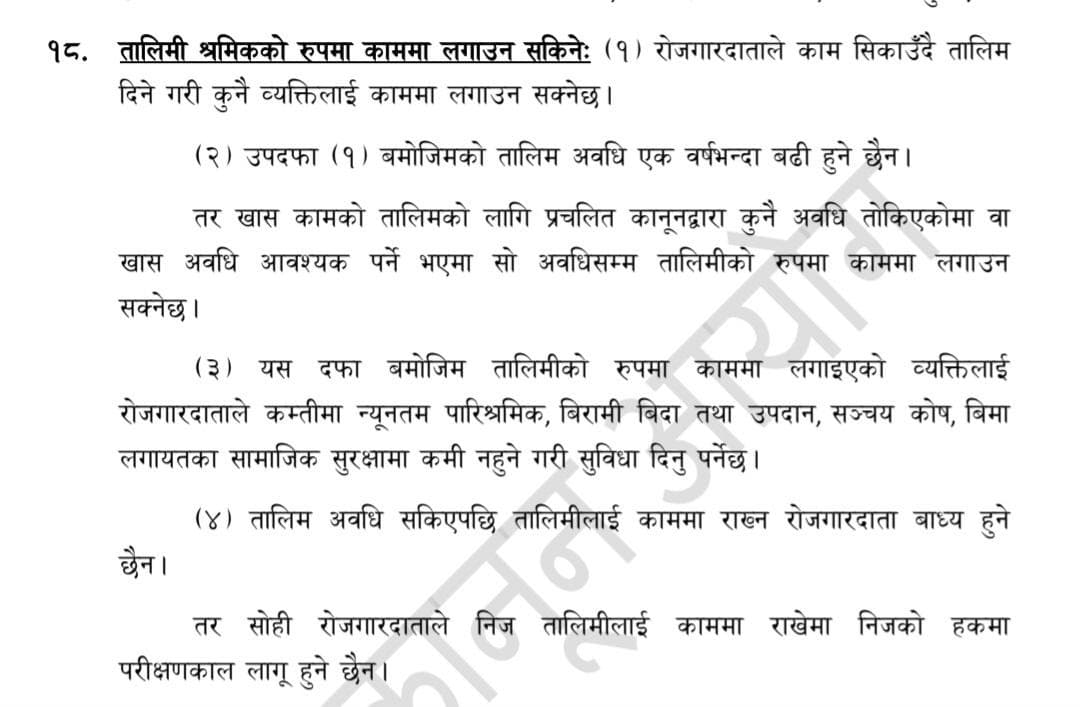
The minimum wage in Nepal is currently around NPR 19,550. The trainees are entitled to the minimum wage. Along with this they are also entitled to sick leave, gratuity, social security and insurance.
Are Interns also Trainees?
Under the current Labor Act, interns do not fall under the definition of trainees. Interns have also not been explicitly defined under the Labor act. However, the labor law does cover the status of internship in Nepal under section 16 of the Labor Act 2074.
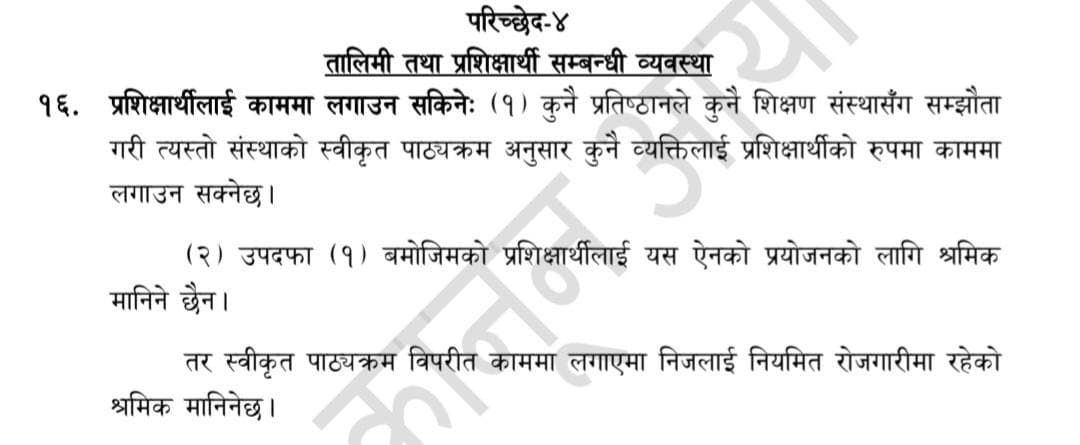
According to section 16, an enterprise can hire interns by making an agreement with any educational institute. The scope of work assigned to them needs to fall under the approved academic curriculum.
Section 16 also clearly specifies that interns aren’t considered as regular employees. If interns are assigned work beyond their approved curriculum only then they’d be considered as laborers.
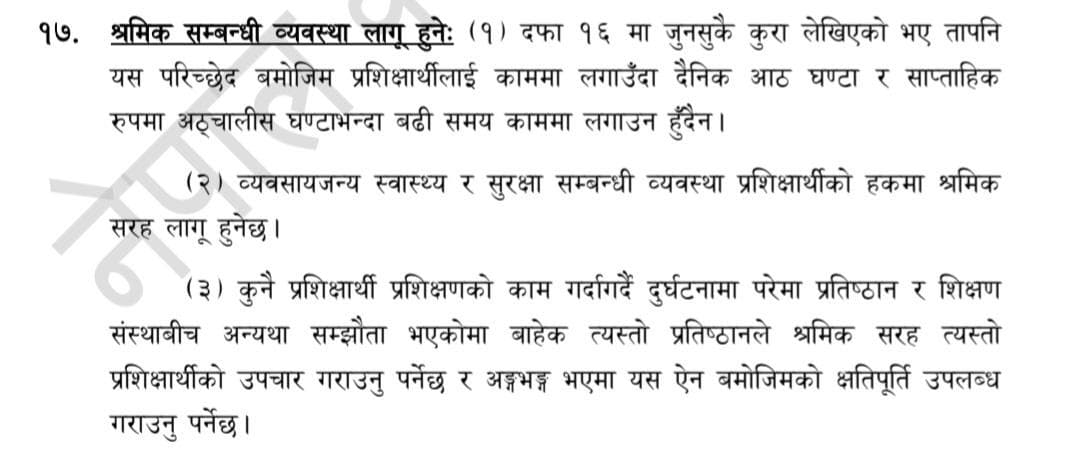
The only provisions that apply for interns within the Labor Act are (Section 17):
- Interns cannot be engaged in work for more than 8 hours a day and 48 hours a week,
- The provisions relating to occupational health and safety also applies to interns,
- Finally, if they have an accident while performing a work task and end up with a physical deformity then they are also entitled to compensation from the employer.
However, if educational institutions and companies have specific agreements outlining these things, the agreement governs the hours of work, health and safety and compensation provisions.
Except for these particular provisions mentioned above, internship in Nepal does not carry entitlements like minimum wage, social security, or insurance for interns. However, there are institutions that provide interns with stipends for transportation, lunch etc but it is not mandated by the law.
Therefore, now it is clear that interns are trainees are governed by completely different sections of the labor law and this specific press release specifically addresses section 18 i.e. trainees and doesn’t address internships (section 16 and 17).
In order to make the information more accessible and simple, the details were simplified and the words were used interchangeably creating confusion among the public. It is important to go back to the source i.e. the law and read the provision for clarity instead of relying on circulating interpretations because sometimes they can get things wrong while trying to simplify the information.
The Legal Gap
This type of confusion doesn’t come as a surprise considering trainees and interns have not been properly defined by the labor law and have been used interchangeably by individuals as well as the companies.
Law doesn’t say who an intern is or who a trainee is and doesn’t specify the roles and responsibility for both. This lack of clear definition not only creates problems for the individual looking for work but also creates a potential for misuse.
When an internship in Nepal is not properly defined in terms of duration, stipend, or minimum standards, it can create room for businesses to even label trainee positions as internships so that they do not have to give the prescribed minimum wages and facilities and can reduce costs.
Again, because the roles, responsibilities and standards have not been clearly defined, an individual may be carrying out internship-like work while being classified as a trainee or the other way around or could be learning as well as training for a specific position which makes the distinction even more blurry and unclear. It is important to address this gap that currently exists in the law.
Is There a Way for Interns to Also Get Stipend and Other Benefits?
Although the current notice was only meant for individuals who have been doing an internship, it doesn’t mean that law totally ignores interns. As internship in Nepal is also an essential part of the academic curriculum, the Labor Act clearly mentions that educational institutions can enter into agreements with businesses to ensure internships for their students. But currently all they do is charge insane fees while pushing the burden of internship search on students where they’re forced to do whatever paid, unpaid internships that they come across while law gives full permission to educational institutions to negotiate and advocate for better internship conditions on behalf of the students on the basis of academic curriculum. So it is essential that students are aware of this provision and make their institutions responsible and responsive towards ensuring stipends and learning environment for the students during the term of internships.
Starting a business in Nepal?
Register your company online — name reservation, MOA/AOA, PAN/VAT and OCR filings, all in one place.


Related Blogs



Subscribe to our newsletter
Get latest news and updates directly to your email.