Nepal’s LDC graduation: Why Attracting Foreign Investment is Critical Going Forward
Khatapana
April 6, 2026 7 min read
 Reviewed by Kailash Panday, Chartered Accountant & Corporate Lawyer
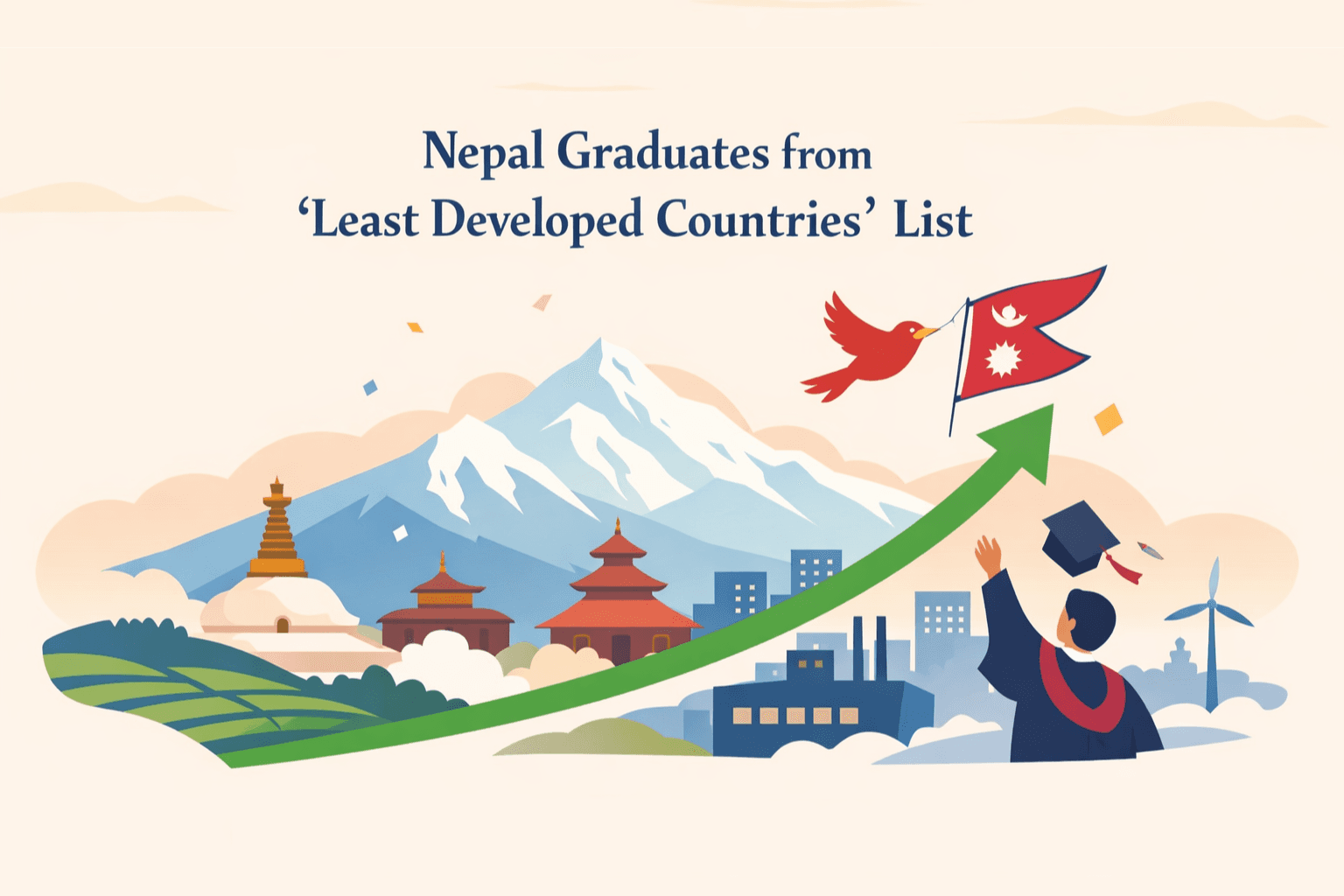
We must have heard that Nepal is a developing country at least a hundred times. It’s a label that we all grew up knowing, one that’s been tossed around in the classrooms, newspapers, books and even political speeches.
But here’s the thing you might have been unaware about, Nepal is actually categorized as a least-developed country by the United Nations. This information comes as a surprise to many since we’re so used to hearing that Nepal is a developing nation. And here’s another latest news that you might not have heard, Nepal’s status will soon change from a least developed country to developing country in November 2026.
It is indeed a great milestone for Nepal and reflects great progress that Nepal has made in various sectors through the years.
Now you might be thinking, “Isn’t this just another label change? What happens when Nepal goes from a least developed nation to a developing one?”
Although, on the surface, it sounds like another label change, this is far more than just a ceremonial milestone especially for businesses, investors and entrepreneurs in Nepal. This status change marks a pivotal moment in Nepal’s economic history with this having implications on trade, foreign investment, taxes and even employment opportunities and for industries and businesses, this means adapting to the changes made in the regulations, labor market and tariffs.
So, this brings us to an important question: what comes next?
This transition marks a fundamental change from an economy which was reliant on foreign aid and concessions provided to the industries and businesses to an economy that must rely on private capital and foreign direct investment. In this type of scenario, attracting foreign investment is not going to be optional but essential.
Let’s break it all down from scratch.
The United Nations categorizes the countries into three broad categories namely developed, developing and least developed country (LDC).
What is a LDC?
A country is categorized as a least developed country when it exhibits a few traits.
First, the country has a very low income i.e. the country could be facing high poverty rates. Generally their gross national income (GNI) is below the prescribed threshold of USD 1088 for three consecutive years.
Second, the country has weak human assets i.e. high malnourishment, poor health and high health risks amongst citizens, high infant mortality and low education.
Third, the country is economically and environmentally vulnerable because of remoteness, agricultural instability, frequent natural disasters, export instability etc. which impacts economic development.
Because of their LDC Status, the Countries Get Additional Support:
LDCs get international support as vulnerable and disadvantaged members
- Preferential Market Access: Developed countries allow products from least developed countries to enter duty free-quota free in simple words the product enters their market without any restrictions. So there are no import taxes and no limits as to how much product you can import into their market. This helps the goods remain cheaper in foreign market, helping such goods remain competitive.
- Specialized Financial Assistance: This assistance consists of grants and low interest loans, significant portions of the Official Development Assistance (ODA) given by donor countries as well as international organizations also go to LDCs to support their vulnerable economies.
- Technical Assistance and Capacity Building: Provision of targeted support to LDCs tailored towards various sectors like health, education and agriculture including technical and financial co-operation to ensure technology transfer to ensure LDCs have the skills and tools to use, manage, and create technology rather than importing it.
- WTO Exemptions: LDCs are exempt from certain rules and obligations and are not expected to make full reciprocal commitments towards developed and developing nations when joining WTO.
What is LDC Graduation?
We discussed the traits that LDCs exhibit i.e. low income, weak human assets and economic vulnerability.
LDC graduation occurs when a country demonstrates sustained progress in one of the two criteria mentioned above for three consecutive years. Nepal met the criteria for human assets as well as the economic and environmental vulnerability. Nepal showed significant progress in health and education with a score of 77.2 with the criteria for graduation being at least score of 66 as well as reduced vulnerability to economic and environmental shocks with a score of 24.9 with the criteria for graduation being score below 32. [In Perspective:Nepal’s LDC Graduation, Vol.39, Issue 3-4, 2025]
A country can also graduate from the category if its average income is three times higher than and the UN confirms that the economy is stable enough to maintain that income level for three years.
What Happens After Country Graduates?
After graduation, the additional support and benefits that LDCs get will get gradually phased out generally over a period of three to five years to ensure smooth graduation.
So, preferential market access, financial assistance, technical assistance, and WTO exemptions that Nepal has been enjoying as an LDC will be gradually phased out.
What Does Graduation Mean For Nepal?
The LDC graduation can present opportunities as well as challenges for Nepal.
The Challenges Faced:
As the advantages that Nepal gets gradually phased out over the five year transition period, there could be increased competition from other developing countries because of loss of preferential market access and increased tariffs on exports. International Trade Center (ITC) in 2022 estimated that projected exports to Nepal would be USD 1372 million in 2026 but the tariff increases will reduce the exports to USD 1313 million which is a loss of USD 59 million with textile manufacturing industry to be mostly affected. [ILO- Employment Impact Assessment on Nepal’s LDC Graduation-2025 pg.9]
The development assistance like grants, concessional loans and humanitarian support helped play an important role in filling fiscal, savings, foreign exchange, technical knowledge and technology gaps and meeting humanitarian needs in Nepal. Such grants are important since Nepal has huge development needs.
The graduation can increase the cost and burden of loans because it will lead to the changes in the World Bank’s category as well shifting Nepal from a low income country to a lower middle income country which could mean higher borrowing costs in the form of higher interests and shorter repayment periods. Donors also could change the grants to concessional loans and increase interest rates for such.
A new assessment report published by ILO has warned that Nepal’s graduation from LDC could reduce exports, and pose employment risks. Over five years, a loss of 132,000 jobs and 1 billion dollars has been predicted with the manufacturing industry specially the textile industry, agriculture industries being affected the most.
Opportunities: To Increase Foreign Direct Investment in Specific Sectors
LDC graduation could improve a country's image and bring it to the attention of the international community. LDC graduation could improve Nepal’s creditworthiness ensuring less risk premium and increased potential for direct investment both domestic and foreign. [LDC Graduation Smooth Transition Strategy, 2024-pg.14]
Both ILO and Nepal Government Transition Strategy report that although there will be losses occurring in the agricultural and manufacturing sector specifically in the textile industry, those losses could be recouped and mitigated with investment in specific sectors.
Nepal’s tourism and IT (digital services) industry is shown to have huge growth potential. Along with these, food, construction, education, and plastic businesses also show good growth potential. Investment in these sectors could yield high output and even multiply employment signifying a strong effect in the economy. The Digital Service industry has also emerged as new avenues of export. Nepal can diversify and gear up its production, negotiate with countries and increase the potential volume of exports in these industries.
Previously, Botswana graduated from LDC status in 1994. Botswana was able to create a simple and business friendly environment post LDC graduation which led increment in Foreign Direct Investment in Botswana. The country was able to tap into its potential market of high value exports such as minerals and was able to bring in foreign investment in such sectors. Government of Botswana didn’t consider graduation to be the aim but rather a milestone for development and continued to implement its development plans focusing on developing its economy. [sawtee-Nepal’s Graduation from LDC Category,2022, pg.11]
Nepal should also similarly cash on the credibility it has gained post graduation and focus on presenting itself as a viable location for foreign direct investment. It should also further focus on simplifying and streamlining the FDI processes to attract more foreign direct investment.
Attracting foreign investment is also crucial to ensure continued technology transfer into the country. New technologies not only improve speed and efficiency but also raise standards across industries in relation to production, management, operational techniques and practices.
So, What Needs to Change Going Forward?
For transition from an aid and concession driven economy, certain changes are necessary.
First, improving the ease of doing business needs to be a priority. This includes simplifying and streamlining procedures and removing unnecessary hurdles for entrepreneurs and foreign investors. Tax frameworks could also be revised to introduce more concessions and encourage investment. Digitalization of the process is also necessary to make it convenient for the investors and businesses. So far, Nepal has moved a lot of the procedural formalities for business registration online and continues to do so slowly which marks a progress in this area.
Second, along with improving the ease of doing business, targeted sector wise strategies can also help. As discussed earlier, Nepal shows good growth potential in areas such as the IT sector and tourism. These priority sectors have already been identified. So, what future laws and policies could do is focus on offering incentives focused on these areas so that the government can attract investment where it is most needed.
In the digital service industry, such changes seem to be already taking place with reduced income tax at 5% for digital service exporters, easing up of the FDI rules in the IT sector including the automatic approval routes and removal of minimum investment threshold for foreign investment. These strategies are clearly aimed to promote exports and investment in the digital services industry. Similar strategies could be introduced for other sectors with growth potential ensuring diversification of exports and industry within the country.
Similarly, graduation shouldn’t be treated as an end goal but taken as a transition into a more competitive global market with fewer international support measures and higher expectations for the country. So while graduation signifies progress in development, it is necessary to no longer rely on previous benefits, aids and concessions and focus on building a resilient economy. Therefore, laws and policies should be introduced in a way to ensure that it brings in sustained investment within the country.
Key Takeaways for Businesses
Businesses should expect increased competition and tariffs for products exported since they can no longer enjoy preferential market access in developed nations.
It is necessary that businesses also explore new and emerging markets like IT/digital services since they show potential for success both domestically and for exports.
Innovation and entrepreneurship will be keys as traditional support mechanisms decline. Businesses should find new ways to ensure they remain competitive. This could mean exploring new markets, diversifying the business, developing new products and services etc.
Conclusion
Ultimately, LDC graduation is not the destination, it is a test of Nepal’s ability to compete, attract and sustain investment in a competitive global economy. Nepal needs to ensure that it makes the most of it. In the future with less aid and fewer benefits, foreign investment emerges as an important pillar of economic growth and industry development in Nepal. Foreign investment not only offers capital but also technology, global integration and subsequent employment for individuals and growth opportunities for industries and businesses here which Nepal needs to move forward. Attracting foreign investment is not just about opening and simplifying pathways but also about creating an environment where investors want to invest long term and stay. This process requires policy and legal reforms as well as a stable and clear strategy for the future.
Ultimately, this graduation poses both challenges and opportunities. It is a test of whether Nepal is ready to stand on its own in this increasingly competitive world. If there is a strategic approach, this can mark the beginning of building a very resilient and self-reliant economy, one not driven by support and aid but one driven by innovation, entrepreneurship, and investment.
Starting a business in Nepal?
Register your company online — name reservation, MOA/AOA, PAN/VAT and OCR filings, all in one place.


Related Blogs
Subscribe to our newsletter
Get latest news and updates directly to your email.