Tax Rate in Nepal: Is the 5% Freelance Tax Discouraging Foreign Investors?
Khatapana
March 15, 2026 10 min read
 Reviewed by Kailash Panday, Chartered Accountant & Corporate Lawyer

Why does the same IT professional face different taxes depending on how they work? This article breaks down the tax rate in Nepal and its policy implications.
Shiva, an IT professional, worked remotely from Nepal for a foreign company for some time and his salary was around 1,500 USD which is around Nepali rupees two lakhs. When he got paid, only ten thousand rupees were deducted as taxes from his salary.
Later, his contract ends and he ends up working for a different foreign IT company but this time its branch office was based in Nepal. He was offered the same salary of around rupees two lakhs but when he received his salary, he couldn’t help but notice his take-home income was much lower than what he had previously earned.
Such a difference really confused him and prompted him to look more into it. He found out that the income that he earned through the foreign export of digital services were only taxed at 5% whereas the income he was earning in Nepal was subject to progressive taxation as well as social security fund deductions resulting in overall deduction of his take-home income.
So, in Nepal his first 5 lakhs in earnings would be tax free but subject to Social Security Deductions, but the next 2-3 lakhs earned will be taxed progressively at the rate of 10%, 20%, income above ten lakhs would taxed at 30% and the amount above 20 lakhs, additional 20% is levied etc.
To put it simply, the more Shiva earned, the higher taxes he’d pay, unlike when he was working remotely for a foreign company, no matter the income, he would only pay 5% taxes on it.
This situation therefore raised an important question about the tax rate in Nepal. Why would the same IT professional face completely different taxation depending on whether they work remotely for a foreign company or for a company established within Nepal? And will this tax framework affect how digital service and IT business operate in Nepal or more importantly, will such a tax system discourage digital service providers and IT companies from working and investing in Nepal?
Since Nepal has recently been trying to position itself as an emerging destination for the digital economy. The government has made two significant policy changes which aimed at transforming the country into an emerging IT hub.
First, it has introduced a 5% tax on export of digital services. This significantly lowers the tax burden on individuals for export income derived from IT and digital services.
Second, it has also eased foreign direct investment (FDI) rules in the IT sector including automatic approval routes and removal of minimum investment thresholds under the Foreign Investment and Technology transfer act.
So, the government seems to be targeting promotion and investment of IT sector specifically whether by service exports or by attracting foreign investors both of which increases foreign currency flow into the country. At the first glance, both appear to be very progressive policies aimed to grow and expand the digital service industry.
However, when observed together, they raise a very important policy question. If Nepali IT professionals can just work directly for foreign companies by paying only 5% tax, why would foreign investors directly invest money in Nepal and set up a company?
This article therefore, attempts to explore and examine whether these policies are working well together or are counterproductive and create conflicting economic incentives.
Understanding the 5% Digital Service Export Tax Rate in Nepal
The 5% tax on exports operates under the broader framework of Tax Act 2058 which is amended by finance acts every fiscal year. Section 95 sub-section 6(b) of the Income Tax Act 2058 states that if a resident natural person not engaged in the business operations receives payment in foreign currency for providing software or any other electronic services of a similar nature outside Nepal, the concerned bank, financial institution and money transfer institution shall collect advance tax at the rate of five percent of the amount received while making such payment.

For the purpose of this act, the Information Technology industry means technology parks, information technology parks, biotech parks, software development, data processing, digital mapping, business process outsourcing, data mining and cloud computing related industries. (section 11 sub section 6 (e))

So, this tax regime generally applies to
- Resident natural person
- Receiving payment in foreign currency
- Providing software or any other electronic services outside Nepal
Main policy objectives for this regime is to encourage foreign currency flow, promote IT oriented services as well as support freelance professionals. Nepal in recent times has a large English-speaking population which is also technically skilled. Many already work remotely for foreign companies in software development. This tax regime helps standardize and regulate the income earned by freelancers and independent contractors and reduces evasion.
Understanding the Establishment of a Digital Service Company in Nepal by a Foreign Investor
The IT and Technology based Industries include Technology Park, IT Parks, biotech park, software development, data centers, Data Mining, digital mapping, business process outcomings, Knowledge Process outcoming, Cloud computing services, web portal services, Web design services, Web Hosting services.
Financial and Regulatory Obligations for Companies
A foreign investor intending to establish a company in Nepal needs to comply with the following acts:
1. Foreign Investment and Technology Transfer Act 2019:
As per the Section 3(1) of FITTA 2019, a foreign investor may make foreign investment in any industry, however as per Section 3(3), approval shall not be given for making foreign investment in any industry of an amount that is less than the amount specified by the Government of Nepal by a notification in the Nepal Gazette. Similarly, an application needs to be made to obtain permission for foreign investment and Nepal Rastra Bank (NRB) also needs to be notified. (section 15 and 16)


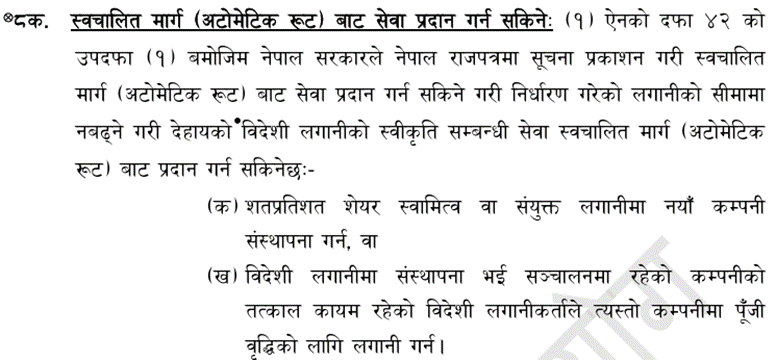
Pursuant to the provision of section 3 discussed above, the Government of Nepal prescribed the minimum threshold of NPR 20 million per investor by a notice published in Nepal Gazette, 2080. However, for IT based industries. The same Government Gazette has removed the minimum foreign investment threshold. Hence, IT-Based industries are exempted from this minimum threshold requirement. Furthermore, the earlier investment ceiling for the automatic approval previously capped NPR 500 million has also been removed which results in special relaxation for IT-Based industries with no minimum investment threshold and no upper ceiling for automatic approval.
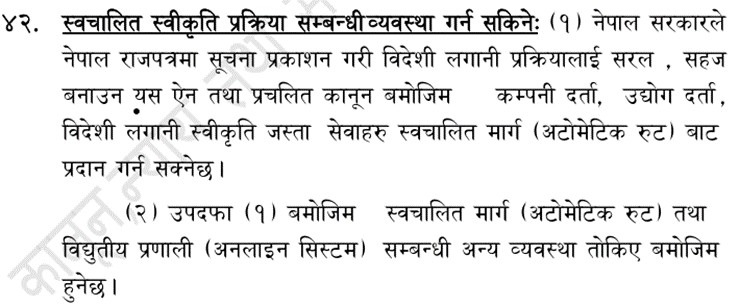
Sec 42 provisions automatic approval process by the Government of Nepal in which it may, by notification in the Nepal gazette, provide services, such as registration of companies, registration of industries, approval of foreign investments in accordance with this Act and the prevailing law, through the automatic route in order to make the process of foreign investment simple, easy. Rule 8A, into the Foreign Investment and Technology Transfer Regulations, 2021established an online, one door system for foreign investment approval, implemented through the Department of Industry. The threshold for IT companies as discussed above was also lifted.
2. The Companies Act 2063
A person desiring to incorporate a company shall make an application to the office under this act with the documents (MOA,AOA, Consensus Agreement, permission obtained and documents revealing identity/ certificate of incorporation for foreign person/company). Similarly, section 154 covers a foreign company’s branch and liaison office establishment, sec 155 mandates submission of book of accounts, audit reports and annual reports of such a company. So, a foreign investor intending to establish a company in Nepal needs to comply with company act’s provisions.
3. Industrial Enterprises Act 2076
Under section 3 of this act, registration is necessary for establishment and operation of an industry. Under section 4, to establish an industry with foreign investment, the person/firm/enterprise intending to establish the industry may submit an application with prescribed documents. After that under section 5, a registration certificate will be issued. Under Schedule 9 of this act, the IT industry has been considered as an Industry of National Priority.
4. Income Tax Act 2058
The standard corporate tax rate in Nepal is 25% but , according to section 11 sub section 3(a), special industries and information technology industries providing direct employment to a certain number of Nepali Citizens throughout the year, certain tax concessions are applicable. Special Industries and IT industries providing direct employment to 100, 300, 500, 1,00 or more Nepalese Citizens throughout the year get 90%, 80%, 75%, 70% tax concessions respectively lowering the corporate tax payable throughout the year.
Additional 10% concessions if direct employment is provided to 100 or more Nepali citizens including 33% women, oppressed and handicapped persons. Repatriation of profit by a foreign establishment is subject to specific withholding tax at 5%.
Comparing the Tax Rate in Nepal: Freelancers Vs IT Companies
Companies Hiring Remote Workers Directly
When other international firms hire Nepali developers remotely, they have no obligation to establish a company here in Nepal. Similarly, there is no FDI, Industry approval required and the national compliance and regulatory obligations do not apply. The company hires an individual directly as an independent contractor and payment is made directly to the individuals in foreign currency through the banking channel and individuals pay 5% taxes on that export income irrespective of the amount earned through such employment.
From a company’s perspective, they have minimal involvement in Nepal and its legal compliance system, there’s no incorporation costs involved, there is low long term commitment to continue hiring individuals from Nepal or provide employment to Nepali nationals except a few independent contractors since there is no formal presence of the company within the country. From a developer’s and service provider’s perspective, the tax burden gets lower, and their income that they take home is on the higher side since lower taxes were paid.
Company’s Establishment and Presence in Nepal
However, if a company intends to establish a branch in Nepal, the company first needs to be registered under Companies Act 2063, along with getting permission from DOI and registering as an industry, it must also comply with the tax laws where corporate tax rate in Nepal applies. However, tax concessions are available for this industry if the employment threshold emphasizing employment of Nepali citizens are met. Similarly, the profit earned is also subject to repatriation rules where applicable taxes need to be deducted and processed through the banking channel after the approval of DOI and NRB. Basically, all the procedural compliance must be met before establishing a company along with ensuring compliance with labor laws in Nepal.
From an individual’s perspective, they might be subjected to a progressive taxation which means that the more they earn, the tax rate will get progressively higher and their incomes are also subject to the social security deductions so the overall take-home income from the income earned will be lower than remote work since it is not taxed at a standard 5% tax rate in Nepal.
From a company’s perspective, the cost of setting up the company is quite high with investments and application costs, along with that there is an increased burden to ensure compliance with all the regulations and rules established by all the legal frameworks and regulations.
While export of services brings foreign currency into the country and improves overall earnings of an individual, FDI brings in capital investments, helps infrastructural development and helps create long term employment domestically. Along with that, while establishing a company, the foreign investors also bring their new technology and software into the country promoting transfer of technology. Ultimately, FDI not only helps bring foreign currency to the country but its ultimate goal is to help build and promote a long term business ecosystem and sustainable economic growth within the country.
Even though FITTA has recently relaxed the minimum investment threshold and there’s no upper ceiling for automatic approval, the companies are subject to greater compliance and regulatory requirements and reduced flexibility if they opt to establish a company in Nepal compared to hiring workers for export of services. From a purely economic perspective, it is obvious that hiring remote workers directly and skipping the regulatory frameworks would look more attractive to businesses which prefer flexibility and low operating costs.
The Policy Gap
The government clearly aims to promote two things which includes digital exports, encouraging foreign currency inflow, ensuring structured employment globally from within the country first through exports, and secondly increasing foreign investment and strengthening the domestic digital service industry.
The current tax rate in Nepal creates two very different incentive structures — one favoring remote digital service exports and the other applying higher taxes and regulatory obligations on domestic company structures. However, by making the service export tax regime favourable, it is a concern that the government might be unintentionally discouraging formal company establishments as well as foreign investment while incentivizing contract based remote work which will reduce investment in the long term because investors might find it simpler and cost effective to just hire independent contractors than open branches in Nepal.
So, Is the Policy Counterproductive?
The 5% tax on foreign exports of services is not inherently flawed. It does help and support youth employment while attempting to formalize contract and remote work which is very prevalent in the digital service industries and increase compliance of income earned in foreign currency.
So, to the main question, if foreign exports services and taxes on it are so flexible and simple, what is easing up of FDI for the IT sector all about?
A lot of freelance and remote work is contract based where the developers are hired for a specific period of time for specific projects which are viable without setting up a company in Nepal. However, a product based company or SaaS company (Software as a Service) (Eg. Zoom, Canva, Microsoft 365, Netflix, Spotify etc.) based companies operate differently. Such companies generally build their own products and services and are focused on long term growth. So, if they want to hire a large team, establish a product development centre in a certain country, manage or expand their business and centers into other countries effectively, the more practical answer for that would be to establish a company in the particular country that they are projecting to launch, expand or developing a product in. This structured incorporation allows them to directly employ staff, ensure compliance with local laws, manage and operate their activities in a very stable and predictable manner.
The easing up of FDI therefore helps simplify the administrative and procedural hurdles helping such companies incorporate easily within Nepal reducing administrative friction and encouraging long term presence in the country. So, the easing is not about taxes but rather simplifying and reducing hurdles that make it possible for the companies to incorporate smoothly.
Therefore, Nepal trying to ease the FDI requirements is sending a message that Nepal is open to such IT and digital service industry investors and willing to ease investment requirements for such industries to enter, grow and expand in the market long term.
Conclusion
Therefore, both frameworks are brought in to incentivize the IT industry, professionals and investors linked to the industry while ensuring that economic activities remain regulated and structured and are not contradictory to one another. While the 5% tax regime benefits and supports freelancers, remote workers who do contract based, project based works digital work, FDI amendments helps facilitate formal incorporation and long term market entry for product based services/companies. Together these policies are complementary and create an ecosystem that supports both freelancers and individual digital service exporters as well as structured corporate growth in the country's digital sector.
While both policies are generally coherent, addressing the differences in the tax rates between income earned via export and domestic digital services income could harmonize the policy better and encourage more professionals and companies to operate within Nepal’s formal corporate structure.
For example, the treatment of the income via export of digital services and domestically earned income from the IT industry could be aligned. This could be achieved by either aligning tax rates more closely for both service providers i.e. by fixing a similar tax rate in Nepal for both individuals irrespective of whether they’re earning domestically or via remote work for foreign companies or, it could also be done by introducing a progressive taxation for digital services with targeted concessions for all digital professionals so as to ensure that domestic digital service providers and investors are not discouraged from working and investing domestically.
Ultimately, the debate is not about whether digital exports should be taxed at 5%, but whether the broader tax rate in Nepal should be harmonized to ensure that both freelancers and formal companies operate under a balanced and competitive tax environment.
Starting a business in Nepal?
Register your company online — name reservation, MOA/AOA, PAN/VAT and OCR filings, all in one place.


Related Blogs



Subscribe to our newsletter
Get latest news and updates directly to your email.