FDI in Nepal: Automatic Route Reform or Visa Loophole?
khatapana
March 1, 2026 11 min read
 Reviewed by Kailash Panday, Chartered Accountant & Corporate Lawyer

FDI in Nepal just got easier as the government removed the automatic route cap. What does this mean for investors, and could it open new business visa loopholes?
If you are a foreign investor exploring Nepal for your next business expansion, you are entering a country that is constantly pushing effort toward the reformation and liberalization in the foreign investment framework.
Over the past two decades, Nepal has been consistently amending its foreign investment laws to attract foreign capital. On paper, this signals a liberal, investment-friendly, hurdle-free environment for foreign investors. As you begin your due diligence, you may encounter a wave of legal terms and conditions, Nepal Gazette notifications, frequent amendments, sectoral restrictions, approval mechanisms, visa restrictions, dynamic regulatory provisions, and so on. Such frequent amendments might be confusing for you as a foreign investor. So, you may ask yourself;
Has Nepal truly liberalized its foreign investment? So, before you commit and fully understand what you are getting into, it is important to understand the proper regulatory systems.
Let’s get started!
What is Foreign Investment?
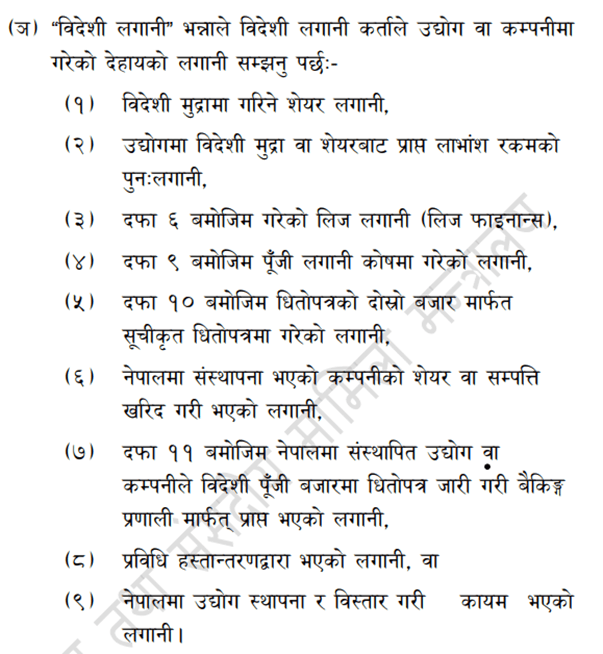
Foreign Investment simply means the investment made by a domestic investor, either individually or jointly to produce goods and services in foreign country. In Nepal, as per Sec 2(j) of The Foreign Investment and Technology Transfer Act, 2019 (2075), “ Foreign Investment” means the following investment made by a foreign investor in an industry or company;
- Share investment in foreign currency,
- Re-investment in an industry of dividends derives from foreign currency or shares,
- Lease finance made in accordance with Section 6,
- Investment made in venture capital fund in accordance with Section 9,
- Investment made in listed securities through secondary securities market in accordance with section 10,
- Investment made by purchasing shares or assets of a company incorporated in Nepal,
- Investment received through the banking channel after issuing securities in a foreign capital market by an industry or company incorporated in Nepal in accordance with Section 11,
- Investment made through technology transfer, or
- Investment maintained by establishing and expanding an industry in Nepal.
Who are Foreign Investors?
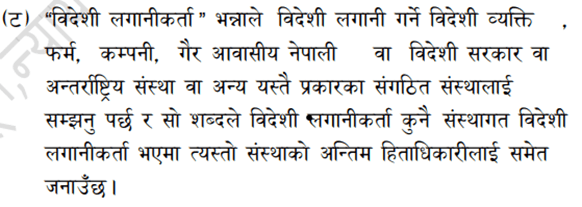
Foreign Investors are individuals, companies, governments, or any institutions from one country who invest capital in foreign countries either in a direct or indirect form. FITTA, 2019 Sec 2(k) provides the statutory definition of Foreign Investor.
Common Entry Routes for Foreign Investors in Nepal
As per the Section 5 of FITTA, 2019, which provides the provision for Investment made by purchasing assets or shares of industry, foreign investors may make foreign investment by purchasing the assets of or shares not exceeding the prescribed percent of any industry established in Nepal.
This allows foreign investors to enter the Nepali market either by acquiring equity in an existing company or by purchasing its tangible or intangible assets. For instance, when a foreign investor acquires equity shares in hydropower industries operating in Nepal, they are investing under this section by purchasing shares of such industry,

Likewise, as per Section 7 of FITTA, 2019, Investment may be made through technology transfer:
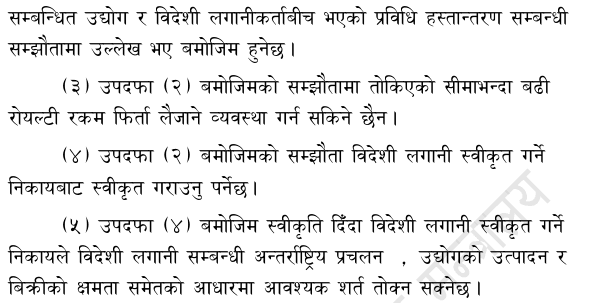
- A foreign investor may make foreign investment by making technology transfer in any industry established in Nepal.
- The terms of technology transfer to be made pursuant to sub-section (1) shall be as specified in the technology transfer agreement entered into between the concerned industry and the foreign investor.
- The agreement referred to in sub-section (2) may not provide for the repatriation of royalty in excess of the prescribed ceiling.
- The agreement referred to in sub-section (2) has to be approved by the foreign investment approving body.
- The foreign investment approving body may, in giving approval pursuant to sub-section (4), specify the necessary terms on the basis inter alia of international practices on foreign investment and production and selling capacity of the industry.

For instance, when a foreign investor invests in the hotels in Nepal, they often enter into technology transfer agreements involving brand licensing, operational systems, etc.
Foreign Direct Investment
In a world full of global business and interconnected economies, Foreign Direct Investment (FDI) acts as a bridge to expand the business beyond borders. FDI basically is a practice where a foreign company or any individual from one country invests their money in other countries outside of their own for the sake of business interest and economic growth. Such investment could be buying assets, building a company, etc. A simple example of FDI could be a company having a main office in the USA investing in building a branch office in Nepal.
FDI is a key to economic development of both developed and developing countries since it is all concerned about money that flows from one country and is invested in companies in other countries. FDI is super beneficial for enhancing employment opportunities, technology transfer, human resource development, increase in exports, exchange of innovations worldwide, and most importantly for economic growth. However, while attracting foreign investment sounds simple in theory, its legal regulation is complex in practice.
Relevant Laws Governing Foreign Direct Investment in Nepal
Foreign Direct Investment in Nepal is governed by the following set of acts and regulations which collectively aims to regulate and promote foreign direct investment in Nepal. These laws address the provisions such as description on foreign investment and its regulations, prior investment approval, technology transfer, repatriation rights, company registration, and so on.
S.N. | Relevant Laws | Major Objectives |
1 | Foreign Investment and Technology Transfer Act, 2019 (FITTA) | It is a principal law that defines foreign investment, regulates the approval mechanisms, prescribes sectoral restrictions, minimum investment thresholds, guarantees repatriation rights, recognizes technology transfer and provides legal protection for foreign investors. |
2 |
Foreign Investment and Technology Transfer Regulations, 2021 | It provides procedural framework for approval, documentation, technology transfer agreements, compliance requirements for foreign invested industries in Nepal. |
3 |
| It regulates the establishment, classification, operation, and protection of industries in Nepal along with foreign investment. |
4 |
| It provides the provision regarding incorporation of a company, its operation, management, corporate governance, and dissolution of companies along with the foreign-invested ownership. |
In addition to these laws, The Foreign Exchange Regulation Act, 1962 and directives issued by the Nepal Rastra Bank (NRB), Public Private Partnership and Investment Act, 2019, Income Tax Act, 2002 together regulates the operation of foreign investors in Nepal in the aspects of currency exchange, taxation, joint investment between public and private sectors.
Foreign Investment and Technology Transfer Act, 2019
Legal Position: Previous Rule of Automatic Route
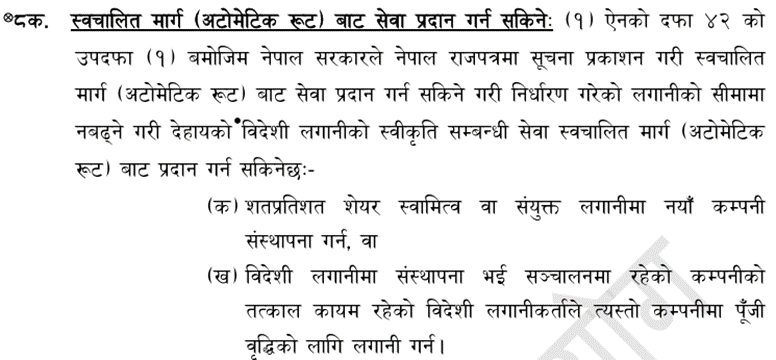
Section 42 of the Foreign Investment and Technology Transfer Act, 2019, empowers the Government of Nepal to introduce an automatic approval mechanism for foreign investment through notification in the Nepal Gazette on 2nd October 2023 (15th Ashoj 2080) intending to simplify the process of foreign investment for attracting foreign investors.
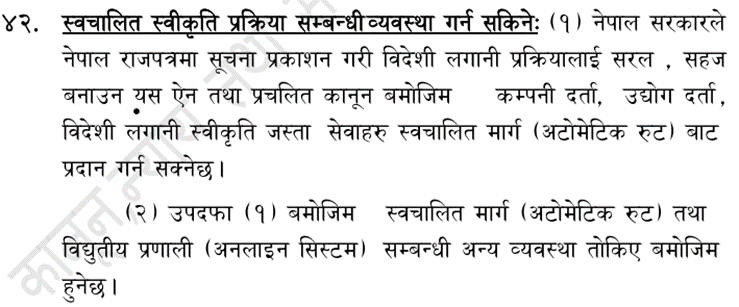
Sec 42. Provision Relating to automatic approval process may be made:
(1) The Government of Nepal may, by notification in the Nepal gazette, provide services, such as registration of companies, registration of industries, approval of foreign investments in accordance with this Act and the prevailing law, through the automatic route in order to make the process of foreign investment simple, easy.
(2) Other provisions relating to the automatic route referred to in sub-section (1) and the online system shall be as prescribed.
Likewise, as per this enabling provision, the Government introduced the automatic route mechanism, and incorporated Rule 8A, into the Foreign Investment and Technology Transfer Regulations, 2021 on 20th April 2023 (7th Baisakh 2080), which established an online, one door system for foreign investment approval, implemented through Department of Industry.
Under the previous notification of Nepal Gazette, 2080, foreign investment was permitted through the automatic route only in seven specified sectors and subject to a maximum investment ceiling of NPR 500 million (50 crore). Investments exceeding this amount required manual approval from the Department of Industry.
Recent Amendment: Removal of Ceiling and Expansion of Sectors
On 4th Falgun, 2082, the Government of Nepal has officially issued a new notification in the Nepal Gazette (Part 5, Issue 64) under Section 42(1) of the FITTA, 2019 through the Ministry of Industry, Commerce, and Supplies.
This notification introduced following three major changes:
1. Removal of NPR 500 million (50 crore) ceiling for investments under the automatic route.
2. Expansion of eligible sectors for automatic approval. Some of the most notable developments are like service sectors increased from 9 to 23 and manufacturing sectors expanded from 19 to 41.
3. Repealed (Cancelled) the previous 2080 notification by replacing the earlier regulatory framework with a new notice of 4th Falgun, 2082.
Expansion of Sector Coverage under the 4th Falgun, 2082 Notification (Automatic Route)
The Government of Nepal specified certain industries eligible for foreign investment approval through automatic route (not exceeding NPR 500 million) through a notification in the Nepal Gazette under Section 42(1) of FITTA 2019 on 15th Asoj 2080. On 4th Falgun 2082, Government of Nepal expanded the following sectors for automatic approval. While some of the sectors have expanded, following sectors that were already covered continue under the automatic route without major alteration.
S.N. | Sectors Coverage | Expansion of Sector Coverage | Sectors That Remain Largely Unchanged |
1 | Energy-Based Industry Expansion | Now covers industries involved in the production of energy from Natural Oil, Fuel and Gas.
| Sectors like Wind energy, Solar energy, Biomass, Cogeneration, Energy feasibility studies, Biogas-based energy continue to benefit from automatic processing. |
2 | Agriculture and Forest-Based Industry Expansion | Food Production industries, Animal feed production, Poultry feed production, Vegetable’s production, Furniture industries, Wood industries, Parqueting, Seasoning, Treatment plant, Plywood, Composite board related wood-based industries.
| Fruit and Vegetable Processing, Tea and coffee processing, Herbal processing, Rubber processing, Cotton processing, Paper, Resin production, remain unchanged.
|
3 | Infrastructure Industry Expansion | Infrastructure related newly brought industries are Conventional centers, Cargo complexes, Commercial complexes, Private warehouses.
| Infrastructure related industries that continue the automatic route include Vehicle parking facilities, Wastewater treatment plants, film city production/ film studios production.
|
4 | Tourism Industry Expansion
| Within Tourism, Healing centers have been newly added.
| Tourism related industries largely remain unchanged. Sectors like Hotels, Motels, Resorts, Restaurant, Amusement Park, Water Park, Conference and sports tourism remain unchanged. |
5 | Service Sector Expansion | Newly covered industries include Printing services, Photography, Yoga centers, Fitness centers, Heavy equipment services, Operation of Physical Infrastructure (such as conference and convention buildings, petrol and petroleum product supply-related pipelines, warehouse and storage facilities, airports, ropeways, sports complexes, roads, electricity houses, railway services, cargo complex services) International Cargo services, Dry Cleaning services, Advertising services, Soil testing services, Health clubs, Minerals Research services, and other related services.
| Several service-sectors remain within the automatic approval eligibility without any change. Such includes Mechanical Workshops, Production business, Hospitals, Nursing Home, Polyclinic, Physiotherapy clinic, Veterinary Services, Heath Treatment which includes services like X-ray, CT scan, MRI, Ultrasound) |
6 | Manufacturing Sector Expansion | This sector has expanded significantly, adding key industrial and construction-related industries such as, cement production, Bricks and tiles production, Iron rod production, Battery Production, Fertilizer production, Lubricant Production, Jaggery production, Rice mill, oil mill, Fabrication related products production, Paint and varnishes production, Paper production, Water purification equipment production, Stationary products, Electronic products, Electric wire, cable production, and other industrial products.
| Includes production of animal feed and poultry feed, Production of Starch and Glucose, Bakery-products production, Confectionery and Biscuit Production, Sugar Production, Beverage Production, Production of textiles, Garments, Production of household electronic equipment, Production of Plastic and plastic goods, Production of bags including suitcases, trolley bag, Production of toiletries products such as soap, shampoo, washing powder, toothpaste, Production of electrical wire, switch, fuse, meter, compressor, Production of materials used for medical, surgical, and orthopedic purposes, Production of cycle, scooter, motorcycle, motor vehicle, Production of materials made from glasses. |
7 | IT and Technology-Based Industries | — | This particular sector remains completely unchanged and continues to enjoy the existing facilities. The IT and Technology based Industries include Technology Park, IT Parks, biotech park, software development, data centers, Data Mining, digital mapping, business process outcomings, Knowledge Process outcoming, Cloud computing services, web portal services, Web design services, Web Hosting services.
|
Minimum Investment Amount: Special Relaxation for IT-Based Industries
As per the Section 3(1) of FITTA 2019, a foreign investor may make foreign investment in any industry, however as per Section 3(3), approval shall not be given for making foreign investment in any industry of an amount that is less than the amount specified by the Government of Nepal by a notification in the Nepal Gazette.


Pursuant to this enabling provision, the Government of Nepal prescribed the minimum threshold of NPR 20 million per investor by a notice published in Nepal Gazette, 2080.
The same Government Gazette has removed the minimum foreign investment threshold for IT-Based industries. Hence, IT-Based industries are exempted from this minimum threshold requirement. Furthermore, the earlier investment ceiling for the automatic approval (previously capped NPR 500 million has also been removed which results in special relaxation for IT-Based industries with no minimum investment threshold and no upper ceiling for automatic approval.
Stakeholders Affected by the Recent FDI Amendments
These recent amendments affect following multiple stakeholders, both positively and negatively.
1. Foreign Investors
2. Domestic Enterprises
3. Government of Nepal
4. Nepal Rastra Bank
5. Employees and Labor Market
6. Consumers
Importance of the change
1. Nepal’s previous restriction for automatic approval for the foreign investment of above NPR 500 million limited large-scale industries. Removing these restrictions makes Nepal more accessible to a wider range of investors.
2. IT-Based industries do not require higher capital investment, instead these industries are more like knowledge, skill-driven. By removing the minimum investment threshold (NPR 20 million) for IT Based industries, Government of Nepal supports in the field of technology and digital development.
3. Previously, investments exceeding NPR 500 million required manual approval from the Department of Industry, leading to time consumption, delay and costly to foreign investors. However, the new notification regarding automatic approval through online one-door systems reduces manual difficulties and leads to efficient, effortless, and effective service.
4. Exemption of minimum threshold (NPR 20million) for IT-based industries encourages small foreign investors and low capital startups as well as promotes emerging IT sectors.
5. New provision relating to automatic approval even for the foreign investment above NPR 500 million attracts foreign investors in higher amounts which ultimately increases employment opportunities, technology transfer, innovations, and competitiveness in Nepal.
Shortcomings or Potential Risks of the Recent FDI Amendments
1. Removing the minimum threshold for foreign investment in certain sectors like IT-based industries could create tension in the thinking of people. If we think practically, investors are unlikely to make an investment that is economically meaningless. Even a small startup requires some capital investment. So, the “zero threshold” without any prescribed floor, may symbolically invite small-scale investment, yet actually misinterpreted by people.
2. Expansion of automatic approval and removal of ceiling can enhance complexities for authorities to monitor and regulate foreign investment.
3. Increment in foreign investment due to automatic approval for all industries might put pressure on medium-scale, small-scale industries, and local companies to compete in the global market.
Visa Facilities for Foreign Investors in Nepal
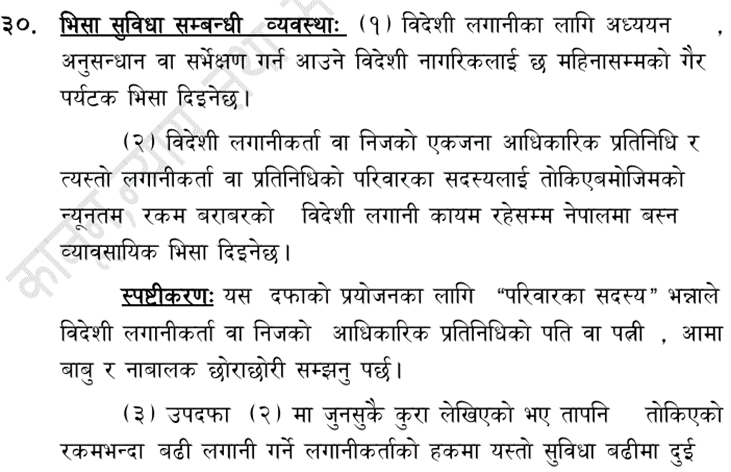
Sec 30 of FITTA 2019 provides a comprehensive framework for visa facilities available to foreign investors, their representatives, and foreign experts associated with foreign-invested industries.
As per Sec 30(1), A non-tourist visa, not exceeding six months, shall be granted to a foreign citizen who visits Nepal to conduct study, research, and survey for the purpose of Foreign Investment.
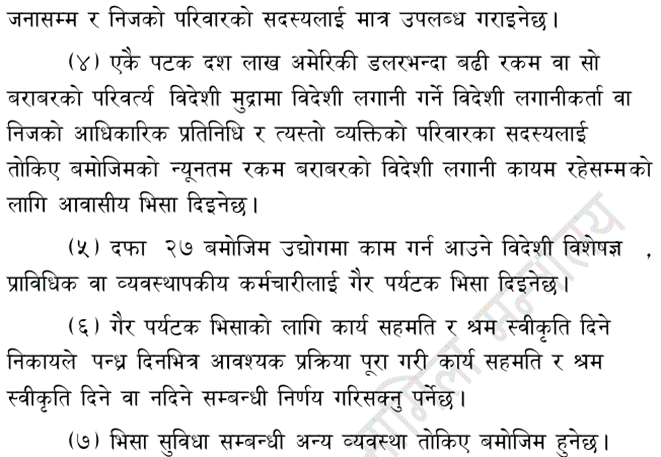
As per Sec 30(2), a business visa shall be granted to a foreign investor, one authorized representative and their family members (husband/wife, father, mother, minor son/daughter). This visa remains valid as long as the foreign investment equal to the prescribed minimum amount is maintained. However, as per Sec 30(3), if the investor makes an investment exceeding the prescribed amount, the facility is limited to a maximum of two persons and their respective family members.
As per Sec 30(4), residential visa shall be granted to a foreign investor who makes foreign investment exceeding USD 1 million (or equivalent convertible foreign currency) at one time, or to the authorized representative and family members. The visa remains valid as long as the minimum investment amount is maintained.
Potential Misuse of Visa Facilities by Foreign Investors in Nepal.
While sec 30 of FITTA, 2019 provides various visa facilities to foreign investors, their representatives, and family members. Though these provisions reflect the liberal approach toward attracting foreign investors, there are concerns regarding the possible misuse in practice.
1. Absence of Minimum Investment Threshold in IT-Based Industries.
Upon the removal of the minimum threshold in the IT sectors, there is a possibility of establishment of an IT company with minimal foreign investment, obtain foreign investment approval and become eligible for a business visa under sec 20(2) of FITTA 2019. There is always the possibility of companies remaining inactive after obtaining the visa through capital investment temporarily just to qualify. Hence, this creates a risk of visa-oriented investment rather than productive foreign direct investment in Nepal.
2. Repeated Use of Business Visa through Renewed Approvals.
The cyclical use of business visas to stay in Nepal for a longer period could be another loophole. A foreign investor may initially enter Nepal on a tourist visa (valid up to 150 days) as per Immigration Regulation, 2051 B.S. Sec 6(2), obtain foreign investment approval and get a business visa and upon expiry of such visa, re-apply approvals and obtain a fresh business visa, and continue this cycle repeatedly. This loophole does not make it difficult for foreign nationals to stay in Nepal for one to two years or longer without actively operating the approved business. On top of that, the government of Nepal lacks individual level monitoring of foreign investors after visa issuance.
Way Forward
Nepal’s reformation effort toward foreign investment journey based on the objectives to attract, and expand Foreign Direct Investment. Since the early 1990s Nepal has made efforts toward positioning itself as an investment-friendly destination. Foreign Investment and Technology Transfer Act, 1992 was enacted to attract and utilize the foreign investment in Nepal.
The early optimism toward foreign investment was weakened by a decade-long Maoist Insurgency (1996-2006). Likewise, COVID-19 severely disrupted the foreign investment. Although Nepal has hosted three Investment Summits and secured large commitments toward foreign investment in Nepal, execution of such commitments still remains a challenge.
The government of Nepal frequently changes its policy regarding minimum investment thresholds. For instance, IT-Based industries were first grouped under a general threshold and later completely exempted. Thresholds are revised without proper research toward its potential risks and misuse.
Moving ahead, the Government of Nepal should prioritize policy stability over frequent amendments. The government should adopt evidence-based and sector-specific reforms rather than an easy way out, like removing the minimum threshold completely in IT sectors, instead should research and adopt standards tailored to it.
Starting a business in Nepal?
Register your company online — name reservation, MOA/AOA, PAN/VAT and OCR filings, all in one place.


Related Blogs

Subscribe to our newsletter
Get latest news and updates directly to your email.