KKFC vs KFC Dispute & Trademark Registration in Nepal
Khatapana
February 27, 2026 12 min read
 Reviewed by Kailash Panday, Chartered Accountant & Corporate Lawyer
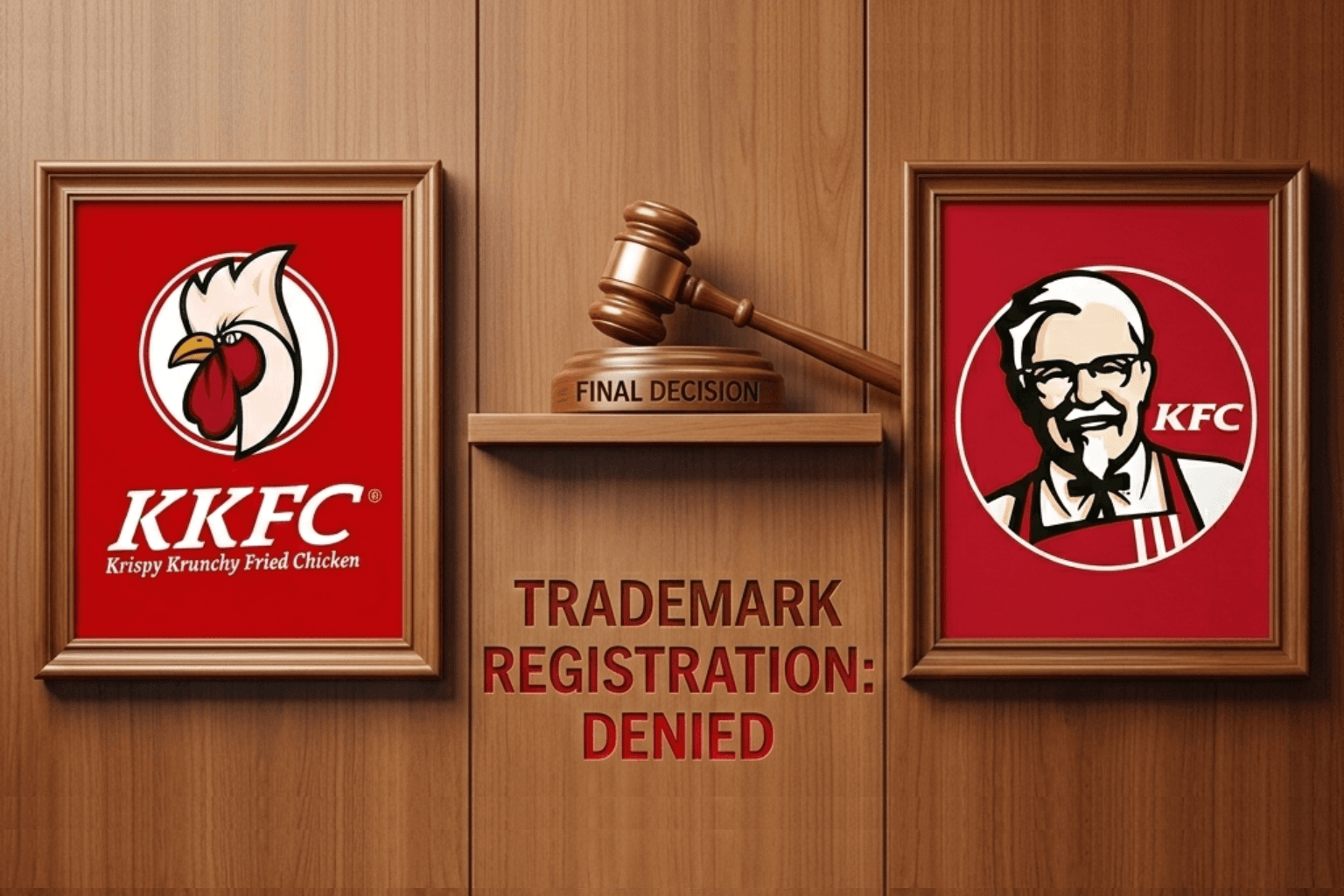
What was the KKFC vs KFC dispute really about? Learn how KFC won the legal battle, what happens next, and key lessons for Nepali businesses regarding trademark registration in Nepal
I made a rest stop at a small store while travelling back to my hometown recently. Without much thought I ended up grabbing a bottle of coke from the fridge and paid for it. As I headed back to my bus, I noticed that the bottle cap was unusually thick and unlike the ones that I have opened before. Naturally, I assumed there might've been a manufacturing defect but it tasted even more different than what I was used to. Upon closer inspection I realised that it was not Coca Cola but Club Cola, a close imitation that looked very similar to the original brand.
We must have all seen some local brands whose logo, designs, color scheme look very similar to famous internationally recognized brands such as Club Cola imitating the popular beverage brand Coca Cola, Royal Tag instead of the whiskey brand Royal Stag. Similar violations have occurred on an international level with Louis Vuitton suing a chicken brand Louis Vuiton Dak for selling chicken under a similar name as the brand, similarly Starbucks suing a small coffee chain Sambucks claiming the similarity in names.
These businesses making a few tweaks in spellings, designs or logos can seem like a harmless or even clever marketing strategy but under trademark law, such minor differences can have big consequences for consumers as well as companies that value reputation, trust and quality of a brand.
You’ve also probably seen recent headlines such as “KFC wins trademark case against KKFC.” But what does that actually mean? What constitutes a trademark infringement? What rights does registration of trademarks give and protect? Does that mean KKFC has to shut down? Did they break the law? Can Nepali businesses use similar names to famous global brands?
Let’s break this all down in simple terms. Because understanding trademark registration in Nepal is essential to make sense of this dispute and its wider impact on businesses and consumers.
First, What is a Trademark?
According to section 2(c) of Patent Design and Trademark Act 2022,“Trade-mark" means word, symbol, or picture or a combination of all three to be used by any firm, company or individual in its products or services to distinguish them with the product or services of others.

In simple terms, a trademark consists of any signs or combination of signs that is capable of distinguishing one's goods or services with the goods and services of others. These signs can include names, letters, numerals, figurative elements, combination of colors as well as combination of signs.
Simple examples of trademarks we would mostly recognize would be marks of apps like TikTok, Facebook, Google, beverage brands like Coca Cola, Pepsi, domestic brands such as Wai Wai, eSewa etc.
Without proper trademark registration in Nepal, businesses may struggle to enforce these rights and prevent misuse of their brand identity.
The one who holds ownership of a trademark has exclusive economic rights in relation to that particular mark meaning, the trademark owner can use the trademark independently. They can also ban another company or firm from using it without authorization as well as prevent usage of trademarks that are similar in writing, drawing, speaking, listening and other representation and likely to mislead consumers. In addition to that trademark holder can also license the trademark for use by another firm or company for a specified purpose and can sell and transfer it to another firm or company.
So various economic rights are provided to trademark owners from usage, sell, transfer, and in case of violation of such exclusive economic rights i.e. a similar trademark likely to confuse consumers is brought into the market without the consent of the trademark holder, trademark infringement occurs.
What is a Well Known Mark and Passing off of Trademark?
While discussing trademarks, it is also essential to discuss the concept of well known marks. A mark that has gained widespread public recognition, even outside its market jurisdiction is a well known mark. Think of brands like KFC, Coca Cola, Facebook, which in the present time are recognized all over the world. These types of marks can enjoy enhanced protection nationally and internationally even when they haven’t been registered. Another question widely associated with well known marks is that what makes the marks well known? To answer that question, World Intellectual Property Organization (WIPO) has introduced certain features to determine if the trade mark is a well known mark: (Joint Recommendation Concerning Provisions on the Protection of Well-Known Marks 1999)
a. Widespread recognition: The mark is recognized by a large portion of the population in a specific area or globally.
b. Duration: Mark used for a long period of time by a specific company
c. High advertising and promotion: heavy marketing efforts leading to consumer awareness and recognition of the brand.
d. Recognition by competent authorities: The competent authorities in a jurisdiction decide that the mark is well known.
e. Established market reputation: The trademark has been registered and used for a long period of time and has gained recognition in the market and consumer association of the mark with certain products.
f. There is a brand value associated with the mark.
Now when someone tries to take advantage of the goodwill and reputation built by these well known trademarks with the intention to take unlawful advantage e.g. Usage of similar name, and imitation, it is known as passing off of a trademark.
So, Why is there a Need for Protection of Trademarks?
From a business’s point of view, a trademark is a unique mark that can set your brand apart from your competitors. It can help to distinguish the products as well as help the products stand out from the competitors and make identification of business possible. Similarly, it can also help build your brand image and reputation. If the products are well liked, it can create a loyal client base and enhance trust, goodwill and reputation of the brand. As discussed earlier, trademarks also provide exclusive economic rights that make it possible to sell, license and franchise temporarily which can be an additional revenue boost for the business. Trademarks rights will also help manage and fight infringement since they can prevent others from using similar marks which can ensure that the brand value and reputation remains intact and there are no counterfeit products in the market.
This is why trademark registration in Nepal plays a crucial role in protecting brand value and ensuring fair competition in the market.
From the consumer’s point of view, a consumer might have purchased a product for a long period of time or looking to purchase a product with a certain level of quality, a trademark can help consumers identify such products ensuring that it comes from a reputable manufacturer. To ensure that consumers buy quality goods with good reputation, customer satisfaction and goodwill, trademarks play an important role. Because of the brand’s reputation the goods can be bought simply by viewing the trademarks and without the need to inspect every single product which also leads to commercial efficiency by reducing search costs for the consumers. It also puts responsibility upon the businesses to deliver a certain level of quality of the product to ensure that the reputation and good will that the brand has earned doesn’t get tarnished and so the consumers are able to get quality products for a long time.
How Does Trademark Registration in Nepal Work?
Trademark registration in Nepal is done through the Department of Industries (DOI). The title to the trademark of a business can be acquired after registration at the DOI. The process of trademark registration in Nepal provides legal recognition and exclusive rights over a brand’s identity.
Here’s the registration process in brief:
Step 1: Application
A person who desires to register a trademark may submit an application to DOI with following details
- Four specimens of such trade mark including the description of the mark
- Details (name, address, phone number, email) of the applicant,
- NICE classification,
- Nature of transaction or goods and services for which the trademark is used,
- Company/Industry/Firm Registration Certificate
- PAN registration certificate and tax payment details
- If approval is required from any concerned department as per applicant’s purpose those documents
- Minute, letter of decision made by the company/firm/industry/organization
- Documents related to power of attorney if granted and document identifying the authorized person.
- Payment voucher
For foreign trademarks some extra details are required,
- Certified copy of valid trademark registration certificate registered abroad
- Document regarding priority date if priority is claimed
- Power of attorney for nomination of representative, address of correspondence in Nepal, document revealing identity of a person receiving power of attorney.
Step 2: Examination
The department will then conduct necessary investigation regarding the documents and on the trademarks checking if it is unique or resembles other trademarks.
Step 3: Publication
If accepted, the mark is published in the Industrial Property Bulletin. Industrial Property Bulletin is used by the Department of Industries to publish the details of trademark applications that have been filed to allow circulation of information on new applications before registration of trademarks. It provides an opportunity for the concerned businesses to inspect or oppose the trademark application. Therefore, if there is any claim against the registration of published trademarks, the concerned body could file a complaint with the department within 90 days from the date of publication of this bulletin. If nobody contests the trademark application, after 90 days the said trademarks would be registered.
It also includes International Classification of Goods & Services for the purposes of Registration of Marks: NICE Class Heading which is a classification of goods and services for the registration of marks. The structure includes classes 1-34 which covers goods and 35-45 which covers services. Some examples include medicine (class 5), vehicle (class 12), jewellery (class 14), communication (class 39) etc.
The term of protection of the mark is 7 years but it can be extended indefinitely for the period of 7 years at a time with the renewal fee being five thousand rupees.
Step 4: Opposition Period (90 days)
As mentioned earlier, before the trademark is registered, any concerned business, party that believes that the registered trademark infringes on theirs, is misleading, violates trademark rights within 90 days can file a complaint within the department to stop the registration of such trademark. Effective trademark registration in Nepal ensures that such disputes can be formally reviewed and resolved through established legal mechanisms.
Step 5: Registration or Dispute
If no opposition = trademark registered. The department will then issue a registration certificate in the name of the trademark owner.
If opposition is filed = dispute proceedings begin.
This opposition system is exactly what led to the KKFC vs KFC dispute.
How did the KKFC and KFC dispute start?
All the way back in 2017 (2074 B.S.), KKFC a Nepali brand, applied to register its trademark. The brand name, colors and presentation all resembled KFC which is a well known brand internationally. Similar to the process described above, KFC objected to the registration claiming that the KKFC was using a brand name similar to KFC which was misleading to the consumers. KKFC’s position was essentially that it was an independent brand, and it simply sought legal registration of its trademark.
So the major legal questions regarding the infringement of trademarks in this context could be:
- How similar were the KFC and KKFC trademarks?
- Could KKFCs trademark cause likelihood of confusion amongst the consumers?
- Was KKFC trying to pass off the trademark causing trademark infringement?
First and foremost, the names KFC and KKFC sound almost similar, the only exception being KKFC was trying to register its name with an additional “K” but majority of the mark excluding the K is still KFC which is not new or distinguishable from the brand that already exists. Both restaurants operate in similar areas i.e. fast food services. They also have a similar menu selling fried chicken, burgers, and sides. KKFC’s logo also follows a similar color scheme to KFC’s signature red and white color scheme.
Therefore, because of their overall similarities of product name, category of service, branding and color scheme, there is a high possibility a regular consumer might get misled about whether KKFC is a separate brand with a distinct identity and services or if it is part of the KFC brand. Therefore the situation looked a lot like KKFC trying to pass off as KFC by imitating its brand design and trying to attract and mislead customers based on KFC’s reputation as a well known international brand.
Some Other Cases Regarding Well known Trademarks and its Protection
There have been several other cases throughout the years regarding the protection of trademarks.
One of the prominent cases regarding trademark protection in Nepal is Kansai Nerolac Paints Ltd vs. Rukmini Chemical Industries Pvt Ltd. [NKP 2077, DN 10761] where Kansai Nerolac Paints was barred from using the Kansai Nerolac brand because Rukmini Chemical Industries had already registered that trademark. DOI initially refused trademark registration because Rukmini Chemical Industries had already filed the trademark. However, the Supreme Court recognized Nerolac as a well known brand among customers with sales outside Nepal and owned by the Japanese company yet again establishing precedent for protection of well known trademarks.
Similarly, in the case of Amrit Distilleries Pvt. Ltd. vs Facebook Inc., both DOI and High Court established that Amrit Distilleries couldn’t register the trademark FACEBOOK because it was a well known mark. Although Amrit Distillery claimed that they were trying to register the mark under class 33 which dealt with alcohol products, the court still established that trademarks should not dilute the reputation of existing brands and the distillery had no goodwill or reputation of their own and was intending to free ride on goodwill and investment made by facebook.[Nepal Journal of Legal Studies, vol.2,issue1, 2019-2020, pg.213]
Protection of Well Known Trademark in International and National Law
Department of Industries (DOI) does provide the opportunity for opposition before registration of trademark under Trademark Directives 2072 under which if similar nature of trademarks are being registered, the trademark holders could oppose the registration of the trademark which is exactly what KFC did and then the dispute proceedings began. The conflict highlights how trademark registration in Nepal can become a critical battleground when brand identities overlap.
Along with that Nepal also has a commitment to protect Trademarks and well known marks under the obligations of Paris Convention for the Protection of Intellectual Property 1883 and Trade Related Aspects of Intellectual Property Rights (TRIPS).
Article 6 bis of Paris Convention prohibits the registration, use of trademark which is a direct reproduction, imitation, translation of a well known mark which has the likelihood of creating confusion amongst the consumers.
Similarly, Article 16 of TRIPS, protects exclusive economic rights of the trademark owner and similar to the Paris Convention, restricts the registration of well known marks likely to cause confusion. These international commitments strengthen the framework for trademark registration in Nepal, ensuring protection for both domestic and foreign brands.
The Verdict: What Decision Was Made, and By Whom?
The department of industry (DOI) made a decision in favor of Kentucky Fried Chicken (KFC). The department decided not to register KKFCs trademark. It was also decided that KKFC cannot use the trademark for production and sale and distribution. The decision reinforces the importance of proper trademark registration in Nepal and adherence to intellectual property laws.
Does this mean that KKFC will shut down? What Will Happen Next?
The verdict doesn’t mean that KKFC needs to shut down. There are following possibilities:
- A rebrand: KKFC can rebrand under a new name then continue its business activities.
- Right to Appeal: If KKFC is unsatisfied with the decision made by the department, it can appeal the decision in high court within 35 days of the decision being made under section 27of Patent Design and Trademark Act 2022.

- Fine and confiscation: However if it continues conducting its activities with the disputed branding, under section 19 of Patent Design and Trademark Act, the department may take action for illegal use of such a trademark which imposes a fine and confiscation of the goods with disputed branding.

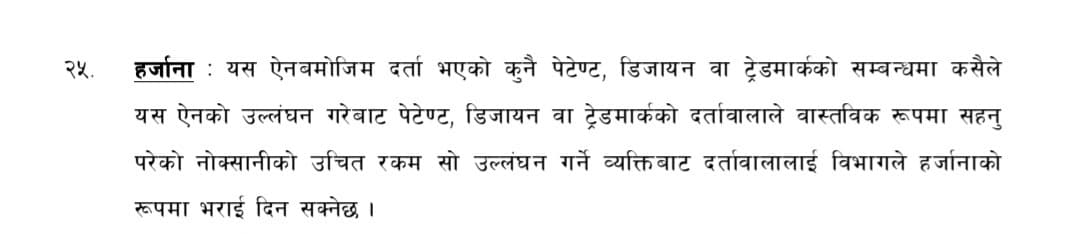
- Liable to pay compensation: Under section 25, if KFC has suffered losses as a result of violation, KFC may also be entitled to compensation.
How is this Case Relevant to Nepali Businesses in General?
To many businesses, this decision serves as a wakeup call. There are various businesses based on imitation of foreign brands, logos, and colors that operate with just slightly altered names. Examples of these brands can be found across various industries such as beverages (e.g. coca cola and club cola), fashion (e.g. miu miu and min min). These types of branding tactics are only good for gathering short term attention towards the brand. Consumers might gravitate towards these brands because they are curious about how it compares to the original or by a sense of familiarity. However such branding practices open the businesses up to legal action, forced rebranding in case of a legal action taken against the company, financial loss because of the rebranding costs, fines and compensation imposed and even damage to reputation. The brand might lose the consumer base that it created because of the legal issues and rebranding. Businesses that neglect trademark registration in Nepalal risk legal disputes, forced rebranding, and loss of consumer trust.
Key Lessons for Entrepreneurs in Nepal
The key focus of a business should be long term sustenance rather than short term gain and recognition. To ensure long term sustainability, it is essential that the business focuses on creating a distinct identity and builds its own brand value. Through sustained unique branding and a focus on providing consumers with a quality product/service, your brand will be able to build a clientele that trusts you and your products which in turn helps the firm gain long term financial viability in the market. Early trademark registration in Nepal is one of the most effective ways to safeguard a business from future conflicts.
Sometimes, prior to registration, there is a lack of proper research on trademarks that have already been registered which leads the firms to create trademarks that are similar to ones that already exist. Therefore, proper research on the market that your product is entering into and research on trademarks that already exist in the market prior to registration of new mark is an asset which helps avoid registration of trademarks that look.
To ensure that the trademark is not infringed or copied it is essential to register it early. It helps avoid future conflicts and disputes. It should also be kept in mind that copying seems smart at first but legally it can open the company to potential trademark infringement claims and lawsuits.
Final Thoughts
The KKFC and KFC issue doesn't only highlight the questions of imitation and practices to mislead consumers, but it also highlights the gap in the legal system and enforceability problems that has been created throughout the years because of lack of updates in Patent Design and Trademark act. Various developments have occurred throughout the years in the field of intellectual property law. Although policies have been introduced to somewhat cover well known marks along with trade dress, collective marks, sound marks etc, the law is still vague and lacks clarity on many things such as protection of well known marks, passing off, brand dilution etc. This continuously evolving nature of the market demands frequent updates in law which focus on reducing ambiguity and protect marks more effectively. Strengthening trademark registration in Nepal and its enforcement will be essential for fostering trust, innovation, and foreign investment.
Businesses and markets here openly sell and even proudly market the product as a first-copy or a second-copy product and no action is taken against them to protect widely known marks. This normalisation and acceptance of imitation not only undermines intellectual property laws but also makes foreign investors representing the original brand reluctant to invest in such a market. Even when they do invest, there’s no action against brands selling counterfeit products with imitated logos or the decision making process when businesses do take action takes a very long time to conclude. This yet again ties back to weaker enforcement of law and slow moving justice delivery even when it is obvious that a brand is imitating a well known brand. Therefore, addressing the issues that haven’t been addressed in the pre-existing act, strengthening action against counterfeits as well as reducing procedural delays in case of violation are key to ensuring trademark protection and foreign investment of authentic brands.
Starting a business in Nepal?
Register your company online — name reservation, MOA/AOA, PAN/VAT and OCR filings, all in one place.


Related Blogs

Subscribe to our newsletter
Get latest news and updates directly to your email.