How to Earn Money Online in Nepal: A Guide to Paying the Lowest Tax Rate
Khatapana
February 13, 2026 21 min read
 Reviewed by Kailash Panday, Chartered Accountant & Corporate Lawyer
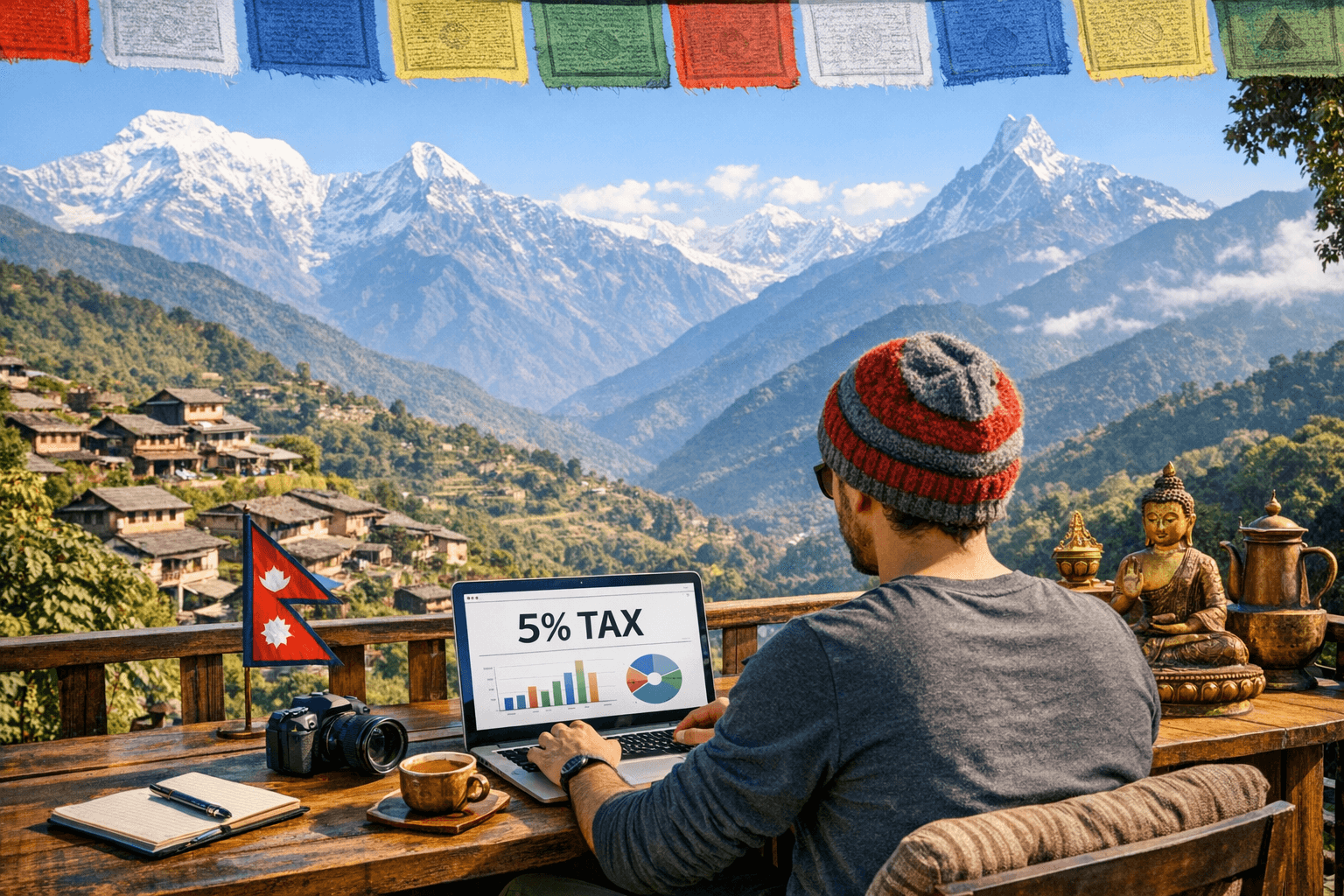
Want to earn money online in Nepal? Learn the freelance tax rate in Nepal, who qualifies for 5%, and how to stay compliant and avoid penalties.
TL;DR
- The Sweet Deal - Foreign client pays you = you’re taxed at 5% rate under the current tax rate in Nepal for foreign-sourced income. Nepali company pays you the same amount = up to 36% tax. Why the disparity? The government wants foreign dollars coming into Nepal, so they reward you with lower taxes.
- The Trap - Most beginners think: "Bank received my money = I'm legal." Wrong. You need three separate things: PAN card, tax payment, AND tax clearance certificate. Missing any one = you're not compliant, even if money is in your account.
- Why This Ruins Dreams - Take ‘Suman’ as an example. Earned $2,000/month for 3 years. Applied for an Australian student visa. The Embassy asked for tax clearance. He had none. Visa rejected. Admission lost. All because he thought the bank receiving money was enough.
- The Fix Is Simple (Solution) - Step 1: Get PAN, Step 2: Tell your bank to deduct 5% tax (if they don't, you’ll have to do it manually )
- The Real Cost of Ignoring Tax - Penalties: NPR 100 every day you're late + 15% interest yearly. But worse? No visa, no loan, no proof your income is legal. The 5% tax is a gift, don't waste it by skipping paperwork. Comply now or pay 3x later when you desperately need that visa.
Meet Suman: A Wake-Up Call
Suman had been freelancing for three years, earning $2,000 monthly from a US-based client. The money came as remittance directly to his NPR account. Life was good. He was saving money, helping his family, and building his career. Then he applied for a master's program in Australia.
"Show us your tax clearance certificate," the embassy said.
Suman stared blankly at the visa officer. "But I receive money legally through the bank. It shows up in my bank statements. Isn't that enough?"
It wasn't. It wasn't even close.
He had no tax clearance certificate. No proof that he'd ever filed tax returns. No documentation that the government recognized this income as legitimate business earnings. When he rushed to the tax office in a panic, they asked for three years of back taxes plus penalties. He spent weeks trying to sort it out, but the visa deadline passed. His admission offer expired. His dream of studying abroad evaporated because of something he didn't even know he needed.
Like many people exploring how to earn money online in Nepal, Suman believed receiving payments through the bank was enough. This story repeats itself more often than you'd think, just with different details because many freelancers don’t understand how the tax rate in Nepal applies to foreign income. Sometimes it's someone trying to buy a house who can't get a loan. Sometimes it's a freelancer who needs a Tax Residency Certificate so their international client stops withholding 20% of their payments. Sometimes it's just the slow-building anxiety of knowing you're not compliant and wondering when it will catch up with you.
Let's make sure this doesn't become your story.
Understanding Why There’s a Separate Tax Rate in Nepal for Freelancers
Before we dive into the mechanics of how to pay taxes, it's worth understanding why the system works the way it does. This context will help you understand the larger picture and make better decisions.
Think about it from the government's perspective for a moment. A regular employee in Nepal earning NPR 100,000 per month faces progressive tax rates that can go as high as 36% on income above NPR 2 million annually. Meanwhile, a freelancer earning the exact same amount from foreign clients pays just 5%. On the surface, this seems wildly unfair to traditional employees. This is one reason why discussions about how to earn money online in Nepal often focus on foreign clients rather than local work.
But the government isn't making this decision out of favoritism for freelancers. They're making a calculated economic choice about foreign currency. Nepal is perpetually hungry for foreign exchange reserves. The country imports far more than it exports, and maintaining adequate foreign currency reserves is a constant challenge for Nepal Rastra Bank. When you earn money from a client in the United States or Europe or anywhere outside Nepal, you're bringing foreign currency into the country. That money gets converted at Nepali banks, adding to the nation's foreign exchange reserves.
This 5% preferential tax rate in Nepal is designed to encourage foreign currency inflows; basically, it’s an incentive. The government is saying: "We want you to keep earning foreign currency and bringing it into our banking system. We'll make it easier on you tax-wise if you do." Section 95(ka) of the Income Tax Act explicitly creates this preferential treatment for foreign-sourced service income. It's not a loophole or an accident. It's a deliberate economic policy.
This also explains why the tax is deducted at the point of currency conversion when you have a proper USD account. The bank is serving as the checkpoint where foreign currency enters the formal financial system, and that's where the tax gets collected. It's elegant in theory, though as we'll see, the implementation has some significant gaps.
Understanding this helps you see that the tax system isn't designed to trap you or make your life difficult. It's actually designed to encourage what you're already doing. The complications arise not from malice but from the gap between policy intent and administrative reality.
How To Earn Money Online in Nepal & Pay Just 5% Tax?
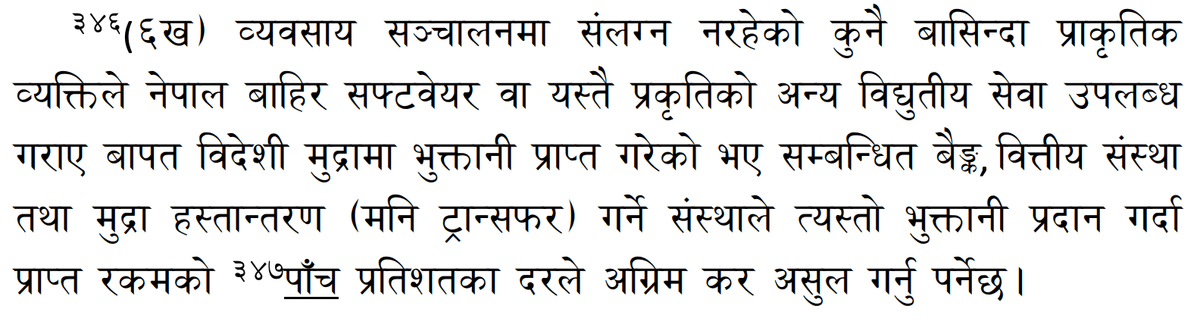
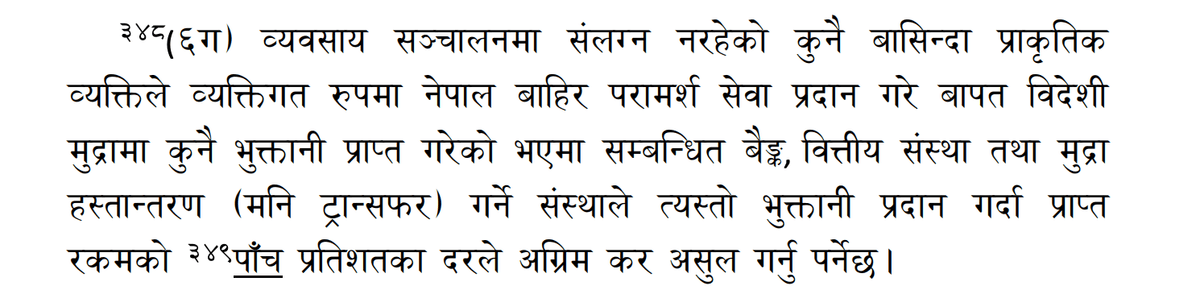
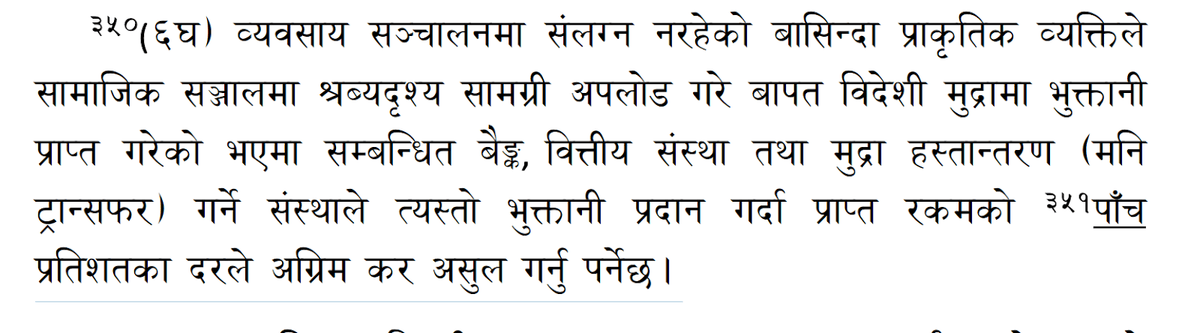
These are the three categories through which one can earn money online, in turn paying a reduced 5% tax rate in Nepal:
Software and Electronic Service (Sub-section 6kha): People who provide software development or similar electronic services to clients outside Nepal and receive payment in foreign currency.
Consulting Service (Sub-section 6ga): People who provide consulting or advisory services to clients outside Nepal and receive payment in foreign currency.
Social Media Content Creation (Sub-section 6gha): People who upload audio-visual content on social media platforms and earn money in foreign currency from those platforms.
These are the same categories most commonly promoted in guides about how to earn money online in Nepal.
The Mandatory Requirements
To qualify for the 5% rate, which is among the lowest effective tax rate in Nepal for individual income, you must meet ALL of these conditions:
- You must be a resident natural person. This means you're an individual living in Nepal, not a company or partnership.
- You must not be engaged in business. This means you haven't registered as a company or formal business entity. You work as an individual freelancer with a registered PAN.
- You must receive payment in foreign currency. The money must come in USD, EUR, GBP, or other foreign currency, not Nepali rupees.
- Payment must be made through official Channels (Nepali Bank Account necessary), Banks, financial institutions, or licensed money transfer operators must handle the transaction and deduct the tax. Furthermore, an individual must register with a Nepali Bank in order to make sure the tax authorities recognise the agency receiving the amount.
- Your client must be outside Nepal. The person or company paying you must be located abroad. Same work for a Nepali client doesn't get the 5% rate.
You don't get the 5% rate if you are:
- A registered company or business - Even if doing the same work, companies pay different tax rates.
- Working for Nepali clients - Domestic income is taxed at progressive rates ranging from 1% to 36%. This highlights the stark contrast in the tax rate in Nepal between foreign and domestic income.
- Receiving payments in NPR only - The foreign currency requirement is essential, even if you are receiving
- Using informal payment channels - Hundi or cryptocurrency transfers that bypass banks don't qualify.
These requirements shape how many people approach how to earn money online in Nepal, prioritizing international clients.
The Three Pillars of Freelance Tax Compliance
Every compliant freelancer in Nepal needs to understand three distinct components of the tax system. Most people confuse these or think one substitutes for another, which leads to problems down the road.
First Pillar: PAN Registration
Your Permanent Account Number is your identity in the tax system.Without it, you essentially don't exist as far as the Inland Revenue Department is concerned. Getting a PAN is surprisingly straightforward. You can do it online through the IRD portal or visit any tax office in person. You fill out Form 01, provide your citizenship certificate and a couple of passport photos, pay a nominal fee that's barely worth mentioning, and within a few days you have your PAN card.
The mistake people make is waiting. They think, "I'll get it when I really need it," or "I'll register once I'm earning more consistently." This is backwards thinking. Get your PAN before your first freelance payment arrives. There's no downside to having it early, and there are numerous downsides to getting it late, starting with the fact that you can't properly document your early earnings.
Your PAN isn't just for taxes. It becomes your financial identity number for all sorts of transactions in Nepal. Think of it like a foundation for a house. You don't wait until the walls are up to pour the foundation. You start with it.
Second Pillar: Tax Payment
This is where things get confusing, and it's where the system has the biggest gaps between what should happen and what actually happens.
The ideal scenario works like this (ensuring compliance with the 5% tax rate in Nepal for foreign earnings): You open a USD account at a Nepali bank. You submit your PAN to the bank and explicitly request that they deduct 5% tax on all foreign currency conversions. When your client pays you $1,000, the bank converts it to NPR, automatically deducts 5% (which would be $50 or about NPR 6,500 at current exchange rates), and credits your account with the remaining 95%. The bank then remits that tax to the government on your behalf. This is clean, automatic, and relatively painless.
But reality often diverges from this ideal. Many beginners learning how to earn money online in Nepal receive payments as remittances without realizing the tax implications. Many freelancers receive their payments as remittances in NPR rather than as foreign currency conversions. In the banking system's eyes, remittances are treated differently. The bank assumes a remittance is a gift from family abroad or personal support, not business income. So they don't deduct any tax. You receive 100% of the payment, which feels great in the moment but creates a problem: you're now responsible for calculating and paying that 5% tax yourself.
If you're in this situation, you're supposed to make advance tax payments quarterly. The system expects you to estimate your annual income and pay 40% of your total estimated tax by mid-January, 70% by mid-April, and 100% by mid-July. Then when you file your annual return after the fiscal year ends, you settle up any difference.
The brutal reality is that very few freelancers actually do this. The money comes in, it's already in NPR, there's no visible deduction, and it's easy to spend it all without setting anything aside. Then the end of the fiscal year approaches, and suddenly you owe a lump sum that you haven't budgeted for. This is how people end up in tax debt.
Even freelancers who have the best intentions struggle with this because the system isn't designed for the irregular, variable nature of freelance income. One month you might earn NPR 150,000, the next month NPR 50,000, the following month nothing because a client delayed payment. Estimating your annual income and making advance payments based on that estimate feels like a guessing game. But it's still your legal obligation.
Third Pillar: Tax Clearance
This is the piece that Suman was missing, and it's the piece that most freelancers don't understand until they desperately need it.
Tax clearance is not the same thing as paying taxes. We’d like to repeat that because it's crucial: paying taxes and having tax clearance are two different things. Even if taxes are deducted at the prevailing tax rate in Nepal, clearance requires filing returns. You can have the bank deduct 5% from every payment you receive for five years straight, and you still won't have tax clearance if you never filed annual returns.
Tax clearance is a certificate that proves you've filed your tax returns and settled your tax obligations. It's the government's official stamp that says, "Yes, this person is compliant with tax law." You need this certificate for an astonishing array of important life events. Student visa applications almost always require it. Bank loan applications for any significant amount require it. If you're applying for certain government contracts or permits, you need it. If your foreign client needs you to obtain a Tax Residency Certificate so they can avoid withholding taxes in their country, you can't get the TRC without first having tax clearance.
The process of getting tax clearance starts with filing your annual return. Once you've filed and paid any balance due, you can apply for the clearance certificate through the IRD portal. If everything is in order, you usually receive it within days. But here's the thing: you need to do this proactively. You can't wait until you need it for a visa application that's due in three days. If there are any issues with your filings or payments, sorting them out takes time.
Think of tax clearance as your proof of financial legitimacy. In a world where informal economic activity is common and cash transactions dominate, having formal documentation that the government recognizes your income is incredibly valuable. It's what separates someone who just claims to earn money from someone who can prove it in ways that institutions recognize.
The Critical Distinction Between Theory and Practice
The Nepali tax system for freelancers looks elegant on paper. There's a clear 5% rate. There's a straightforward process. There are defined deadlines. But the implementation reveals gaps that trap people who don't understand the nuances.
Let’s walk through a common scenario that illustrates the problem. Say you're a talented graphic designer, and you land a client in the UK through Upwork. They pay you through Payoneer, which then transfers the money to your Nepali bank account. The payment shows up as a foreign remittance in NPR. Your bank statement shows the money arrived. You can spend it, save it, or send it to your family. Everything seems fine.
But from a tax compliance perspective, nothing has happened. Your bank didn't deduct tax because it came as a remittance. You haven't registered the income with IRD. You haven't paid the 5% manually. You haven't filed any returns. As far as the tax system is concerned, this income doesn't exist, which means you also don't exist as a legitimate income earner.
Now fast forward two years. You've built up a solid client base. You're earning NPR 200,000 per month consistently. You decide to apply for a loan to buy a motorcycle. The bank asks for tax clearance for the past three years. You suddenly realize you have none of this documentation.
You go to the tax office. They calculate what you owe: 5% on all your earnings for the past two years. Let's say that's NPR 240,000 total in taxes. But then come the penalties. Late filing fees of NPR 100 per day for 730 days is NPR 73,000. Interest at 15% annually on the unpaid tax is another NPR 72,000. Your NPR 240,000 tax bill has ballooned to NPR 385,000, and you still need to file all the back returns and wait for them to process before you can get tax clearance. The loan opportunity passes you by.
This situation is increasingly common among those figuring out how to earn money online in Nepal through platforms like Upwork or Fiverr, and it's not because people are trying to evade taxes. It's because the system has a fundamental mismatch between how freelancers actually receive payments and how the tax collection mechanism is designed to work.
The bank-based automatic deduction works perfectly when you're receiving direct USD deposits that the bank converts. It breaks down completely when payments flow through international payment platforms that convert currency before it reaches Nepal, or when clients send money through remittance channels rather than commercial transfers. The IRD hasn't fully adapted to these realities of modern freelance work, so individual freelancers bear the burden of navigating the gap.
Real Scenarios and How to Navigate Them
Let me walk you through several real situations that freelancers face, with detailed explanations of how to handle them properly.
When Your Bank Won't Deduct Tax
You've done everything right. You registered for PAN immediately. You went to your bank, showed them your freelance contract with your foreign client, filled out KYC declaring yourself as a freelancer, and explicitly requested that they deduct 5% tax on incoming foreign payments. Then your first payment arrives, and the bank credits 100% to your account. No deduction happened.
This is frustratingly common, and it happens for several reasons. Sometimes the bank's internal systems aren't properly configured. Sometimes the staff member who processed your request didn't actually enter it into their system correctly. Sometimes your payments are coming through channels that the bank doesn't recognize as triggering tax deduction requirements.
Your first step is documentation. Go back to the bank and request a meeting with the branch manager, not just a teller. Bring your freelance contract, your PAN card, and your bank statements showing the foreign payments. Put your request in writing. Ask them to deduct 5% from all future foreign-sourced payments and to provide you with tax deduction certificates for each transaction.
If the bank continues to refuse or simply doesn't follow through, you have two options. First, you can switch to a bank that properly handles freelancer accounts. Some banks in Kathmandu are more experienced with freelance taxation than others, particularly those with larger foreign currency operations. Ask other freelancers which banks they use successfully.
Second, if you can't or don't want to switch banks, you must handle it yourself. This means setting aside 5% of every payment in a separate savings account that you don't touch. Treat it as if that money doesn't belong to you, because in a real sense, it doesn't—it belongs to the government. Then make quarterly advance tax payments through the IRD e-filing portal.
The critical thing is documentation. Keep copies of every communication with your bank where you requested tax deduction. If IRD ever questions why you paid manually rather than through bank deduction, you have proof that you tried the automatic route and the bank failed to comply. This matters because it shows good faith effort on your part.
The Tax Residency Certificate Crisis
This scenario has become increasingly common as more Nepali freelancers work for established international companies rather than one-off clients through platforms.
You land a legitimate remote position with a US or European company. They're willing to pay you as an independent contractor, which is great. But their accounting department says they need a Tax Residency Certificate from you. Without it, they're required by their country's tax law to withhold 20% or more of your payment for taxes in their jurisdiction. With a TRC proving you're a tax resident of Nepal, that withholding doesn't apply, and you get your full payment (minus only Nepal's 5%).
You go to get a TRC from the IRD. They ask for proof of tax payment for previous years. If you haven't been paying taxes, they won't issue the certificate. It's a catch-22: you need the TRC to justify paying taxes on this income, but you need proof of tax payment to get the TRC.
Some tax offices add another complication. They cite a rule that you must be in Nepal for 183 days or more in a year to qualify as a tax resident individual. This is technically a rule from international tax treaties about determining which country has primary taxation rights over an individual's income, but some offices misapply it to Nepali citizens living in Nepal. If you're a Nepali citizen residing in Nepal earning income here, you are unambiguously a tax resident, but explaining this to an office that's decided otherwise can be difficult.
The solution to the TRC problem depends on your situation. If you have previous freelance income that you never paid taxes on, you need to come clean. Calculate what you owe for past years, including penalties and interest. Yes, it will hurt financially. But do the math on what you're losing. If your new client will withhold 20% without a TRC, and you're earning $3,000 monthly, that's $600 per month or $7,200 per year you're losing. At an exchange rate of NPR 130 per dollar, that's NPR 936,000 annually. Paying back taxes and penalties for past years, even if it costs NPR 300,000 or 400,000, pays for itself in less than six months.
If you're genuinely just starting out and have no previous freelance income, you can pay current year taxes immediately and request a TRC for the current year only. This is cleaner, though some offices may still give you difficulty.
If you encounter the 183-day residency argument, request a written explanation of why you're being denied. Often when officials know their decision will be documented in writing, they reconsider. You can escalate to a senior IRD officer. In extreme cases where significant money is at stake, a consultation with a tax lawyer may be worth it.
Mixed Income Sources: Foreign and Local
This is where tax calculations get genuinely complicated, and where many freelancers inadvertently underpay or overpay taxes.
Imagine you're a software developer. You have two foreign clients who pay you a combined NPR 150,000 monthly. You also do occasional work for Nepali companies, earning another NPR 50,000 monthly. The foreign income is taxed at 5% flat. The local income is taxed at progressive rates, starting at 1% on the first NPR 500,000 annually, then 10% on the next chunk, and so on.
Here's where it gets tricky. If your Nepali client is a registered business, they're required to withhold 1.5% tax from your payment before paying you. So on that NPR 50,000, they deduct NPR 750 and give you NPR 49,250. They provide you with a certificate showing this withholding. This creates a paper trail, which is good, but it also means you need to track two different types of tax payments.
When you file your annual return, you need to separate these income streams completely. Your foreign income of NPR 1,800,000 annually is taxed at 5%, generating NPR 90,000 in tax liability. Your local income of NPR 600,000 is taxed progressively. The first NPR 500,000 is taxed at 1% (NPR 5,000), and the remaining NPR 100,000 is taxed at 10% (NPR 10,000), for a total of NPR 15,000. But your clients already withheld a total of NPR 9,000 throughout the year (NPR 750 × 12 months), so you only owe NPR 6,000 more.
Your total tax liability is NPR 96,000 (NPR 90,000 + NPR 6,000). If your bank auto-deducted the 5% on your foreign income, you've paid NPR 90,000 already. Add the NPR 9,000 withheld by local clients, and you've paid NPR 99,000. When you file your return, you actually get a NPR 3,000 refund.
The problem is that most freelancers don't track this carefully. They might double-pay taxes on some income, or miss payments on others. The key is maintaining absolutely clear records that separate foreign and local income, with documentation of all tax payments from any source.
Understanding this distinction is essential for anyone researching how to earn money online in Nepal while staying compliant.
The Real Cost of Non-Compliance
Let's talk about what actually happens when you don't pay taxes, because there's a lot of misinformation and wishful thinking in freelancer communities about this.
The immediate cost is obvious: you owe the taxes you didn't pay. Non-compliance with the required tax rate in Nepal can trigger penalties and interest. The IRD charges late filing penalties of NPR 100 per day. This sounds small until you realize it's per day, not per month. If you're two years late on filing, that's 730 days, which is NPR 73,000 in late filing penalties alone. Then there's interest on the unpaid tax at 15% annually, which compounds. On a tax liability of NPR 200,000, two years of interest adds NPR 60,000.
These aren't theoretical penalties that the government might waive if you're nice to them. They're automatically calculated and legally owed. Some people imagine they can negotiate them down, and in rare cases of genuine hardship with documented circumstances, some flexibility might exist. But in general, once you're in the penalty spiral, you're paying to get out of it.
But the financial penalties aren't even the worst part. The real cost is opportunity cost and stress. When Suman lost his university admission because he couldn't get tax clearance in time, the financial cost was easily NPR 500,000 or more in lost opportunity. When someone can't get a business loan because they lack tax clearance and watches a competitor seize the market opportunity they identified, that cost could be millions over time.
There's also the psychological cost that nobody talks about. If you're earning income and not paying taxes, you know you're not compliant. Every time you hear about IRD modernizing their systems, every news story about tax enforcement, every friend who mentions their tax situation, you feel a spike of anxiety. This low-grade stress accumulates over months and years. It affects your sleep, your decision-making, your willingness to take advantage of opportunities that might require proving your income.
Some freelancers convince themselves they're too small to matter, that IRD won't bother with someone earning NPR 100,000 per month. This might be true in terms of active enforcement coming after you. But it becomes immediately untrue the moment you need something from the system. The moment you apply for a visa, a loan, a Tax Residency Certificate, any official documentation, suddenly your non-compliance matters enormously.
The calculation is simple. You're paying 5% tax on foreign income, which is extraordinarily low compared to almost any other taxation scenario. A traditional employee earning the same amount pays substantially more. The government is essentially subsidizing your foreign currency earning with this low rate. Taking advantage of the benefit while dodging the obligation is short-sighted.
Building these systems early is critical for anyone serious about how to earn money online in Nepal as a long-term career.
Building Sustainable Tax Compliance
Let me share what sustainable compliance actually looks like, not as an ideal but as a practical system you can implement.
Start with automation wherever possible. Automation ensures you consistently meet the applicable tax rate in Nepal without errors. If your bank can auto-deduct taxes, set that up once and forget about it. If you're being paid through a platform that can handle tax deduction, use that feature. Every piece of manual work you eliminate is one less thing you can forget or procrastinate on.
For the parts you can't automate, build rituals. When a payment arrives in your account, you immediately do three things. First, you log it in a spreadsheet with the date, client name, amount in original currency, exchange rate, and NPR amount. Second, you move 5% to a separate savings account designated only for taxes (if the bank didn't already deduct it). Third, you file the invoice or payment confirmation in a digital folder organized by fiscal year and month.
This takes five minutes per payment. If you receive ten payments per month, that's less than an hour monthly to maintain perfect tax records. Compare that to the dozens of hours people spend at the end of the fiscal year trying to reconstruct their income from incomplete information.
Set quarterly reviews. On the first weekend of Kartik (mid-October), Magh (mid-January), Chaitra (mid-March), and Ashadh (mid-June), you review your tax situation. Look at total income year-to-date. Verify your tax savings account has 5% of that total. Make any required advance tax payments. Update your annual projection.
This quarterly rhythm catches problems while they're small. If you realize in Kartik that you're NPR 20,000 short in your tax savings, you can adjust over the next three months. If you don't notice it until Ashwin when filing is due, it becomes a crisis.
When the filing deadline approaches, you're not starting from scratch. Your income is already logged. Your taxes are already paid or saved. You're just completing the paperwork to formalize what's already done. This transforms tax filing from a dreaded ordeal into a simple administrative task.
For freelancers earning over NPR 2 million annually, hiring a chartered accountant is worth considering. The fee is typically NPR 10,000 to 30,000 per year, which is less than 1% of your income. What you get is professional accuracy, audit protection if IRD ever questions your returns, and peace of mind. The CA also stays updated on tax law changes that you might miss, ensuring continued compliance as rules evolve.
Future-Proofing Your Freelance Career
Tax compliance isn't just about avoiding penalties. It's about building the infrastructure for long-term professional success.
When you have years of clean tax returns and clearance certificates, you can do things other freelancers can't. You can get bank loans to invest in better equipment or expand your business. In addition to bank loans, you can also access various concessional loans that the Nepal government has been giving out. You can apply to study abroad without visa complications. You can prove income when renting a better apartment or buying property. You can scale from solo freelancer to small business owner with employees, because you have documented financial history.
The freelance economy in Nepal is maturing rapidly. As more people explore how to earn money online in Nepal, compliance will become a defining factor for success. Five years ago, freelancing was niche and informal. Today, it's becoming mainstream, and institutions are adapting. Banks are developing financial products specifically for freelancers. The government is considering regulations to protect freelancer rights and resolve payment disputes. International clients increasingly expect proper tax documentation from contractors.
This formalization trend means the window for informal, undocumented freelancing is closing. What you could get away with in 2020 is harder in 2025 and will be nearly impossible by 2030. Starting with proper compliance now positions you to benefit from this formalization rather than being caught out by it.
Think of tax compliance as professional infrastructure, like having a good computer or reliable internet. It's not the exciting part of freelancing, but it's foundational. You're not building a side hustle you'll do for a few months until something better comes along. You're building a legitimate professional career that could span decades and generate millions in income. That requires proper foundations.
Could This Minimize Brain Drain in Nepal?
Nepal has struggled with brain drain for decades. Every year, thousands of students leave for better education and job prospects abroad. But things are changing. As more people learn how to earn money online in Nepal, migration is no longer the only route to financial stability. With remote work and global freelancing opportunities, it’s no surprise that a lot of Nepali professionals are earning in foreign currency while staying close to family, investing locally, and contributing to Nepal’s economy.
This doesn’t mean people will stop going abroad; nor should they. Studying overseas still offers exposure and opportunities. But online income changes the equation. It allows students and professionals to remain connected to Nepal, return home without starting from zero, and build global careers without permanent migration.
And let’s be honest. If someone wants to leave for better opportunities, we can’t stop them. What we can do is help them make informed decisions instead of relying on guesses or “let’s see what happens.”
With visa policies becoming more unpredictable, especially with changes like Australia moving Nepal to Assessment Level 3, a rejection can mean lost time, lost money, and missed opportunities.
Wouldn’t it help to know, beforehand, how strong your profile actually is? To understand what might get flagged or where you could improve before submitting an application?
Well, that’s exactly what the Visa Success Predictor by Best for Studies is designed to do. It reviews key factors like academic background, financial documents, and recent visa trends to give you a realistic sense of your chances before you commit months of effort and thousands of rupees.
For students balancing study abroad plans with online income opportunities, making informed decisions has never mattered more.

If you’re applying (or know someone who is,) it’s worth taking a look: www.bestforstudies.com
Frequently Asked Questions: The Deep Answers
Is the 5% tax rate in Nepal genuinely final, or will I owe more later?
The 5% is final in the sense that it's the only income tax rate applied to foreign-sourced service income below NPR 4 million annually. You won't suddenly discover you owe progressive tax rate in Nepal on top of the 5%. However, calling it "final" can be misleading because it suggests you pay 5% and you're done, when in reality you also need to file returns and obtain clearance.
The confusion often arises because people conflate "final tax rate" with "no further obligations." The tax rate is final, but your compliance obligations aren't complete until you file and document everything properly. Additionally, if you have other income sources beyond foreign freelancing, those are taxed separately at different rates, which is where people sometimes get surprised by additional tax bills.
Can I really just avoid all this by using informal money transfer methods?
Technically, yes, you could receive payments through informal channels like hundi operators or cryptocurrency transfers that don't go through Nepali banks. Practically, this is an extraordinarily bad idea for multiple reasons.
First, it's illegal money laundering, which carries criminal penalties far exceeding any tax you'd owe. Second, you have zero legal recourse if something goes wrong. If a hundi operator takes your money and disappears, you can't exactly file a police report about your illegal money transfer. Third, you can never prove this income exists for any legitimate purpose, which means it's essentially worthless for building your future. Fourth, informal channels often have worse exchange rates or higher fees than you save in taxes.
The people who advocate for informal transfers are usually either those who've gotten lucky so far or those who don't have long-term plans requiring documented income. If you're just earning pocket money temporarily, maybe the risk calculation is different. But if you're building a career, informal transfers are sacrificing your future for a tiny present benefit.
My friend hasn't filed taxes for five years and seems fine. Why should I worry?
This is survivorship bias in action. You're hearing from the people who haven't faced consequences yet, not from those who have. For every friend who's gotten away with non-compliance, there are others who've faced problems you don't hear about because people don't advertise their tax troubles.
Moreover, "fine" is relative. Your friend might seem fine because they haven't yet tried to do anything that requires tax clearance. The moment they apply for a visa, a loan, or need a Tax Residency Certificate, their years of non-compliance become a massive problem. The consequences aren't random punishment from IRD; they're automatic barriers to accessing opportunities that require documented income.
There's also a timing element. IRD's enforcement capabilities are improving yearly as they digitize systems and integrate with banking data. What worked in 2020 works less well in 2025 and may not work at all in 2030. Your friend's current situation tells you nothing about whether their approach will continue working or whether yours will.
Your Starting Point
If you've read this far, you understand the system. You know what's required, why it's required, and how to do it properly. The question is whether you'll implement it.
For brand new freelancers, start right. Get your PAN before your first payment. Set up proper banking with tax deduction. Build the tracking system from day one. Future you will be grateful.
For those who've been operating informally, recognize that every month you delay makes the cleanup harder and more expensive. Calculate honestly what you owe. Make a plan to come clean. The short-term pain of paying back taxes and penalties is far less than the long-term cost of continued non-compliance.
For those who are mostly compliant but disorganized, tighten your systems. Move from reactive compliance to proactive management. You're 80% there; finishing the job is easier than you think.
The 5% tax rate on foreign freelance income is genuinely one of the best tax deals available in Nepal. Take advantage of it properly. Build legitimate financial infrastructure. Create documentation that opens doors rather than closes them.
Remember Suman, who lost his university admission over missing tax clearance. Don't let that be your story. The cost of compliance is negligible. The cost of non-compliance can be everything.
If you are learning how to earn money online in Nepal, understanding tax compliance is just as important as finding clients.
Starting a business in Nepal?
Register your company online — name reservation, MOA/AOA, PAN/VAT and OCR filings, all in one place.


Related Blogs

Subscribe to our newsletter
Get latest news and updates directly to your email.