Private Firm vs Private Company Under the Companies Act 2063
Khatapana
January 13, 2026 14 min read
 Reviewed by Kailash Panday, Chartered Accountant & Corporate Lawyer
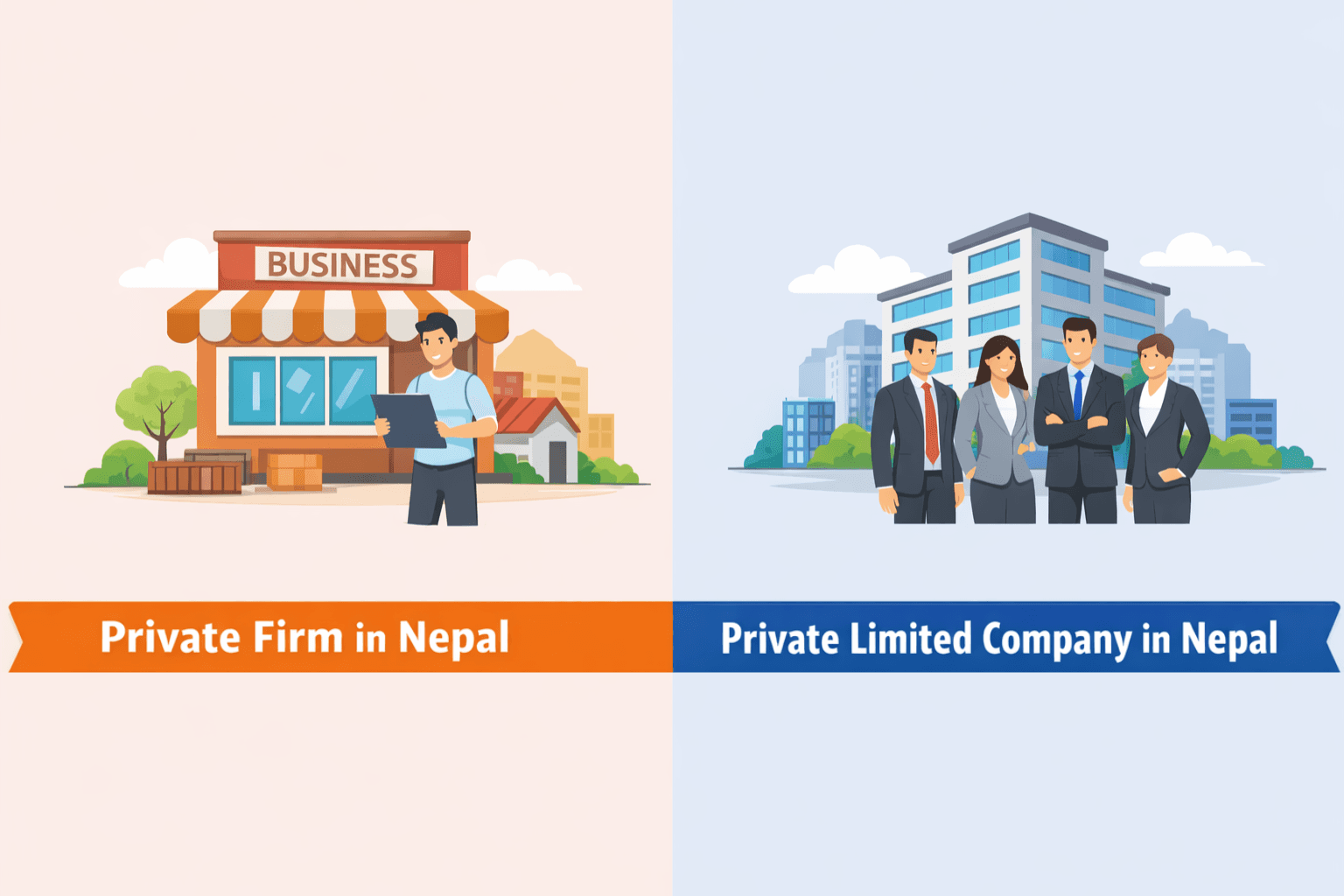
Confused between a private firm and a private company in Nepal? This guide explains legal structure, tax treatment, compliance under the Companies Act 2063.
Starting a business comes with a lot of decision-based hurdles and complexities. During the formation phase of a business, an individual travels through myriads of options and often becomes uncertain about the best possible pathway for their business. As businesses are always destined to be profit oriented, it is pertinent to extract the best possible roadmap with minimum hassle and minimum expenditures.
A person who has studied business administration or holds an MBA may be able to navigate the administrative aspect of a business. However, when it comes to compliance with legal standards, particularly those governed by the Companies Act 2063 and allied statutes, even formal education often falls short. This gap between commercial intent and legal execution is where many businesses unknowingly create long-term risks.
This article attempts to provide a layman’s guide to establishing a Private Firm or a Private Company in Nepal, while aligning practical business decision-making with the legal framework laid down under the Companies Act 2063 and the Private Firm Registration Act.
Understanding Business Structures in Nepal: Private Firms vs Private Companies
The general notion is that one business structure involves multiple investors with shared interests, while the other stands on a single individual or, in some cases, a partnership. However, this surface-level understanding ignores the deeper legal architecture that governs how businesses function in Nepal.
If an investor intends to establish a business focusing on specific objectives, the dilemma lies in identifying which business structure best suits those objectives. In legal dimensions, this decision resembles a doll dress-up game, but with companies. Just as a child figures out which dress fits a doll, an investor must determine which legal casing or veil best fits their business.
The difference, however, is that once this veil is chosen, it cannot be changed as easily as changing clothes. A business is recognized as a legal person under Nepalese law. Once incorporated under the Companies Act 2063, a company acquires rights, duties, and legal responsibilities separate from its founders. This legal personality allows it to own property, incur liabilities, pay taxes, and comply independently with regulatory requirements.
In practical terms, this “doll” requires legal validity, tax compliance, permits, and continuous adherence to the law, particularly the Companies Act 2063 and tax legislation. There have been numerous instances where businesses failed not because of poor products or markets, but because founders chose an unsuitable structure at the beginning and found themselves legally constrained later.
Sole Proprietorship under Nepalese Law
A sole proprietorship is the simplest form of business in Nepal, where one individual owns and operates the business entirely. There is no legal distinction between the owner and the business; they are one and the same entity in the eyes of the law.
This structure operates under the Private Firm Registration Act 2014 and not under the Companies Act 2063. The key concept here is straightforward: you are the business, and the business is you. All profits, losses, liabilities, and legal obligations flow directly to the individual owner without any legal separation.
Because the Companies Act 2063 does not apply to sole proprietorships, such businesses do not enjoy limited liability protection, nor do they exist independently of the individual operating them.
Private Limited Companies under the Companies Act 2063
A private limited company, on the other hand, is a separate legal entity registered under the Companies Act 2063. It is owned by shareholders, managed by directors, and enjoys limited liability protection for its owners.
Under the Companies Act 2063, a private company exists independently of its promoters. It can enter into contracts, hold assets, sue or be sued, and continue its existence irrespective of changes in ownership or management. The law treats the company as a distinct legal “person,” which fundamentally alters how risk, responsibility, and continuity are handled.
This distinction created by the Companies Act 2063 is not merely procedural, it determines how liability is allocated, how taxes are imposed, how capital can be raised, and how the business can evolve over time.
Key Factors to Consider Before Choosing a Business Structure
Choosing between a private firm and a private limited company is not a cosmetic decision. It is a foundational legal choice that determines how the business will operate, grow, attract capital, bear risk, and eventually exit. Once a business is incorporated under the Companies Act 2063, or registered as a private firm outside its scope, reversing that choice is procedurally complex and often expensive. Therefore, several variables must be carefully examined before deciding the legal veil under which a business will function.
Business Purpose and Legal Capacity
The structure of a business must align with its objectives. Certain activities (such as banking, insurance, large-scale financial services, or capital market operations) cannot legally operate as sole proprietorships. These activities demand institutional credibility, regulatory oversight, and risk segregation, which only a company structure under the Companies Act 2063 can provide.
Similarly, a group of profit-driven investors will rarely come together to form a business with unlimited personal liability. The business structure must complement the purpose it seeks to achieve, ensuring that the initial legal decision does not restrict future expansion, licensing, or regulatory approvals. The Companies Act 2063 exists precisely to facilitate such scalable and regulated commercial activity.
Capital Requirements and Investment Flexibility
In a decentralized global economy, capital often flows across borders and demographics. An investor must understand the regulatory framework governing capital infusion, particularly foreign investment. The Companies Act 2063, read together with foreign investment laws, allows private companies to issue shares, induct investors, and restructure ownership.
A private firm does not require proof of capital at the time of registration, which may appear attractive at an early stage. However, this flexibility comes at the cost of scalability. A private firm cannot issue shares, onboard equity investors, or restructure ownership in the manner permitted under the Companies Act 2063. As a result, capital growth remains tightly bound to the individual proprietor.
Procedural Formalities and Decision-Making
Not every entrepreneur is looking to build a large corporate institution. Some prefer operational simplicity and minimal formalities. A private firm offers that ease. Fewer filings, fewer meetings, and faster unilateral decision-making.
A private company incorporated under the Companies Act 2063, however, operates within a more formal governance structure. Board meetings, statutory registers, annual filings, and compliance obligations are part of its daily reality. While this may slow decision-making, it also introduces transparency, accountability, and long-term legal stability, especially when multiple stakeholders are involved.
Exit Strategy and Continuity
Business formation should never be disconnected from long-term exit planning. Some businesses are designed for perpetual existence, while others are project-based and intended to wind up once objectives are achieved.
A private firm is deeply tied to the individual operating it. Its continuity is fragile and often terminates upon the proprietor’s exit, incapacity, or death. A company under the Companies Act 2063, by contrast, enjoys perpetual succession. Ownership can be transferred, shares can be sold, and management can change without dissolving the entity itself. Ignoring these realities at the formation stage often results in costly restructuring later.
Liability Exposure and Risk Allocation
Risk allocation is one of the most decisive factors in choosing a business structure. In a sole proprietorship, all liabilities, be it commercial, contractual, and statutory, attach directly to the individual. There is no legal separation.
A private limited company under the Companies Act 2063 offers limited liability protection. Shareholders’ exposure is restricted to their capital contribution, making this structure particularly suitable for businesses with higher operational, financial, or regulatory risks. This separation of personal and business risk is one of the strongest arguments in favor of incorporation under the Companies Act 2063.
Number of Founders and Skill Distribution
Another inevitable question is whether the business will be built alone or in collaboration. A sole proprietorship allows complete control and full profit retention, but it also concentrates risk and responsibility on one individual.
Where multiple founders, investors, or domain experts are involved, a company structure governed by the Companies Act 2063 provides a legally enforceable framework for dividing rights, responsibilities, and ownership. It allows clarity in decision-making, dispute resolution, and succession planning, elements that informal partnerships often lack.
Tax Compliance and Regulatory Treatment
Taxation is an unavoidable consideration in business structuring. The tax burden, compliance requirements, and reporting obligations vary significantly depending on whether the business is a private firm or a company under the Companies Act 2063.
Unless a business qualifies for specific exemptions or concessions, taxation is applied based on the legal structure adopted at inception. A misaligned structure can result in higher effective tax rates, compliance inefficiencies, and lost incentives that could have been avoided through better planning under the Companies Act 2063 framework.
How Are Private Companies and Sole Proprietorships Taxed in Nepal (Corporate Tax)?
Before we embark on the crux of taxation, it is important to understand the nature of tax laws in Nepal and how they interact with different business structures formed either under or outside the Companies Act 2063.
Nepal follows a self-assessment tax system. Under this model, businesses are required to calculate their own tax liability, file tax returns, and pay taxes in accordance with prevailing laws. Tax collection and administration are carried out by the Inland Revenue Department under the Ministry of Finance. Where taxation falls within the powers and functions of provincial governments, the procedure follows the respective provincial framework. In all cases, tax is calculated based on the net profit of the business after allowing deductions, exemptions, and concessions as provided under the Income Tax Act.
The legal structure of a business directly affects how income is assessed and taxed.
Tax Treatment Based on Business Structure
A private limited company is the most common form of incorporation under the Companies Act 2063. Because the Act recognizes the company as a separate legal entity, it is taxed independently at applicable corporate tax rates, irrespective of the personal income of its shareholders.
A sole proprietorship, on the other hand, does not enjoy separate legal personality and does not fall under the Companies Act 2063. Its income is treated as the income of the individual owner and is taxed at applicable personal income tax rates.
Avenues of Taxation
For small shops and individual-run businesses, taxation may arise through multiple channels depending on the nature and scale of operations.
- Income tax is imposed on profits generated from business activities.
- Municipal taxes may be levied by local governments based on registration, location, or business activity.
- Tax Deducted at Source obligations may arise when hiring employees or engaging contractors and service providers.
These avenues apply irrespective of whether the business is incorporated under the Companies Act 2063 or operates as a private firm, although enforcement and compliance scrutiny are generally higher for companies.
Tax Compliance for Private Limited Companies
Registered companies, including private limited companies incorporated under the Companies Act 2063, are subject to stricter compliance requirements. Such companies must maintain proper books of accounts and prepare audited financial statements.
Because a company is treated as a separate legal person under the Companies Act 2063, its tax compliance obligations are more detailed and structured.
Annual Tax Filing Requirements for Private Limited Companies
Private limited companies are required to comply with the following annual and periodic tax filings:
- Submission of the Income Tax Return (ITR).
- Filing of Value Added Tax returns on a monthly or quarterly basis, where applicable.
- Payment of advance tax installments, if required based on projected income.
- Submission of the annual audit report within the prescribed timeline.
- Filing of Tax Deducted at Source returns for taxes withheld on payments made by the company.
These obligations stem directly from the recognition of companies as independent legal entities under the Companies Act 2063, reinforcing the distinction between corporate taxation and individual taxation.
Tax Rates in Nepal
For small businesses operating as sole proprietorships, businesses with a certain range of transactions and profit often end up with more or less similar tax liability. Recognising this, the government has exempted such businesses from complex tax calculations and introduced simplified taxation mechanisms. These simplified regimes apply to businesses that are not incorporated under the Companies Act 2063, and are intended to reduce compliance burden for individual operators.
The simplified taxation methods primarily include presumptive taxation for small business operators and taxation based on turnover.
Presumptive Tax for Small Businesses
For small-scale sole proprietors who are resident natural persons, the Income Tax Act provides a simplified taxation regime based on annual turnover and income levels. This regime applies to individuals operating businesses outside the framework of the Companies Act 2063.
Small businesses with an annual turnover of up to NPR 30 lakh and taxable income of up to NPR 3 lakh are subject to a fixed lump-sum tax based on their location:
- Businesses operating in Kathmandu Valley are taxed at NPR 7,500.
- Businesses operating in metropolitan or sub-metropolitan areas are taxed at NPR 4,000.
- Businesses operating in rural or other areas are taxed at NPR 2,000
For medium businesses where turnover ranges between NPR 30 lakh and NPR 1 crore and taxable income is up to NPR 10 lakh, tax is calculated as a specified percentage of turnover rather than a flat amount.
This simplified presumptive regime does not apply to individuals providing professional services such as doctors, engineers, lawyers, consultants, and similar professions. Such professionals are excluded regardless of whether they operate independently or through registered firms.
Taxation Based on Turnover
Small taxpayers with annual turnover up to NPR 5 million may opt for turnover-based taxation. Under this method, tax is levied as a percentage of turnover, typically ranging from 0.25% to 2%, depending on the nature of the business.
This regime is again limited to businesses operating outside the Companies Act 2063 framework. Persons providing professional services, including lawyers, doctors, engineers, sportspersons, auditors, actors, and consultants, are not eligible to pay tax under this method.
Tax calculation under this regime follows a tiered approach:
- For turnover up to NPR 30 lakh, presumptive taxation for small businesses applies as described above.
- For turnover exceeding NPR 30 lakh, turnover-based tax is applied in addition to the presumptive tax, at rates prescribed based on the nature of business activity.
General Tax Rates for Sole Proprietors
Where a sole proprietor does not fall under or does not opt for the simplified taxation schemes, income is taxed under the progressive tax slabs applicable to natural persons.
Tax rates range from 0% (or 1% Social Security Tax in the case of salaried employees) to as high as 39% for very high-income earners. An important distinction exists for registered sole firms: the 1% Social Security Tax on the first income slab does not apply to individuals who have registered a sole proprietorship.
Additionally, a sole proprietor and their spouse may elect to be treated as a single “natural person” (a couple) for tax purposes. This option allows access to different tax thresholds and can be beneficial for household-level tax planning, an option not available to companies incorporated under the Companies Act 2063, which are taxed independently at corporate rates.
Concessions and Exemptions Available in Nepal
Tax concessions and exemptions play a significant role in determining whether a business should operate as a sole proprietorship or be incorporated under the Companies Act 2063. Many of these incentives are intentionally designed to support small-scale, grassroots entrepreneurship and are therefore more accessible to sole proprietors than to companies.
Tax Incentives for Sole Proprietorships
Sole proprietorships are eligible for several business-oriented tax concessions aimed at encouraging early-stage enterprises and priority sectors.
- Micro-Enterprises (लघु उद्यम)
A micro-enterprise is granted a full income tax exemption for seven years from the date of commencement. Where the enterprise is operated by a female entrepreneur, the exemption period is extended by an additional three years, resulting in a total exemption period of ten years. These benefits are generally available to businesses operating outside the Companies Act 2063 framework and are intended to lower entry barriers for small entrepreneurs. - Agricultural Businesses
Income derived from specified agricultural activities, such as silk production, fruit farming, poultry, dairy, and similar operations conducted through a firm is exempt from income tax. This exemption reflects the government’s policy preference to support agriculture-based livelihoods, which are often run as private firms rather than companies incorporated under the Companies Act 2063. - Special Industry Concession
Resident natural persons operating a “Special Industry,” including manufacturing, agriculture, or forest-based enterprises, may receive a rebate on the tax rate applicable to their income. This concession is structured to promote domestic production and value addition at the individual entrepreneur level.
Compliance and Allowable Deductions for Sole Proprietors
Compliance obligations for sole proprietors are relatively flexible when compared to companies incorporated under the Companies Act 2063, but certain accounting and reporting standards still apply.
Natural persons are generally required to maintain accounts on a cash basis for employment and investment income. However, for business income, proprietors are permitted to use the accrual basis of accounting where appropriate.
Proprietors may also claim specific deductions from taxable income. Annual life insurance premiums up to NPR 40,000 and health insurance premiums up to NPR 20,000 are deductible, providing limited personal tax relief tied to financial security and healthcare coverage.
In terms of reporting, many small proprietors are exempt from filing a full income tax return if their income is subject only to final withholding tax. However, individuals earning significant business income are required to file an annual income return, even if they are not incorporated under the Companies Act 2063.
Corporate Taxation for Private Companies
Private companies incorporated under the Companies Act 2063 are subject to a distinct corporate tax regime that differs fundamentally from individual taxation.
The general corporate tax rate applicable to most private companies is 25% on taxable income. This flat rate applies regardless of income level, reflecting the separate legal personality conferred by the Companies Act 2063.
Certain sectors are subject to a higher corporate tax rate of 30%. These include banks and financial institutions, general insurance companies, telecommunications and internet service providers, money transfer businesses, capital market entities, and industries involved in the production of tobacco, liquor, or beer.
Where a company operates a “Special Industry,” such as manufacturing or agriculture, it may be eligible for a 20% rebate on the applicable corporate tax rate. This concession mirrors similar incentives available to individuals, though it operates within the corporate framework established by the Companies Act 2063.
Incentives for Conversion from Private to Public Company
The law also provides targeted incentives for large private companies that transition to public ownership.
A private company with a paid-up capital of NPR 50 crore or more that converts into a public company is entitled to a 10% tax rebate for a period of three years from the date of conversion. This incentive is designed to encourage capital market participation and broader public ownership.
However, this benefit does not apply to companies that were already legally required to be public under Section 12 of the Companies Act 2063. Such entities cannot claim the rebate merely by complying with an obligation already imposed by law.
Which Taxation Format Is Better and for Whom?
Once you’ve crossed the foundational questions of structure and compliance, the practical concern that remains is taxation. If you are an aspirant entrepreneur who has already figured out the basics of starting a business, the real question is no longer whether to pay tax, but how your business will be taxed and which format aligns best with your scale and income profile.
At this stage, the comparison is not between a small business and a large public company. It sits squarely at the junction between a sole proprietorship and a private limited company, where turnover is still moderate and growth is incremental. Within this space, the law offers multiple taxation pathways rather than a single rigid outcome.
For resident natural persons deriving income only from business activities within Nepal, the law provides simplified taxation options. Where annual turnover does not exceed Rs. 30,00,000 and net income remains below Rs. 3,00,000, the presumptive tax regime applies. This method removes the burden of detailed tax calculations and allows eligible business owners to pay a fixed amount, regardless of VAT registration status.
Tax decision-making, however, does not depend on turnover alone. The nature of the business also plays a decisive role. As discussed earlier, concessions exist for micro-enterprises, agricultural activities, and special industries, which can materially alter the effective tax burden. In addition, small taxpayers with annual turnover of up to NPR 5 million may choose turnover-based taxation at rates ranging from 0.25% to 0.30% of turnover, provided they are not engaged in excluded professional services.
This is where structure and income level begin to matter more than labels.
When Are Private Firms More Effective?
Private firms tend to be more tax-efficient at lower income levels. Because sole proprietorships are taxed under progressive personal income tax slabs, the effective tax rate remains comparatively lower when income is modest.
For example, at a taxable income of Rs. 15 lakh, a private firm would incur a tax liability of approximately Rs. 1,75,000, translating to an effective tax rate of about 11.67%. In contrast, a private limited company earning the same amount would be taxed at a flat corporate rate of 25%, resulting in a tax liability of Rs. 3,75,000.
At this stage, the simplicity and lower effective tax burden of a private firm make it a more efficient choice for many small and early-stage businesses.
When Does a Private Company Become the Better Option?
As income levels rise, the balance begins to shift. Once taxable income moves beyond the lower slabs and approaches higher marginal rates, the flat corporate tax structure of a private company starts to offer a clear advantage.
At a taxable income of Rs. 50 lakh, a sole proprietor could face an effective tax rate of around 33%, resulting in a tax liability of approximately Rs. 16,60,000. A private limited company, taxed at the flat rate of 25%, would pay around Rs. 12,50,000 on the same income.
At higher income levels, the predictability and ceiling provided by corporate taxation often outweigh the flexibility of personal taxation, making the private company structure more tax-efficient.
A Practical Growth Pattern
In practice, many entrepreneurs do not choose one structure forever. A common and sensible growth pattern is to begin as a private firm during the early, lower-income stages and convert into a private limited company as profits scale beyond the Rs. 20–25 lakh range.
This transition does not need to be reactive. When planned correctly, conversion can be timed to align with income growth, compliance readiness, and long-term business goals, allowing entrepreneurs to optimise tax outcomes at different stages of the business lifecycle.
Final Thoughts
There is no universally “better” taxation format. What works best depends on income level, business nature, growth trajectory, and risk tolerance. At lower income levels, private firms benefit from progressive taxation and simplified regimes. As income rises, private companies offer stability, predictability, and lower effective tax rates.
The mistake many entrepreneurs make is treating tax structure as a one-time decision rather than a dynamic one. Tax efficiency is not about choosing the cheapest option today, but about selecting a structure that can evolve as the business grows.
The most sustainable approach is not to ask which structure pays less tax in isolation, but which structure aligns with where your business is now, and where you realistically expect it to be in the coming years.
That alignment, more than any single tax rate, is what determines whether your structure supports your growth or quietly works against it.
Starting a business in Nepal?
Register your company online — name reservation, MOA/AOA, PAN/VAT and OCR filings, all in one place.


Related Blogs


Subscribe to our newsletter
Get latest news and updates directly to your email.