How Nepal Rastra Bank Is Preparing for the Next Banking Shock
Khatapana
December 2, 2025 14 min read
 Reviewed by Kailash Panday, Chartered Accountant & Corporate Lawyer
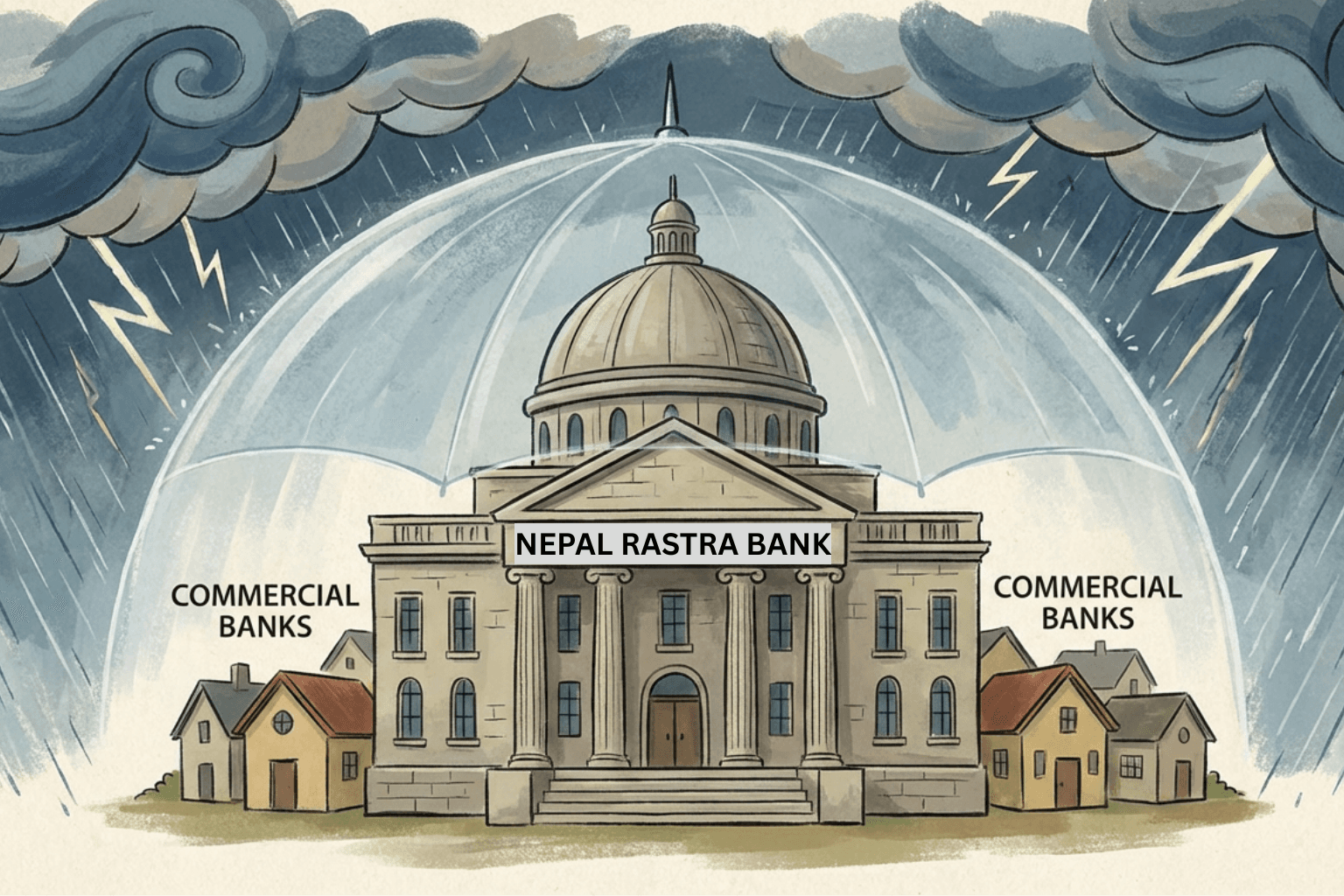
How is Nepal Rastra Bank preparing for the next banking shock? A simple breakdown of the new D-SIB framework and what it means for every Nepali.
Imagine waking up one morning and hearing that one of Nepal’s biggest banks has suddenly collapsed. ATMs aren’t working. Online payments are failing. Companies can’t process salaries. People are lining up outside branches, panicking about their savings. And even if your bank isn’t in trouble, the fear spreads across the entire system, because once a major bank falls, everyone feels the shock.
This isn’t an exaggeration. This is exactly what happened in many countries during the 2008 global financial crisis, and Nepal Rastra Bank knows that a single big bank’s failure can drag the entire economy down with it.
That’s why NRB has introduced a brand-new rulebook called the Framework for Dealing with Domestic Systemically Important Banks (D-SIBs), 2025. In simple terms, it’s NRB’s way of identifying which banks are so important to Nepal’s financial system that their failure would be devastating, and then making sure those banks remain extra strong, extra safe, and extra well-supervised.
This article breaks down the entire framework in the simplest possible language. We’ll explain what a D-SIB actually is, Why NRB created this framework, How Nepal Rastra Bank identifies which banks qualify, What changes, and finally how it will affect us all.
By the end of this guide, you will understand why this is one of the most important reforms Nepal Rastra Bank has introduced in recent years.
Now that we know why this matters, let’s break down the most basic question: What even is a D-SIB?
What Even Is a D-SIB?
So here’s the simple version: when Nepal Rastra Bank uses the term Domestic Systemically Important Bank, it’s really just talking about a bank that is too important to let fail. Not because the bank is special, but because if it collapses, it could drag the rest of the economy down with it. Think about the biggest commercial banks you see all over Nepal, the ones with branches in almost every district, massive customer bases, huge transaction volumes, and mobile banking apps everyone’s using. NRB’s new framework doesn’t officially name anyone yet, but those “giant” banks are exactly the kind of examples that help us understand what a D-SIB looks like.
But what makes a bank a ‘D-SIB’? Here are the factors that determine which banks get this label.:
1. Size: They hold a huge chunk of the country’s money
The first thing to get is that a systemically important bank is one where a lot of the country’s money is concentrated. Imagine a single bank that stores the salary accounts of thousands of teachers and civil servants, the working capital of big companies, the savings of hospitals and schools, and millions of regular people’s deposits. If that bank freezes, it’s not just its customers who suffer. It’s the entire rhythm of everyday life. Salaries don’t get paid, bills can’t be cleared, businesses can’t move money around, and the panic spreads faster than any rumour ever could.
That’s why NRB looks at size. The bigger the bank, the bigger the mess if something goes wrong.
2. Interconnectedness: They’re deeply connected to other banks
This is the part most people never think about, but it’s honestly the most important. Banks don’t live on their own little islands. They’re all tied together, constantly exchanging money, clearing each other’s payments, routing transactions, settling cheques, and even lending to one another overnight.
Let’s paint a simple picture.
Imagine Bank B is one of the biggest players in the country. Now imagine Bank A, Bank C, and Bank D rely on Bank B for different things. Bank A keeps some of its liquidity parked there. Bank C uses Bank B’s system to clear payments for its corporate clients. Bank D routes a chunk of its digital transactions through Bank B’s network.
Now, if Bank B suddenly hits a crisis and can’t meet its obligations, guess what happens? Bank A immediately struggles with liquidity. Bank C’s large payments get stuck. Bank D’s customers start panicking when they hear “a big bank might be in trouble.” These banks may have been perfectly healthy, but because they were tied to Bank B, the shock hits them too.
That’s what NRB calls interconnectedness. And it’s a huge reason why some banks are labelled D-SIBs. They’re quite literally woven into the wiring of the whole system.
3. Substitutability: They’re extremely hard to replace
If a small bank shuts down, it’s sad, but other banks can gradually absorb its customers, shift accounts, and take over transactions. Life goes on.
But now picture a massive bank that handles a huge slice of government salaries, QR payments, trade finance for importers, and remittances flowing into Nepal. If that bank disappears even for a single day, the entire financial system slows down. There’s no backup plan that can magically take over millions of users and thousands of complex transactions at once.
That’s what NRB calls substitutability, or, in simpler terms: “How replaceable is this bank?” And the answer for the biggest banks is usually “not very.”
4. Complexity of Operations: They’re often complex, making them harder to fix
Some banks keep things simple. Others (usually the bigger ones) deal with large investment portfolios, foreign currency transactions, bonds, cross-border deals, and more complicated financial products. When a bank like that gets into trouble, it’s not something you fix over a cup of tea and a meeting. It takes time, specialised knowledge, and careful handling.
This is why NRB looks at a bank’s complexity. The more complex it is, the harder it is to stabilise, especially in a crisis.
Putting it all together
When you combine size, interconnectedness, substitutability, and complexity, you get a very clear picture of what a D-SIB is. It’s basically a bank that carries so much of Nepal’s financial weight that if it stumbles, the entire system trembles with it.
Nepal Rastra Bank introduced this new D-SIB framework to figure out which banks hold this level of importance, and to give them extra guardrails so they stay strong even when the economy faces pressure.
Now that we’ve broken down what a D-SIB really means, the next obvious question is: why did NRB decide to bring this framework now? Let’s dive into that next.
Why Nepal Rastra Bank Introduced This Framework Now
At this point, you might be wondering, “Okay, I get what a D-SIB is, but why did NRB suddenly decide to create a whole new framework around it now?”
Honestly, the timing makes perfect sense once you look at the bigger picture.
Remember the 2008 global financial crisis? Even if Nepal wasn’t hit directly, the world watched giant banks collapse like dominoes. Lehman Brothers in the U.S., Northern Rock in the U.K., banks in Europe needing bailouts. And ironically, these were banks that were “too big to fail”, but they failed anyway, and the fallout was brutal. Economies shrank, people lost jobs, governments had to spend billions to stop everything from falling apart.
Since then, NRB learned a very important lesson from that period: one big bank’s failure can create chaos far beyond its walls. And in a country like ours, where confidence in the banking sector is absolutely essential, even a small spark of doubt can spread fast.
Globally, regulators realised the same thing. The Basel Committee (the world’s guideline body for banking safety standards) told all countries to create their own local system for identifying and strengthening their “systemically important banks.” Basically: don't wait for a crisis, prepare early.
So, better late than never, NRB finally took that seriously. In addition to that, the Fourth Strategic Plan of Nepal Rastra Bank under the Pillar 2, Objective 1, had already presented a mandate for D-SIBs and its issuance by 2025. The purpose behind this is to ensure that a strong banking system with additional capital requirements is created so that it can be a pillar for people during a financial crisis.
It was high time, too, given how the Nepali banking system has become more interconnected, more digital, and more dependent on a few large players than ever before.
Now that we know why NRB is doing this, it naturally leads to the next question: what exactly is the purpose behind this whole setup?
The Core Purpose of the D-SIB Framework
To put it simply, the whole point of this framework is to keep the banking system, and the economy safe. But Nepal Rastra Bank isn’t doing this in a vague or symbolic way. It has a very clear and very practical purpose behind it.
First, NRB wants to identify which banks are truly systemically important. Not just big banks, not just popular banks, but the ones whose failure would actually shake the entire financial system. Until now, this was based on assumptions or general impressions. With the D-SIB framework, it becomes a structured, data-driven process.
Second, NRB wants to strengthen those banks. Think of it as giving the most important players a thicker safety cushion. If something unexpected happens (maybe a global shock, a liquidity crunch, or a sudden market panic,) these banks will have enough extra capital to absorb the hit without dragging the economy down with them.
Third, NRB wants to reduce the chances of a crisis in the first place. If the key pillars of the financial system are strong, the rest of the structure stays stable. It’s the same logic as reinforcing the biggest foundation beams in a house. Once those beams are secure, everything else is safer.
And finally, NRB wants to supervise these banks more closely. That means deeper monitoring, better risk management expectations, stronger recovery plans, basically, making sure these banks don’t take unnecessary risks and don’t slip into trouble unnoticed.
How NRB Will Identify D-SIBs (The Scoring System Made Simple)
Okay, now we get into the part everyone is curious about: How does Nepal Rastra Bank actually decide which banks are systemically important? And don’t worry — this isn’t as complicated as it sounds. NRB uses something called an indicator-based measurement approach, which is just a fancy way of saying, “Let’s look at the data and measure each bank in a fair, structured way.”
Think of it like NRB running an annual health check-up on all “A” class banks. Each bank gets measured across a few key dimensions, and then NRB assigns a score. The higher the score, the more important, or “systemic” the bank is.
Let’s break down how this works in a simple way.
The Four Dimensions Nepal Rastra Bank Looks At
Now that we know why NRB examines these different aspects of a bank, let’s talk about the practical side; how much weight Nepal Rastra Bank gives to each dimension, and what exactly it uses to measure them. Think of this part as NRB going from theory to a proper scoring system.
1. Size (40% weightage)
The first and most heavily weighted factor is Size, which carries a full 40% of the total score. NRB measures this by looking at a bank’s total exposures. If you imagine a bank’s overall footprint (everything it owns, owes, and handles) that’s what total exposure captures. Bigger exposures mean the bank represents a bigger share of the system, so naturally it occupies the largest portion of the scoring.
2. Interconnectedness (30% weightage)
This is where NRB checks how tied a bank is to other banks. If a bank is deeply connected (through lending, payments, investments, and settlement activities,) its failure could trigger other banks to fail too. That’s the domino effect.
NRB measures this through:
- Intra-financial system assets (how much the bank has lent to other banks)
- Intra-financial system liabilities (how much other banks owe to it)
- Securities outstanding (financial instruments connecting the bank to others)
This makes up 30% of the score, because interconnected banks spread shocks the fastest.
3. Substitutability (15% weightage)
Here NRB asks: “If this bank suddenly stopped operating, can other banks step in easily?”
If the answer is no (meaning it handles a huge amount of payments or trading,) then its substitution risk is high. NRB looks at the value and volume of payments made in Nepali rupees, and the trading volume of the bank.
This category makes up 15% of the scoring.
4. Complexity (15% weightage)
Not all banks are simple deposit-takers. Some deal in complex financial products, cross-border operations, and sophisticated investments. These banks are harder to “fix” if something goes wrong.
NRB looks at the following:
- Level-2 assets
- Trading and available-for-sale securities
- Cross-jurisdictional activities
This accounts for the final 15% of the score.
Each of these four dimensions adds up to the bank’s final systemic importance score. And once that score is calculated, NRB then decides whether the bank qualifies as a D-SIB, and if it does, which bucket it belongs to.
How the Data → Score → Bucket System Works
When Nepal Rastra Bank assigns a bank to a D-SIB bucket, it requires that bank to hold something called Higher Loss Absorbency (HLA). The name sounds heavy, but the idea is straightforward:
HLA is extra capital the bank must keep aside as a safety cushion.
This extra capital must be held in the form of Common Equity Tier 1 (CET1). CET1 is basically the highest-quality, most dependable money a bank can hold, things like the bank’s own shares and retained profits. In everyday language, CET1 is the bank’s emergency fund, the pot of money that absorbs losses first if something goes wrong.
Now, how much CET1 a bank needs to set aside is calculated as a percentage of something called Risk-Weighted Assets (RWA).
RWA is just a fancy way of saying: “Not all assets are equally risky, so let’s adjust them based on how risky they are.”
For example:
- Cash is low-risk → low weight
- Loans to risky borrowers → higher weight
- Complex investments or foreign exposure → even higher weight
So when NRB says a bank must hold, say, 0.60% additional CET1 against its RWA, it means:
“The bank must keep 0.60% extra high-quality capital based on how risky its assets are.”
It’s like telling someone: “The more risky things you’re carrying, the bigger your safety gear should be.”
Once NRB calculates each bank’s systemic score, it places them into buckets. Each bucket has a specific HLA requirement:
- Bucket 1: 0.20%
- Bucket 2: 0.40%
- Bucket 3: 0.60%
- Bucket 4: 0.80%
- Bucket 5: 1.00% (reserved for the most critical banks, if needed)
The higher the bucket, the bigger the CET1 cushion the bank must maintain. A bank in Bucket 4, for example, must hold four times more extra capital than a bank in Bucket 1.
This system is NRB’s way of ensuring that the banks most important to Nepal’s financial system, the ones whose failure would affect millions, always have the strongest protection in place.
With that safety structure explained, the next natural question is: What happens once a bank officially becomes a D-SIB?
What Happens When a Bank Becomes a D-SIB?
Becoming a D-SIB isn’t like receiving an award. It’s more like being told, “Congratulations, you’re important. Now here’s your extra responsibility.”
Nepal Rastra Bank’s logic is simple: If a bank is important enough to shake the entire system, it must be strong enough to prevent that from happening.
So what does NRB require from a newly designated D-SIB?
Extra Capital Requirement (Higher Loss Absorbency – HLA)
Think of this as NRB telling the bank: “Keep a bigger emergency fund.” This “emergency fund” is in the form of Common Equity Tier 1 (CET1) capital, which is the highest-quality, most reliable type of capital a bank can hold.
The idea is simple. If a crisis hits, the bank should be able to absorb losses without collapsing or needing a government bailout.
The Higher Loss Absorbency - HLA requirements (again, directly from the D-SIB Framework 2025) look like this:
- A D-SIB in Bucket 1 must keep an extra 0.20% capital
- In Bucket 2, it becomes 0.40%
- Bucket 3 requires 0.60%
- Bucket 4 requires 0.80%
- Bucket 5 would require 1.0
Simply put, the more systemically important a bank is, the thicker its financial safety cushion must be.
What If a Bank Doesn’t Comply?
If a D-SIB fails to meet its required HLA level, it faces penalties under Directive No. 1 of the Unified Directives for A, B, and C class banks. These penalties can be severe and are designed to force compliance.
There’s also something called a cooling period. If a bank’s score drops and it moves to a lower bucket, NRB doesn’t immediately relax its capital requirements. The bank must stay in its current bucket for one full year before moving down. This prevents banks from gaming the system or using short-term tricks to avoid higher capital requirements.
So in short: once you’re a D-SIB, you need to stay strong all the time.
Now the final step: How does NRB keep this entire system updated year after year?
How NRB Will Monitor and Update This Each Year
Nepal Rastra Bank isn’t creating this framework just to announce it once and forget about it. The D-SIB scoring and designation process repeats every single year, like a financial annual exam.
Here’s the simple timeline NRB follows:
By end of August:
NRB collects all the data it needs from every “A” class commercial bank. This includes everything used to calculate size, interconnectedness, substitutability, and complexity.
By end of September:
NRB calculates each bank’s systemic score. This is where banks are ranked, compared, and evaluated against the threshold.
By end of October:
NRB publicly publishes the new list of D-SIBs and tells each bank what its HLA requirement is for the upcoming fiscal year.
By end of the same fiscal year:
Every designated D-SIB must meet its new capital requirement.
This annual cycle ensures two things: First, no bank can hide behind last year’s ranking. Second, as banks grow, merge, change business models, or expand their digital systems, their D-SIB status will reflect those changes.
This is how Nepal Rastra Bank keeps the D-SIB system relevant, up-to-date, and constantly in sync with the country’s evolving financial landscape.
When Will This Take Effect?
One thing people always ask after hearing about a new regulation is, “Okay, but when does this actually start?”
Nepal Rastra Bank has made the timeline very clear. The Higher Loss Absorbency (HLA) requirements (the extra capital that D-SIBs must hold) will officially kick in from mid-July 2027. That gives banks enough time to understand the new rules, adjust their capital planning, and strengthen their internal systems before the requirements become mandatory.
NRB also isn’t treating this as a “set it and forget it” framework. The entire system will be reviewed at least once every three years, which is important because banking isn’t static. Banks merge, grow, launch new products, adopt new technologies, and enter new markets. By reviewing the framework regularly, NRB ensures it stays relevant to the way Nepal’s financial system actually evolves.
So even though the framework is being introduced now, its implementation is phased, thoughtful, and designed to allow banks, and the economy to adapt smoothly.
What This Means for Ordinary Nepalis
Now let’s get to the part that most people really want to know: “How does any of this affect me?” And honestly, it affects you more directly than you think.
Even if you never step foot inside Nepal Rastra Bank, and even if you don’t follow banking news, the safety of the banking system shapes your life every single day.
For ordinary Nepalis, this framework brings some plausible benefits.
First, it means safer banks. When the largest banks in the country hold extra capital and are supervised more closely, the chances of them failing drops dramatically. That means your deposits, your salary account, your business transactions, and your digital payments are more secure.
Second, it reduces the risk of government bailouts. In many countries, when a huge bank collapses, the government has to step in with taxpayer money to rescue it. As D-SIBs are obliged to hold additional Common Equity Tier 1 capital, they are better prepared to handle losses during a financial crisis. This helps reduce the likelihood of a large bank requiring government assistance during a crisis. In simple words, the D-SIB framework helps to ensure that the public or the government does not have to save a failing bank.
Third, it boosts confidence in Nepal’s financial system. When businesses, investors, and foreign companies see that NRB is taking stability seriously, they trust the country more. Trust leads to investment, and investment leads to growth that can help boost the economy of the country as a whole.
And finally, it creates a more stable economy overall. If a major bank faces difficulty, the shock won’t spread as fast or as far. Payments will keep moving, businesses will keep operating, and the financial system won’t freeze up. Stability may not feel dramatic in day-to-day life, but it’s the foundation of economic progress.
So even though it feels like a technical policy tucked deep inside the banking sector, the effects of this framework reach every household, every business, and every worker in Nepal.
What This Means for Banks
While this framework brings a lot of benefits to the public, it also places significant responsibilities on the banks themselves, especially those that end up being classified as D-SIBs.
For starters, these banks will have to improve their risk management. It’s not enough to be big; you need to be big and safe. That means stronger internal systems, more cautious lending practices, and sharper oversight across all operations.
They will also need to maintain higher-quality capital, especially in the form of CET1. This is the most reliable kind of capital, and holding more of it makes the bank more resilient during times of stress.
Their payment systems, cross-bank interactions, and operational structures will also become more transparent. NRB will expect clearer reporting, better documentation, and more accurate data, all of which help detect problems early.
Most importantly, these banks will face more stringent supervision from Nepal Rastra Bank. That means more inspections, more reviews, more scenario testing, and more regular touchpoints with the regulator. It’s not punishment, it’s NRB making sure the pillars of the financial system stay strong.
In short, banks will have to level up. They’ll need to modernise governance, upgrade technology, and hold themselves to higher standards, all because they play an outsized role in Nepal’s economic stability.
Final Thoughts
At the end of the day, everything Nepal Rastra Bank is doing with this D-SIB framework comes back to a simple promise: protecting the country’s financial system so people can live, work, and build their futures with confidence.
By identifying the banks that matter most, strengthening them with extra safeguards, and supervising them more closely, NRB is taking a proactive, long-term approach to preventing crises before they happen. This isn’t just about regulations alone. It’s about safeguarding the savings of millions of Nepalis, ensuring businesses can operate smoothly, and keeping the entire economy stable even when global shocks hit.
It also marks a major step forward for Nepal. Aligning with global banking standards, modern risk management practices, and forward-looking policies, NRB is showing that Nepal’s financial system is actually maturing.
And as these changes take effect over the next few years, one thing becomes clear: Nepal’s banking system is getting more resilient, safer, and ready for future challenges.
Related Articles:
Starting a business in Nepal?
Register your company online — name reservation, MOA/AOA, PAN/VAT and OCR filings, all in one place.


Related Blogs

Subscribe to our newsletter
Get latest news and updates directly to your email.