Gen Z Revolution in Nepal: Five Days That Changed a Nation
Khatapana
September 14, 2025 13 min read
 Reviewed by Kailash Panday, Chartered Accountant & Corporate Lawyer
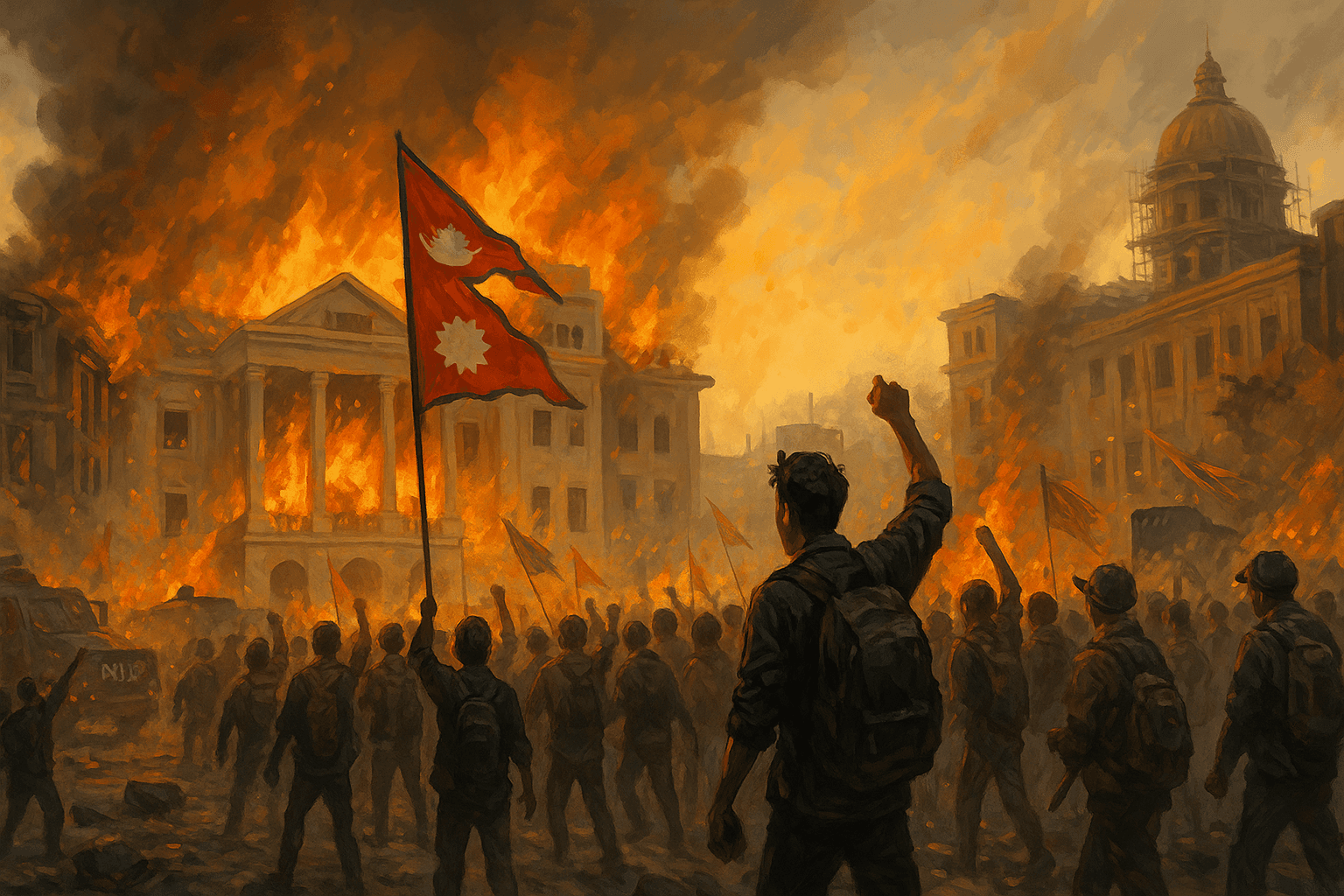
In just five days, Nepal’s Gen Z toppled a PM, forced Parliament’s dissolution, and even appointed a new PM. Explore what led to the chaos and how it unfolded.
Nepal’s politics has been one long rollercoaster, and not the fun kind. Since we got rid of the monarchy back in 2008, we've cycled through fourteen different governments and not one managed to stick around for a full five-year term. It's like musical chairs, but with prime ministers. Leaders show up, make promises, then disappear when things get messy. Meanwhile, citizens are just sitting there like, "Will we ever get some actual stability?"
But then something completely revolutionary happened between September 8th and 12th, 2025. What started as the Gen Z speaking out against corruption in Nepal, turned into five days of absolute chaos. A sitting Prime Minister had to resign, the army rolled into the streets, people broke into the Parliament, government buildings were on fire, the parliament got dissolved, and the country even got its first ever female Prime Minister. Yes, all in the span of just 5 days. And leading all of this, was Nepali Gen Z, armed with nothing but years of pent-up frustration.
So if you want to understand what really happened during those five crazy days, we've got to rewind a bit. Because this story has been building for way longer than you'd think.
The Deeper Roots of the Movement (Context Before the Spark)
The Gen Z Revolution in Nepal didn't just happen out of nowhere. Sure, the “exposing politicians’ kids” trend was the match that lit the fire, but honestly, that fire had been smoldering for years.
A Generation That's Had Enough
Nepal's young people, especially Gen Z, have basically grown up watching politicians get rich, while ordinary citizens continue to struggle. Jobs are practically nonexistent, starting a business means drowning in red tape, and corruption is so baked into the system that people just accept it as normal.
But the thing that really stings is that these kids have been watching politicians' children, showing off their fancy lives on Instagram. We're talking imported cars, designer clothes, lavish parties, while millions of regular Nepalis are lining up to work abroad just to sustain their lives. Just last fiscal year (2081/82), 839,266 Nepali citizens went abroad for foreign employment. It's not just unfair, it's almost insulting.
The Political Circus Never Ends
Since 2008, Nepal has seen 14 governments in 17 years, almost none lasting a full term. Why? The constitution itself gives politicians a loophole.
Article 76(1) of the Constitution of Nepal says: if a party wins a majority, its leader becomes Prime Minister. But since no party ever gets a clear majority, we always fall back on Article 76(2), which allows coalitions.
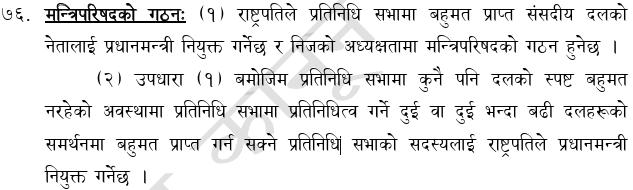
That’s where the circus begins. Instead of working on common policies, politicians cut deals to split the PM’s chair; 2.5 years for me, 2.5 years for you.
That’s how we ended up with alliances like the “gathabandhan” between CPN-UML (a communist party) and Nepali Congress (a capitalist party). Ideology doesn’t matter; as long as they get a turn in power, they’re happy. For Gen Z, who’ve only ever seen politics run like this, it’s quite frustrating, and understandably so.
Why This Wasn't Really About Social Media
So when people say the protests were about a social media ban, they're missing the point entirely. Yeah, the ban was what finally pushed people over the edge. But the real anger was about decades of broken promises and a system that seemed designed to keep young people down. The ban just confirmed what they already knew; the government wasn't interested in fixing things, they just wanted to silence anyone who dared complain.
The Most Heartbreaking Detail
Now, for something that’ll stick with us, students were specifically asked to show up in their school uniform. This was always meant to be a peaceful protest and even if things escalated, students would be protected from any form of violence from the police. But in an unexpected turn of events, most that got shot that day were in their school uniform, wearing a school bag.
The Spark Before the Fire (Sept 4–7)
The immediate lead-up began on September 4, 2025, when the government announced it was banning 26 social media platforms, including Facebook, WhatsApp, Instagram, YouTube, and X (formerly Twitter).
The official reason being, these platforms hadn’t registered with Nepali authorities by the September 3 deadline. The government argued this was about taxation and regulation.
But many of these companies were already registered with the Inland Revenue Department (IRD) and paying taxes. So what was really going on? According to critics, the new rule wasn’t about tax compliance at all. It was about giving the government more direct control over online platforms, essentially creating a legal path to censorship.
The Nepo Kids Trend
Around the same time, a wave of its kind was spreading on social media: the “Nepo kids” trend. Borrowed from Indonesia, it involved young people calling out the children of powerful politicians for flaunting lives of luxury. Nepali TikTok, Instagram, and Facebook filled up with posts comparing their wealth to the struggles of ordinary citizens.
In a country where almost a million people leave every year for foreign employment, the message struck a deep chord: why do our politicians’ kids live like royalty while our parents toil abroad?
The Call to Protest
Social media platforms got banned on September 4 and by September 7, youth leaders and anonymous online accounts were urging students to protest peacefully. The instructions were clear:
- Wear your school uniform.
- Carry your school ID.
- Bring at least one book in your bag.
The symbolism was powerful. These weren’t hardened activists, they were students demanding dignity and a future.
And with that, the stage was set for September 8, the day Nepal erupted.
September 8: The “Peaceful” Protest
September 8th started with this incredible energy. By 9 a.m, hundreds of young people showed up at Maitighar. No political party flags, and no big-name leaders giving speeches, just students and young professionals waving the Nepali flag, saying “We’ve had enough” . It was actually quite refreshing to see.
Escalation
At first, it was exactly what you'd expect from a student protest. People chanting, holding up signs, everyone recording everything on their phones. The crowd marched from Maitighar to Everest Hospital and while some stopped right there, some decided to go further down to the parliament of Nepal. The area was protected with barricades, but protestors stormed through it and even tried to enter the parliament building. That's when the police decided to bring out their greatest hits: tear gas, and water cannons
And then, the thing nobody thought would actually happen, they started using live ammunition. On students. With backpacks. The government claimed that only rubber bullets were authorized, but in the hospitals, doctors were pulling out cold, hard iron bullets from kids’ bodies.
The Massacre
By the end of the day, it was a bloodbath. Nineteen people were killed, most of whom were mere students. 250+ were injured, and among the dead was a 12-year-old kid. Witnesses were saying police were literally aiming for people's heads. And this wasn't just happening in Kathmandu; over in Itahari, two more young protesters got gunned down.
What was supposed to be kids peacefully asking for a better future turned into the bloodiest day Nepal had seen in years. At that point, nobody was thinking about corruption anymore. This was about a government that had just fired bullets into a crowd of children.
Immediate Fallout
The backlash was instant. Home Minister Ramesh Lekhak resigned that same evening, and the government tried to save face by announcing they were lifting the social media ban, but honestly, that was like trying to stop a tsunami with an umbrella.
Trust was completely shattered. Curfews got slapped on Kathmandu, Birgunj, Pokhara, Butwal, Bhairahawa, Damak; basically every major city in the country. The government had completely lost control, and everyone knew it.
September 9: Collapse of Government Control
If September 8th was the shock that nobody saw coming, September 9th was pure, unfiltered rage. By morning, crowds were flooding back onto the streets, but this time they were absolutely furious. And honestly, who could blame them? Yesterday the government had shot kids with backpacks, and suddenly, it was no longer just a Gen Z protest. Everyone, regardless of their age, joined in union.
They didn't just stand around chanting this time. They went straight for high-profile politicians, They went straight for Parliament and pushed right through the gates that had kept regular people out for decades. Those barriers that seemed so permanent were gone in minutes. Inside, it was total chaos with rooms getting trashed, cars flipped over, stacks of documents going up in flames. It was messy, but it was symbolic at the same time.
Fires Everywhere
They didn't just stand around chanting this time. At first, people went after the homes of ministers and politicians. You could see angry crowds dragging furniture out, smashing up cars, and then lighting the whole place on fire. Social media was flooded with videos of people even chasing down politicians in the streets, some getting beaten right there on camera.
For those few hours, power didn’t look untouchable anymore
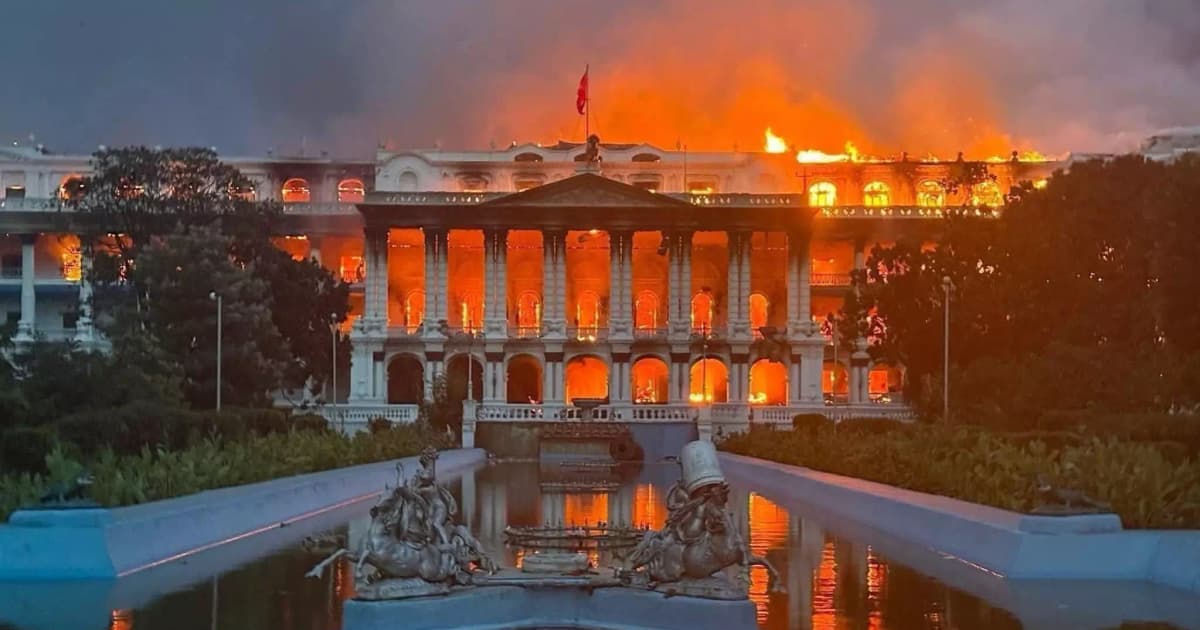
But it didn’t stop there. The flames spread to the buildings that literally defined the state. Parliament was burnt down; Singha Durbar, the pride of the bureaucracy was left burning. Even the Supreme Court annex got torched.
Moreover, police stations were torched. Party offices; UML, Nepali Congress, anything tied to the old order was stripped bare and set on fire.The CIAA (anti-corruption body), ironically, wasn’t spared either.
And then came the private businesses in alliance with the then government. Bhatbhateni supermarkets went up, the shiny new Hilton Hotel, the Chandragiri resort, the Varnabas Hotel, all attacked.
Oli Resigns
And in the middle of all this chaos, Oli blinked. His ministers were resigning, his MPs were defecting, and the state was in the middle of a full-blown chaos. And just like that, Oli was out.
The Airport Showdown
Meanwhile, protesters had their eyes on Tribhuvan International Airport. They weren’t about to let politicians hop on the next flight to Delhi or Dubai to wait things out. That airport is Nepal’s lifeline. It’s the only fully functional international airport we’ve got, and losing it to vandalism would’ve been a disaster on top of a disaster. So the army rushed in, shut the airport down, stranded passengers, and diverted flights to Pokhara.
Prison Breaks
And then came the wildest twist of the day: prison breaks. Jails across the country were suddenly wide open, and an estimated 13,500 prisoners walked free. Some grabbed rifles, others vanished into the chaos. The army tried to reel it back in; catching a few hundred, even encountering some, but the damage was done. Imagine the fear: government offices in flames, airports shut, prisoners on the loose. Nepal felt like it was unraveling minute by minute.
September 10–11: Military Control and Gen Z Leadership
By September 10th, the military had moved in everywhere. Soldiers on every street corner, at intersections, posted outside TV stations. Armored trucks were rolling through neighborhoods where kids normally kick around footballs. They slapped a strict curfew on everyone; nobody leaves their house unless absolutely necessary.
The Human Cost
But the damage was already heavy. As of September 14, 2025, the death toll has crossed 70, with more than 1,300 injured. Hospitals overflowed with the wounded. The grief was raw, the anger even more so. It almost felt like the state had declared war on its own youth.
Gen Z Doesn’t Back Down
With Oli gone, ministers in hiding, and the whole government basically collapsed, the question became: what now? The army was in control of the streets, but they weren’t about to just crown a new Prime Minister themselves. They clearly told the youth leaders “you need to choose your own representatives, come to army headquarters, and tell us how you want the next six months to look.”
So how did Gen Z handle it? By doing what they do best: going online. They jumped onto a massive Discord call with 10,000+ participants, which was then broadcast live on national TV and streamed across social media.
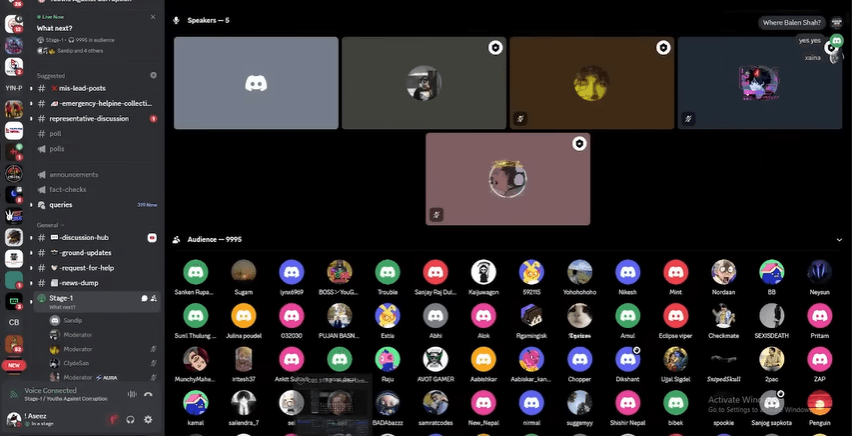
At first, it was about picking who would represent them in talks with the army. But soon, the discussion turned to the bigger question: who should actually be the interim Prime Minister?
Names flew around; Balen, the independent mayor of Kathmandu; Kulman Ghising, the man who ended Nepal’s load-shedding crisis; even Harka Sampang, Dharan’s grassroots mayor; Sumana Shrestha, MP and former Education Minister; Sagar Dhakal. But when the polls were tallied, one name stood out above the rest: Sushila Karki.
Nepal’s first female Chief Justice. Known for her integrity, her honesty, and for taking down corrupt officials even when it made her powerful enemies. For the young protesters, she was a symbol of the kind of politics they wanted: clean, accountable, and fearless.
September 12: Toward a Fragile Resolution
After three days of chaos, everyone knew the country couldn’t stay in flames forever. On the night of September 11, the Army chief met Gen Z representatives at Tundikhel. The youth had one clear demand: appoint Sushila Karki as interim Prime Minister. On paper, the choice was obvious.
But here’s the problem. Two big constitutional roadblocks stood in the way:
1. Article 76(1) says only a Member of Parliament (MP) belonging to a party with a majority can be Prime Minister. Karki isn’t an MP.
2. Article 132(1) prohibits former Chief Justices from holding government positions.
With Parliament in ashes, the Court under attack, and the government leaderless, Nepal was staring at a constitutional dead end, the constitution itself looked finished. But the President refused to admit it. After all, if the constitution was “dead,” then his own presidency would be invalid too. So, to strike a compromise with Gen Z’s demand, he dissolved Parliament, clearing hurdle no. 1 for Sushila Karki’s appointment as interim Prime Minister. But hurdle no. 2 is still actively and can still challenge her appointment
Moreover, she was appointed under Article 61 of the Constitution of Nepal, which ironically does not even talk about appointment of PM.
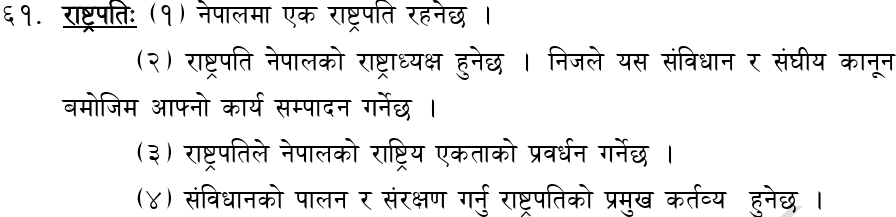
And this may open a floodgate of writ petitions questioning the constitutional validity of her appointment as well as the dissolution of the Parliament. Meaning, what feels like victory could be undone at any time.
If this were a competition, it’s like this Gen Z revolution in Nepal walked away with the third prize; better than nothing, but far from what the people truly wanted. But then we still have a semi-final and a final coming up. Semi-final in the form of writ petitions challenging the formation of the interim government and dissolution of the parliament and the final would be the upcoming general elections that the interim government is mandated to hold within next 6 months.
So what could have been the possible outcomes?
- Best case (1st prize): Tear down the constitution completely, let Gen Z appoint their own interim PM, and draft a new interim constitution with term limits, direct PM elections, and a clean slate. The risk? Without a constitution, Nepal becomes vulnerable to foreign interference.
- Second best (2nd prize): Keep Parliament alive, but force MPs to sign a binding agreement (with the President and judiciary as witnesses) to amend the constitution within a week. This would mean direct PM elections, a two-term cap, maximum age limits, full asset disclosure, end of perks, and accountability for Oli and others responsible for violence.
- Third prize (what we got): Stick with the current constitution, dissolve Parliament, and appoint Karki anyway. But this leaves all the same loopholes that fueled instability in the first place.
- Fourth: Well things could have gone far worse like martial law or foreign meddling! Thankfully, we didn’t get to that. It could have been anything. Let’s not delve this into much.
And this is where the harsh reality sets in: Nepal is still bound by the same constitution that doesn’t allow direct PM elections. That means popular figures like Balen can’t just step up as PM unless they form a political party, dominate Parliament nationwide, and win a majority; all within six months. Highly unlikely. Which means, when the dust settles, we might just see the same old parties and the same old faces back in power.
But the truth is, Gen Z never set out to overthrow the entire system. They wanted transparency and accountability. Nobody, not even themselves, imagined things would escalate this far. They did not have a true leader or a responsible organization in the first place. And because they weren’t fully prepared for the constitutional traps ahead, their victory may end up looking more like compromise. Just like an incident from our mythology where an Elephant picked up a King out of nowhere, the Army seemed to have picked an organization called “Hami Nepali” and their leader Mr. Sudan Gurung, who in the first place were only volunteering.
So yes, Sushila Karki’s appointment feels historic. But in reality, it might just be the “third prize” in a game still rigged by the same rules.
Economic Consequences of the Uprising
Now here’s the part we often forget to talk about; the money. Because while politicians argue about constitutions and protesters chant in the streets, the economy quietly takes the hit.
First, the obvious: buildings and businesses burned. Livelihoods gone overnight. Think about Bhatbhateni supermarkets; it was people’s jobs, suppliers losing inventory, small producers who relied on those shelves suddenly left stranded.
Then the shockwaves:
- Employers freeze hiring because of uncertainty.
- Banks already struggling with bad loans are now staring at even more defaults.
- Insurance companies are overwhelmed with claims. And here’s the kicker: we only have two reinsurers in Nepal, both fragile and undercapitalized. So guess what? Those losses are going to ripple through the whole financial system.
- Tourism? Forget it. Who’s going to book a trek when all they’re seeing on international news is burning buildings and curfews?
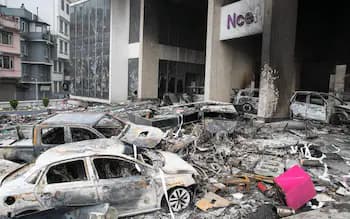
Investors too are rattled. The attack on Ncell’s headquarters was a giant red flag for foreign companies. If even multinationals aren’t safe, who in their right mind is going to put money here right now?
On top of that, the government suddenly has to spend big on reconstruction while tax revenues are drying up. That means the fiscal deficit, which was already ugly, is only going to get uglier.
And the scary part is; Nepal’s credit rating had just been nudged upward not long ago. If this instability drags on, that’s gone. Worst case, you get capital flight; money leaving the country at the exact moment Nepal desperately needs it to stay.
But, and this is important, it’s not all doom. If this crisis actually forces political reform, if corruption gets tackled and institutions rebuild trust, the same Gen Z energy that brought down Oli could fuel a whole new growth story. The fork is right in front of us: either resilience or ruin.
Regional and Global Context
Of course, Nepal doesn’t live in a bubble. Sitting between India and China, every move here gets magnified.
And outside South Asia, people are drawing comparisons. Remember Sri Lanka in 2022, when angry citizens stormed the President’s house and chased him out? Or Bangladesh in 2024, when youth-led protests shook the system? Well, now the world is adding Nepal 2025 to that list.
International observers are worried. They see the army patrolling the streets and whisper about “democratic backsliding.” But at the same time, they can’t ignore the legitimacy of what’s happening: this isn’t a coup by generals, it’s a revolution by teenagers with backpacks and smartphones.
In short, the world is watching. Some with concern, some with hope, but nobody is looking away.
Current Status and Path Forward
So where are we now? In one word: limbo. Yes, we finally have the interim Prime Minister the youth demanded, but let’s be clear; she’s still just an interim PM, and her appointment could be challenged in the Supreme Court for being unconstitutional. Nothing is fully settled yet.
On the surface, life is crawling back to normal. Shops are reopening, traffic is back, and people are trying to move on. But the economic aftershocks are only beginning. The NEPSE market is still shut for the week, banks are open but cautious, and investors are holding their breath. The real test of stability will be seen in the months ahead, especially when businesses and workers start feeling the longer-term impact.
Politically, Gen Z isn’t stopping here. They’re demanding elections within six months; not just a change of faces, but real reforms: transparency, anti-corruption measures, and an end to the same old power games. The challenge is balancing that push for change with the constitutional framework. Tear it all down and start fresh? Or work within the system so it doesn’t collapse entirely? That tug-of-war is already underway.
The streets are calmer, yes. But the bigger battle; rebuilding faith in the system, hasn’t even started yet.
And as we look ahead to the next elections in Falgun, one thing must not be forgotten: the sacrifices made. Nineteen young martyrs lost their lives in school uniforms, asking for nothing more than dignity and a future. When we cast our votes, we owe it to them to remember why this fight began in the first place.
Conclusion: Beyond the Uprising
What happened between September 8–12 was a generational revolt. For years, Nepali politics was dominated by the same faces, the same families, the same excuses. Then, in five explosive days, Gen Z flipped the script.
Nepal now stands at a real crossroads. Either this moment sparks genuine reform; cleaner politics, accountable leaders, a system young people can believe in, or it just becomes another chapter in the cycle of instability we’ve been stuck in since 2008.
But one thing is undeniable: Gen Z has changed the game. They showed they can mobilize, organize, and demand change without waiting for party bosses or big speeches. They shifted the balance of power simply by refusing to accept business as usual.
So yes, the fires may be out for now, and Nepal might look calmer on the surface. But the message from this uprising is clear: the old politics is living on borrowed time. And even the interim PM we just celebrated could see her appointment overturned in court, reminding us that nothing about this moment is guaranteed.
Starting a business in Nepal?
Register your company online — name reservation, MOA/AOA, PAN/VAT and OCR filings, all in one place.


Related Blogs
Subscribe to our newsletter
Get latest news and updates directly to your email.