Teacher Salary in Nepal: Government vs Private School Pay
SalaryInBox
January 16, 2025 3 min read

Quick answer
School teachers in Nepal report a median gross salary of NPR 22,000 a month on SalaryInbox. The middle half earn NPR 12,000–30,000, and the top 10% earn NPR 40,500 or more. Across all education-sector jobs the median is NPR 45,000.
- Government (TSC) teachers are paid on the official pay scale with grades.
- Private school pay is set by each school; compare offers with the Rs 19,550 minimum wage.
- Use the salary tax calculator to estimate take-home pay.
Figures are SalaryInbox community contributions (checked 15 October 2026), not a survey of every school.
Quick answer: School teachers in Nepal report a median gross salary of NPR 22,000 a month on SalaryInbox. The middle half earn NPR 12,000–30,000, and the top 10% earn NPR 40,500 or more. Across all jobs in the education industry the median is NPR 45,000. Government (TSC) teachers are paid on the official pay scale for their level and grade, while private schools set their own pay. To see your take-home pay, use our free salary tax calculator.
Teacher salaries in Nepal (monthly gross)
| Median | Middle 50% | 90th percentile | |
|---|---|---|---|
| School Teacher | NPR 22,000 | NPR 12,000–30,000 | NPR 40,500 |
| Education industry, all roles | NPR 45,000 | NPR 30,000–60,000 | NPR 90,000 |
| Government & public sector, all roles | NPR 45,500 | NPR 43,000–66,500 | NPR 77,500 |
Source: SalaryInbox, checked 15 October 2026. Figures are rounded to the nearest NPR 500 and come from salaries people shared on SalaryInbox, not a survey of every school in Nepal.
Government school teachers (TSC)
Teachers in community (government) schools are recruited through the Teacher Service Commission (TSC) exams. Their pay follows the government teacher pay scale for their level (basic, secondary) and grade, so a teacher in a remote district earns the same basic salary as one in Kathmandu. Pay rises with each grade earned through years of service.
Beyond the salary, government teaching jobs come with:
- grade increments with seniority,
- retirement benefits,
- paid leave, including maternity leave, and
- a festival allowance.
That stability is why TSC posts are so competitive. For the latest government pay scale and the FY 2083/84 revision, see Government Employee Salary Scale in Nepal.
Private school teachers
Private (institutional) schools set their own pay, so salaries vary widely with the school's fees, reputation and location. The SalaryInbox median of NPR 22,000 for school teachers is a good benchmark, and the bottom quarter earn NPR 12,000 or less. For comparison, Nepal's national minimum wage is NPR 19,550 a month.
Common problems teachers report in private schools:
- No standard pay scale: pay depends on the school, and raises are not guaranteed.
- Fewer benefits: many schools offer no health insurance or retirement fund beyond what the law requires.
- Job insecurity: contracts can end when enrollment drops or a school closes.
- Little training: fewer chances for professional development or certification.
The upside is faster hiring and room to negotiate. Teachers of high-demand subjects such as English, science and maths usually have the most bargaining power.
International schools
Schools that teach international curricula such as IB or Cambridge generally pay more than other private schools. They charge higher fees and look for teachers with advanced degrees, teaching certifications and strong English. SalaryInbox doesn't yet have enough salaries to show a separate figure for them.
Teacher salary by region
Government teachers earn the same basic salary everywhere, because the pay scale is national. Private-school pay tends to be higher in the Kathmandu Valley and larger cities like Pokhara, where fees and living costs are higher, and lower in rural areas.
SalaryInbox doesn't have enough salaries yet to break teacher pay down by city. If you teach, share your salary anonymously to help build that data.
How to work out a teacher's take-home salary
Your gross salary isn't what lands in your bank account. Income tax, and SSF or provident fund contributions if your school deducts them, come off first. Enter your monthly salary in the Khatapana salary tax calculator to see your tax and take-home pay under the FY 2083/84 tax slabs.
SalaryInbox: salary transparency for teachers
SalaryInbox is a free platform where people in Nepal share their salaries anonymously. Teachers can use it to:
- Share their salary anonymously to build a reliable picture of teacher pay.
- Compare salaries by job title and industry.
- Negotiate with real data instead of guesswork.
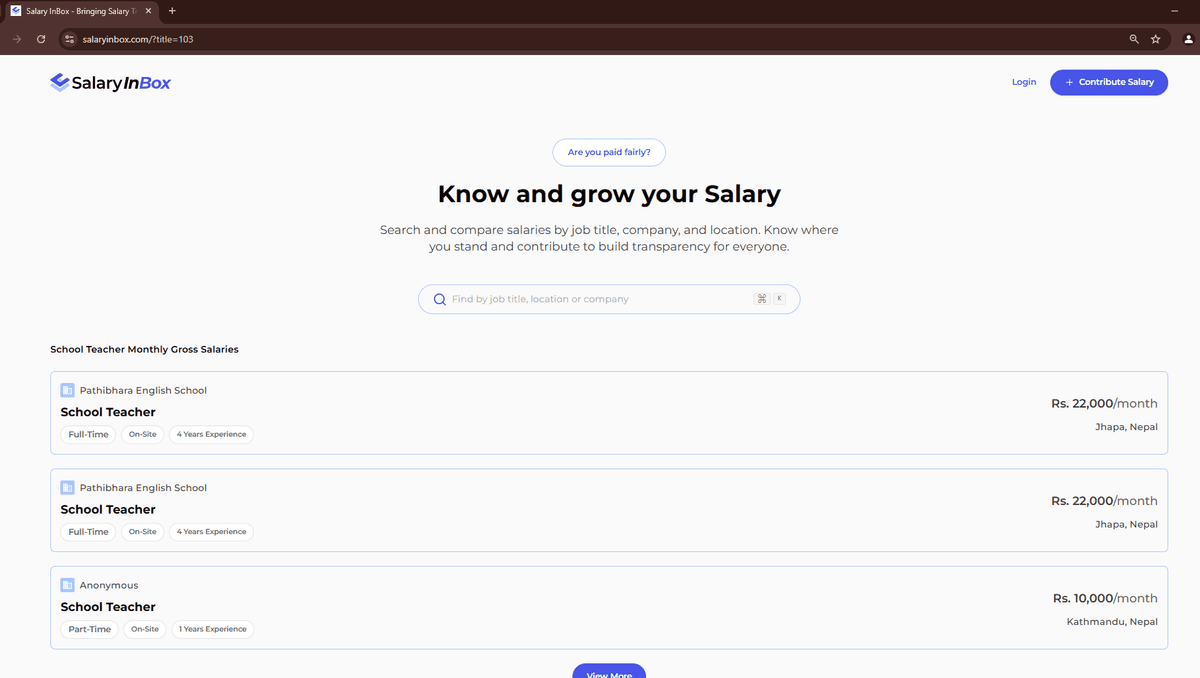
The more teachers share, the more accurate these figures get. Share your salary on SalaryInbox.
FAQ
How much does a teacher earn in Nepal?
School teachers report a median gross salary of NPR 22,000 a month on SalaryInbox, with the middle half earning NPR 12,000–30,000. Government teachers are paid on the official pay scale for their level and grade.
Do government teachers earn more than private teachers?
Usually, yes, especially in the early years. Government teachers are paid on a fixed national scale with grades, retirement benefits and allowances. Private-school pay is set by each school and varies widely.
Is teacher salary the same everywhere in Nepal?
For government teachers, the basic salary is the same across the country. Private-school pay is usually higher in Kathmandu and big cities than in rural areas.
How do I calculate a teacher's take-home salary?
Enter your gross monthly salary, SSF or provident fund contributions and any deductions in the salary tax calculator. It shows your income tax and net pay.
Sources
- SalaryInbox, School Teacher salaries
- SalaryInbox, Education industry salaries
- SalaryInbox, Government & public sector salaries
- The Himalayan Times, Minimum wage raised to Rs 19,550 a month
Run your business from your phone
Register companies, track compliance and manage payroll from your phone with the Khatapana app.


Related Blogs



Subscribe to our newsletter
Get latest news and updates directly to your email.