Nepal’s $46.5 Billion Energy Dream: Ambitious or Achievable?
Khatapana
January 3, 2025 2 min read
 Reviewed by Kailash Panday, Chartered Accountant & Corporate Lawyer
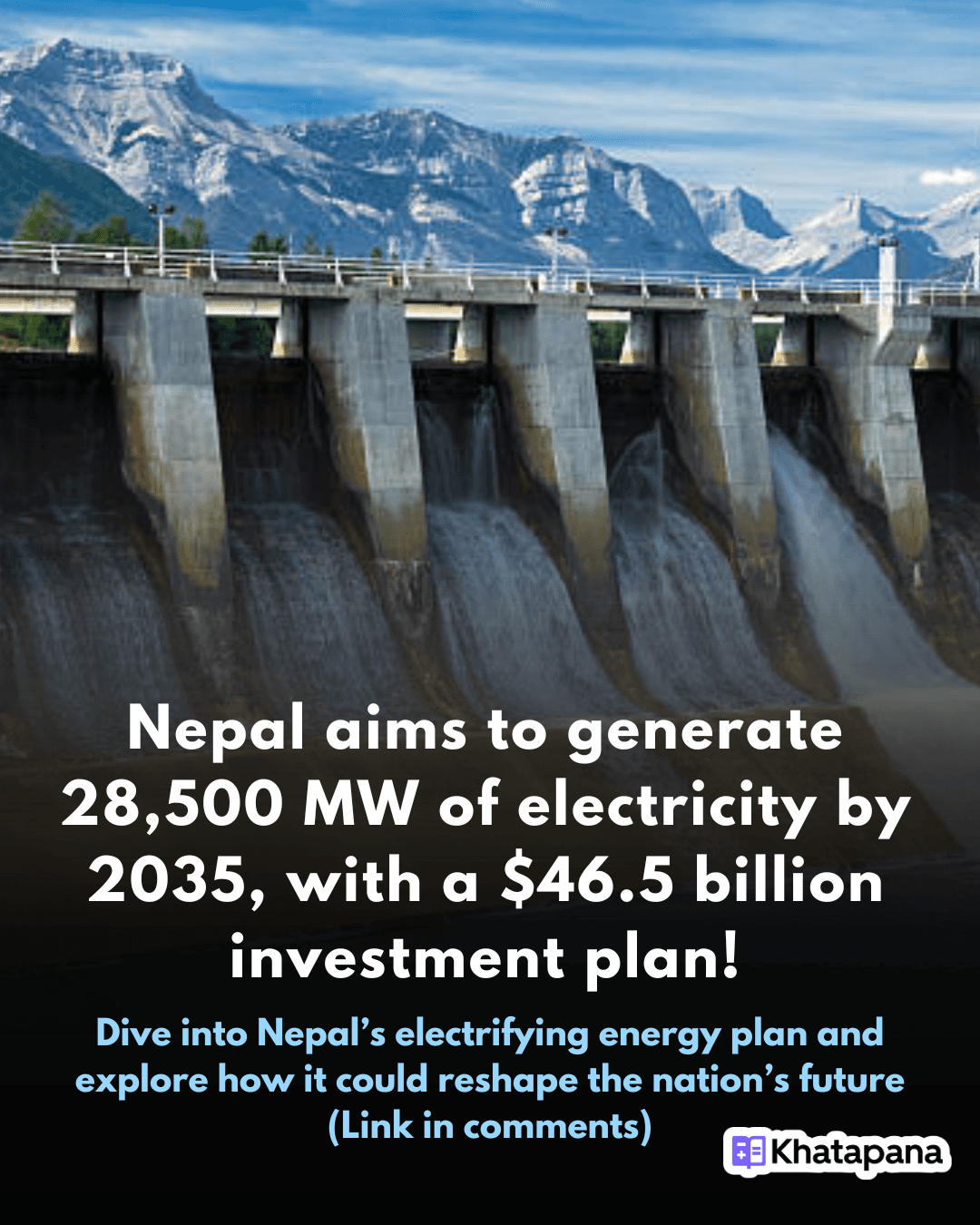
Nepal, once synonymous with power outages, is now setting its sights on a game-changing goal: generating 28,500 MW of electricity by 2035. Yes, you read that right! This ambitious vision comes with a hefty price tag of $46.5 billion (a staggering Rs 6.231 trillion). But is it achievable, or just another lofty dream? Let’s break it down.
The Numbers Game: What’s in the Roadmap?
Nepal’s government has rolled out an ‘Energy Development Roadmap and Working Guideline’ to harness its hydropower potential. Here’s how it’s structured:
Types of Projects:
- Run-of-River: To be completed in 4 years.
- Semi-reservoir: Targeted within 6 years.
- Storage: Planned for completion in 7 years.
Cost Estimates:
- Run-of-River: $1.6 million per MW.
- Semi-reservoir: $1.7 million per MW.
Transmission Infrastructure:
- Transmission Lines:
- 6,431 circuit km of 132 kV.
- 4,061 circuit km of 220 kV.
- 6,440 circuit km of 400 kV.
- Substation Capacity: To be upgraded to 40,000 kVA.
Where’s the Money Coming From?
Raising $46.5 billion isn’t child’s play. Here’s the funding blueprint:
- Government Injection: $6 billion.
- Nepali Banks & Financial Institutions: $10 billion.
- Climate Financing: $2 billion.
- Nepali Diaspora (including migrant workers): $12 billion.
- Nepal Electricity Authority (NEA): $8 billion.
- Foreign Direct Investment, Grants, and Loans: $8.5 billion.
While the mix looks diverse, convincing the diaspora to contribute $12 billion or securing $2 billion in climate financing will be monumental challenges.
Who Gets the Juice? Domestic vs. Export
Of the planned 28,500 MW:
- 13,000 MW will power Nepalese homes and industries.
- 15,000 MW is earmarked for export, primarily to India.
Nepal has already signed a long-term energy export deal with India for 10,000 MW over the next decade. If executed well, this could redefine Nepal’s economic landscape.
Why This Matters: The Bigger Picture
Nepal’s per capita energy consumption target is set at 1,500 kWh annually—a quantum leap from current levels. The roadmap projects:
- Government Revenue: Rs 88 billion.
- Private Power Producers’ Earnings: Rs 3.9 trillion.
- NEA’s Earnings: Rs 2.6 trillion.
These aren’t just numbers; they symbolize an economic revolution waiting to unfold.
Challenges Ahead
1. Funding Woes:
Securing $46.5 billion is a tall order, especially with uncertainties surrounding climate financing and diaspora contributions.
2. Implementation Timeline:
Completing Run-of-River projects in 4 years and storage projects in 7 years sounds optimistic given Nepal’s history of delays.
3. Export Dependency:
Relying heavily on India for 10,000 MW is risky. Geopolitical shifts or market changes could derail plans.
4. Domestic Consumption:
Can Nepal’s infrastructure and industries absorb 13,000 MW effectively? Demand growth must align with supply.
What Needs to Be Done
To turn this dream into reality, Nepal must:
- Diversify Export Markets: Explore opportunities with Bangladesh, Bhutan, and even China to reduce dependency on India.
- Streamline Bureaucracy: Eliminate red tape and create a transparent, efficient process to avoid delays.
- Engage the Private Sector: Provide clear policies, incentives, and risk-sharing mechanisms to attract investors.
- Boost Public Awareness: Encourage diaspora participation by showcasing the economic and environmental benefits of the roadmap.
Our Take: A Balancing Act
Nepal’s $46.5 billion energy roadmap is bold, audacious, and inspiring. Think of it as climbing Everest—not easy, but achievable with preparation and teamwork. If executed well, this plan could light up Nepal’s future—literally and figuratively.
The question is: will Nepal seize this opportunity, or will it remain another tale of unrealized potential? Let’s hope it’s the former.
Starting a business in Nepal?
Register your company online — name reservation, MOA/AOA, PAN/VAT and OCR filings, all in one place.



Related Blogs

Subscribe to our newsletter
Get latest news and updates directly to your email.