Dashain and Tihar: How Festival Shopping Fuels Nepal's Economy Amid Trade Deficit Concerns
Khatapana
October 24, 2024 3 min read
 Reviewed by Kailash Panday, Chartered Accountant & Corporate Lawyer
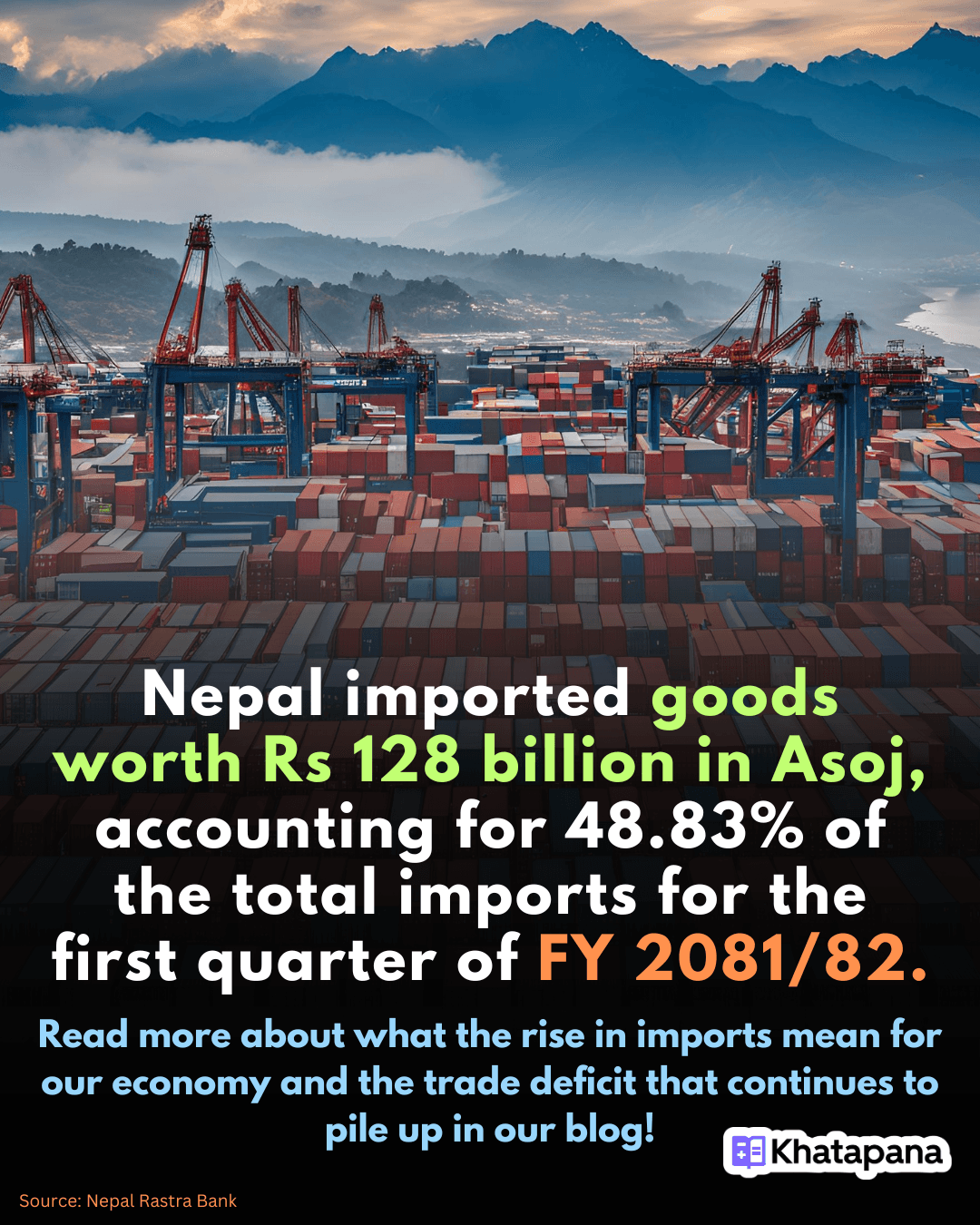
Let’s face it, Dashain and Tihar are a big deal in Nepal. Not only from a celebration perspective. Wth big festivals come big shopping sprees. Last month, this shopping frenzy gave a serious boost to Nepal’s import numbers. How serious? The first quarterly report on Nepal’s foreign trade published by the Department of Customs (DoC) shows that Nepal imported goods worth Rs 128.21 billion in Asoj alone. That’s almost half of what the country spent in the entire first two months of the fiscal year!
You can practically see it: families rushing to buy new clothes, household goods to make sure everything’s perfect for the celebrations. It’s no surprise that people went all out during the country’s two biggest festivals.
But while the shopping spree might seem like great news for retailers, the bigger picture isn't so rosy because the huge spike in imports has deeper implications for Nepal’s economy. We’re talking about that ever-growing trade deficit and the not-so-great export-import balance.
So, let’s dig into what the numbers really mean, how the country’s exports fared, and why this growing trade deficit should have us all paying attention.
Exports: A Silver Lining?
Just in one month, Nepal spent nearly half (48.83%) of its entire first-quarter import budget. That's the power of festival shopping, my friends. From fossil fuels to agricultural products, we didn’t hold back. But it’s not all doom and gloom—exports saw some action too.
So, while everyone was busy importing goods, Nepal’s exports quietly made a bit of progress. During the same month, exports grew by Rs 13.29 billion. That’s a decent leap! To put it simply, we exported 53% more than what we did in the previous two months combined.
But here’s the kicker: even with that bump, exports still look tiny compared to our giant import bill. In the first three months of this fiscal year, Nepal exported goods worth Rs 40.87 billion, but imported Rs 407.76 billion. That means we’re spending about 10 times more on imports than what we make from exports. Not exactly the kind of balance anyone likes to see.
The Trade Deficit: A Ticking Time Bomb?
Now, let’s talk about that elephant in the room—the trade deficit that is skyrocketing. As of the first quarter of the Fiscal Year 2081/82, we’re sitting on a whopping Rs 352.37 billion trade deficit. This means that even though we’re exporting more, the sheer scale of what we import far outweighs it.
And it’s not like this is a new problem. Sure, overall imports dipped by 4.17% from the same period last year, and exports dropped by 6.11%. But that’s not enough to fix the trade imbalance. We’re still buying way more than we’re selling, which isn’t great for the economy.
What Does This All Mean for Nepal?
In the short term, the government is probably thrilled by the customs revenue they collected during festival time—Rs 37.80 billion in one month alone! That's over half of what they collected in the first two months combined. Not bad, right? But let’s not get too comfortable.
Long-term, Nepal’s trade deficit is like a leaky bucket. No matter how much water (or cash) you pour in, if you don’t fix the hole (i.e., the trade imbalance), you’re eventually going to run dry. We can’t keep relying on imports, especially for things we can produce ourselves.
What Can We Do Better?
It’s time to get creative. Nepal has so much potential, especially in agriculture and energy. But for some reason, we’re still importing products we could easily make here. Why not focus on boosting local production and exports? We’ve got to start selling more and buying less if we want to reduce that yawning trade deficit.
Also, encouraging industries to up their game for the export market wouldn’t hurt. With the right strategies, we could easily make a bigger splash internationally. Who knows, maybe next year, Nepal won’t just be known for its festivals, but also for exporting some of the goods we’re so used to importing.
Wrapping It Up: A Reality Check
While the festive surge in imports might feel like a regular phenomena, it’s actually just a reminder of how much work Nepal has ahead. We’re importing too much and exporting too little, and unless we change that, the trade deficit will continue to grow. The festivals seem to just add to that by giving a much needed ecnonomic boost but we need a long-term fix.
Until then, let’s just hope that the shopping spree continues for some time so that the market and merchants can lighten up a bit!
Starting a business in Nepal?
Register your company online — name reservation, MOA/AOA, PAN/VAT and OCR filings, all in one place.


Related Blogs

Subscribe to our newsletter
Get latest news and updates directly to your email.