Demand Soars, Prices Stall: Decoding Nepal’s Economic Puzzle
Khatapana
October 4, 2024 3 min read
 Reviewed by Kailash Panday, Chartered Accountant & Corporate Lawyer
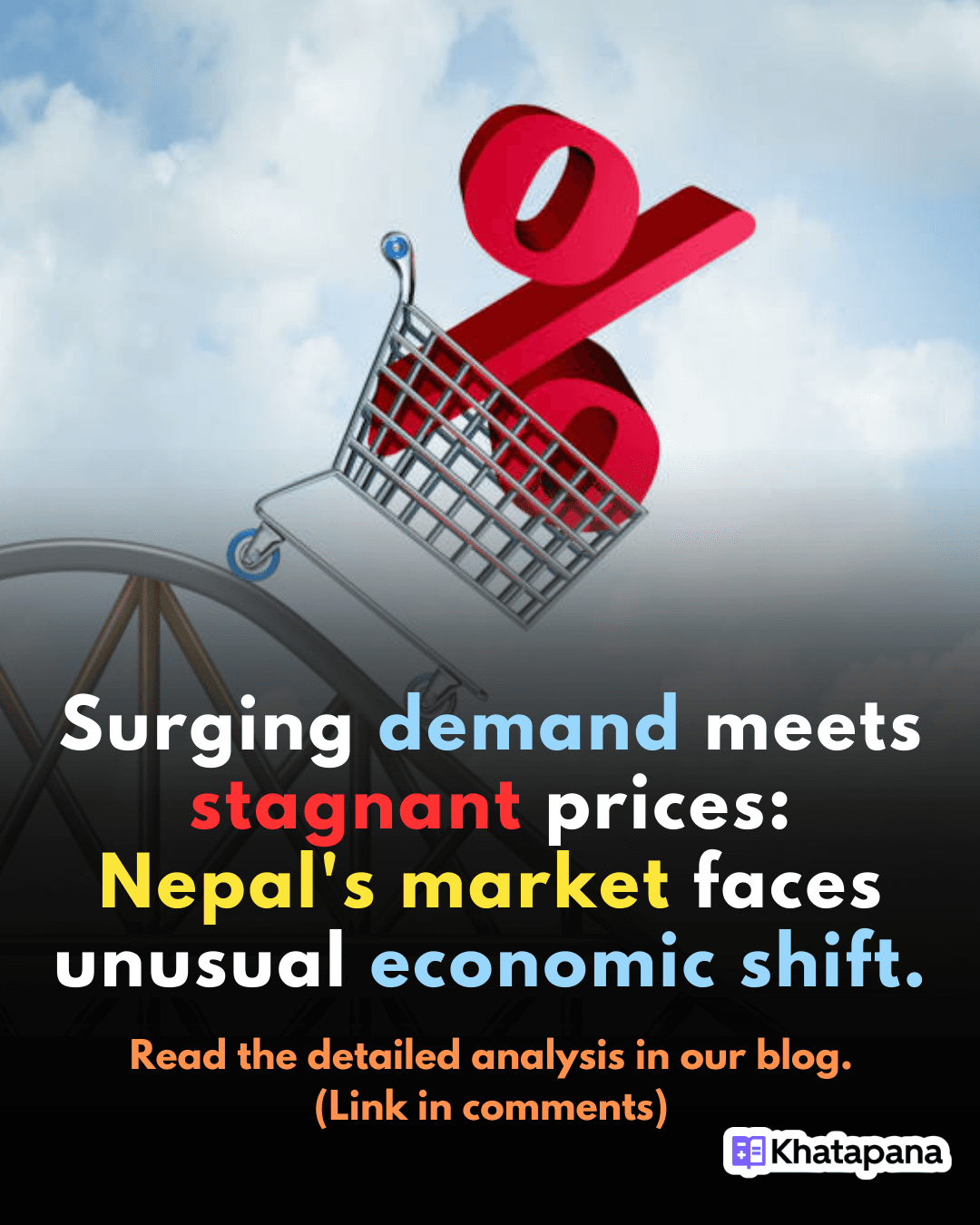
When you hear that prices aren’t rising as fast as they used to, it might feel like a good thing, right? But, as with most economic news, things aren’t quite that simple. In Nepal, we’re seeing low price growth alongside increasing demand—two things that seem a little contradictory at first. So, what’s really going on here? Let’s dive in and break it down!
Prices Are Calming Down—Is That Actually Good News?
According to Nepal's latest Economic and Financial Situation Report (July-August 2023), the overall consumer price growth rate has dropped to 4.1%. That’s a huge difference from the 7.52% inflation rate we were grappling with this time last year. Now, a slower rise in prices sounds like a win for our wallets, right? Well, hold on—there’s more to the story.
Breaking it down: food and beverage prices have gone up by 6.17%, and non-food and services have only increased by 2.94%. Here’s where it gets tricky: while some prices are under control, the cost of veggies has skyrocketed by 19.07%. Pulses are up 12.09%, and yet, spices have gotten cheaper, dropping by 2.75%. So, while inflation might be slowing down overall, the things we need every day, like vegetables, are getting a lot pricier. This puts real pressure on households.
Lower inflation sounds great on paper, but it can also signal something more concerning—like a slowdown in economic activity. In other words, are prices stabilizing because fewer people are buying, and businesses aren’t expanding? That’s a question worth asking.
So, Why is Demand on the Rise?
If prices are staying relatively low, you’d think demand would follow suit, right? Surprisingly, demand in Nepal is actually going up, and it’s mostly because of one major factor: remittances. Let’s break this down a little more.
Nepal’s production of goods and services has taken a hit. Merchandise exports are down 9.6%, and even imports from India (our biggest trading partner) have dipped by 0.6%. These imports include key materials like construction goods and airplane parts—things we need to keep big projects going. So, why the rising demand if production and imports are slowing down?
It all comes down to money coming in from Nepalis working abroad. Remittances have jumped by 16%, bringing in a whopping NPR 137 billion in just one month! This influx of cash gives people more money to spend, which boosts demand for goods and services, even though the economy isn’t producing more. But here’s the catch: relying on remittances isn’t exactly a sustainable strategy for long-term growth.
Are the Banks Playing It Too Safe?
Another piece of this puzzle is what’s happening in the financial sector, especially with banks. Loans to the private sector have only increased by a tiny 0.3%, which is way too low to keep the economy growing at a healthy pace. Why are banks being so cautious? A big reason is that the loan interest rates—even though they’ve come down slightly—are still hovering around 10%, which makes borrowing pretty expensive.
Interestingly, while the average base rate for commercial banks has dropped from 10.11% last year to 7.61% this year, that hasn’t translated into much relief for borrowers. This hesitation to lend means fewer new businesses are popping up, existing ones aren’t expanding, and overall economic growth is dragging.
So, if banks don’t loosen up and offer more affordable credit, we could be looking at slower growth in the long run.
The Bigger Picture: What Does This Mean for Nepal?
Nepal’s economy relies heavily on outside factors, and the biggest one is, you guessed it—remittances. On the one hand, our foreign exchange reserves have grown to USD 15.58 billion, thanks in large part to all that money coming in from Nepalis working abroad. On the other hand, though, we’ve got a current account deficit of NPR 30.89 billion. What does that mean? Simply put, we’re spending more money on imports than we’re making from exports, which is a problem.
The surge in demand might seem like a good thing at first glance, but it really underscores a deeper issue. Nepal’s economy is way too dependent on money from abroad. Without developing our own industries and boosting local production, we’re leaving ourselves vulnerable to any global economic hiccups.
What’s Next for Nepal’s Economy?
For now, the drop in inflation is offering a bit of relief, but let’s not overlook the rise in prices for essentials like vegetables—that’s still tough for a lot of families. Plus, the sluggish lending growth, shrinking imports, and lack of industrial activity are all red flags for the future.
If Nepal is going to see sustainable economic growth, we need to get more proactive. That means encouraging banks to lend more to businesses, investing in domestic industries, and creating jobs here at home. We can’t rely on remittances forever. Policymakers need to focus on reducing our dependence on external income and strengthen our own industries to keep the economy growing.
The current data might look okay in some areas, but it’s clear that without serious investment in our own economy, any relief we’re feeling now could be short-lived. Nepal’s future growth depends on building up our industrial capacity, boosting business investments, and ensuring that the rise in demand is matched by local production.
Starting a business in Nepal?
Register your company online — name reservation, MOA/AOA, PAN/VAT and OCR filings, all in one place.


Related Blogs

Subscribe to our newsletter
Get latest news and updates directly to your email.